Posted in Adult Day Programs for Special Needs, Behavior/ ABA, Down syndrome, Dual Diagnosis Down syndrome and autism, Recreation/Leisure and Special Needs

Blog #259~Nick’s Dual Diagnosis: Down Syndrome and Autism – Day Program Resumes

Blog #259~Nick’s Dual Diagnosis: Down Syndrome and Autism- Day Program Resumes

After nearly a 4 year hiatus, Nick is FINALLY back in his adult day program! The Covid-19 pandemic and subsequent staff shortages really halted these programs across the country. When these programs started back up, they did so cautiously. Many were hesitant to admit clients with higher needs. My son Nick is 30 years old and has a dual diagnosis of Down syndrome and autism (DS-ASD). I am thrilled to share with you how his transition went back to his day program.

I will admit that I’ve been hesitant to write about Nick’s return to his program for fear of jinxing it. The transition back started as a trial run with Nick going half days, 3 times a week. We worked closely with the behaviorist (BCBA) to create a smooth transition. The BCBA sent questionaires to all of the personal support workers that have been working with Nick for the past few years to get their perspectives. Social stories, daily schedules and a communication book were created to help Nick understand and navigate his new routine. All of these tools are evidenced based practices that help indidivuals with autism and other disabilities to have smooth transitions.

The BCBA did observations and took data on behaviors which led to the creation of a behavior support plan. She fully expected that behaviors would occur when Nick started back. He did test the staff as she expected, with many attention seeking behaviors. Lisa, who is Nick’s personal support worker, reminded us that he’s had her 1:1 undivided attention for nearly 4 years here at home. The new ratio of the day program is 6 clients: 2 staff per room. The class sizes are much smaller than when Nick attended before the Covid-19 pandemic, which has proven to be easier to manage and safer.

Nick gradually expanded to 5 days a week and eventually went to full day hours. The staff was commited to making it a success and he settled into this new routine very well. One key to this success was having Nick’s personal support worker, Mireya work in the room with him for the first few weeks. Here they are making greeting cards for senior citizens:

The adult day program provides a variety of activities for the clients. I sent in a few of the matching activities that Nick does at home so there was some familiarity and success with things that he is good at. Here are a few more photos of activites and jobs that he has been doing:

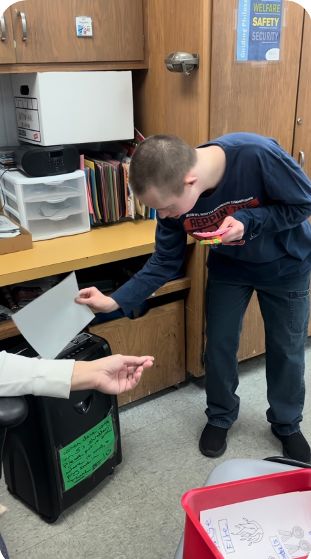
Nick shredding documents:
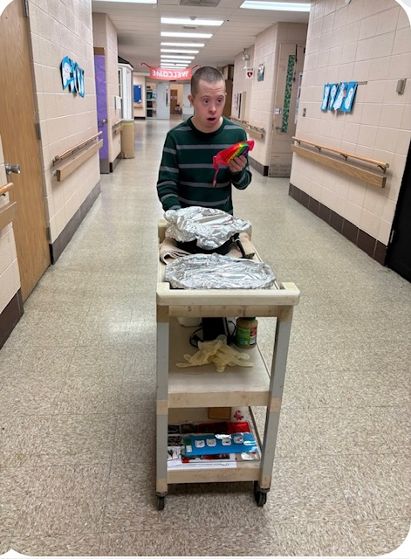
Nick pushing the cooking cart:
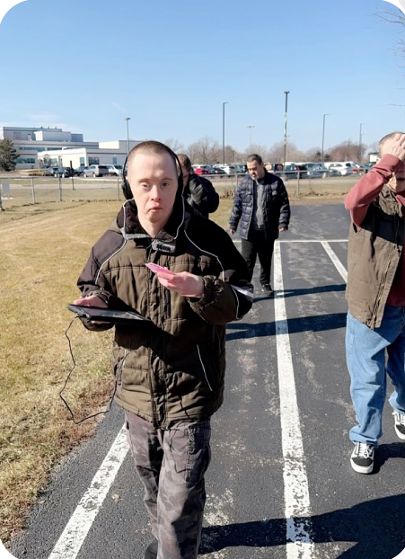
Nick in the gym:

Nick walking on the track:
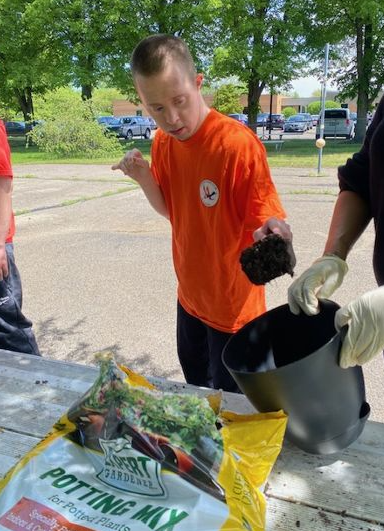
Nick gardening:

As you can see, Nick has a full day of fun and meaningful activities at his day program. He is always excited to go each day. We are so happy that this opportunity is available for Nick and the other clients who thrive with a routine and structure. I would like to express my deepest appreciation to Nick’ personal support workers, Lisa, Mireya, Lara and Jeannette for their hard work and commitment over the past few years. Having respite care allows families to be able to work outside the home and get a break to enjoy some personal time. I also want to thank my husband, Al for taking on the bulk of driving Nick to and from his program.

I look forward to sharing more about Nick’s return to his day program in future blogs and on social media. Be sure to follow us to see more pictures and videos of Nick in action on Facebook and Instagram at: Down Syndrome with a Slice of Autism. That’s what is in my noggin this week.

~Teresa 🙂

Posted in Adult Day Programs for Special Needs, Autism, Down syndrome, Dual Diagnosis Down syndrome and autism

Blog #216~Putting Social Stories Into Action

Blog #216~Putting Social Stories Into Action

Recently I had to take a page out of my own playbook.  I took both iPads and locked them up for an entire week.  My son, Nick repeatedly throws and drops his iPads when he is done or the battery dies.   Nick is 24 years old and has a dual diagnosis of Down syndrome and autism (DS-ASD).  During that week, I created a social story designed to teach him how to take care of his iPads.

A social story is a visual support that helps individuals understand new events, and reinforces a desired skill, task, or behavior. They are useful for individuals that have Down syndrome, autism or other intellectual/developmental disabilities. Over the years, we’ve used social stories to help Nick navigate new situations like starting back to school, doctors and dentist appointments, vacations, and independent living skills such as showering and brushing teeth. Social stories provide a blueprint as to what will occur and what is expected from a behavior standpoint. Knowing what will happen and what’s expected, will also help to reduce anxiety.

In this case, the social story was designed to help Nick understand what is expected of his behavior, and why it’s important to make good choices.  Here is Nick’s iPad social story:

iPad social story

In Blog #214 you can read how to make a social story, click here to view:

https://nickspecialneeds.com/2018/08/20/blog-214-how-to-make-a-social-story/

Social stories should be broken down into steps using visuals and succinct wording that depict the who, what, where, when, why and how an event or behavior needs to happen.  Review the social story several times with the child before the event, new routine or behavior is to occur.

After a week with no iPads, Nick was excited to get them back.  Before this occurred I read the social story several times.  Nick followed along and pointed to the basket that he needed to put his iPads in when he was finished using them.  I made sure to stay in close proximity when he was using his iPads, to redirect him in case he decided to drop or throw them.

So, did the social story work help to curb the iPad drops and throws?  Absolutely, it reduced the incidences by 80% in just one week.  That’s a huge improvement.  Nick returned his iPads to the basket frequently, and in some cases he at least set it on the table instead of chucking it.  This indicates that he has impulse control and able to make better choices.   He received lots of verbal praises and elbow bumps for making good choices.

happy choice sad choice

Each day,  I review the social story before Nick gets to use his iPads to reinforce making good choices.  In a few weeks, I will introduce a new social story to deal with another behavior area we struggle with around the house.  Many parents of children with a dual diagnosis of Down syndrome and autism have trouble with dropping, swiping and knocking over items.  Nick’s behavior in this area has increased over the last couple of months.  This will be a tough one to tackle, stay tuned…….

Cats Earth was flat

Remember that the goal in using a social story is to teach the behavior or outcome that you are expecting from the child.  Give them a script for success for making good choices.  Keep in mind, when introducing a social story, to use one at a time consistently, before adding more.

At my son’s  adult day program, they are using a social story with positive reinforcement for making good choices.  Nick has quite a rap sheet pulling fire alarms, with over 50 pulls since third grade.  Each day, the staff reviews the social story and walk the halls with him, encouraging him to “keep walking with hands to self”.  This story was developed by myself and the ABA therapist on staff at his day program.  The story reminds Nick (using visuals again), that it’s not nice to pull fire alarms, as it scares his friends,  hurts their ears, and that it is hard for some clients to move.  If he pulls an alarm, Nick must exit the building and go next door, so he doesn’t see or hear the fire trucks.  When he makes good choices, he earns a happy face and gets a reward at the end of the day:

nick social story sprite reward for fire alarms

Not to jinx things, but so far, the fire alarm social story is working well. 🙂

The happy face visuals have been effective for Nick, and  pairing it with the idea of making good choices.  Nick likes to please, but at the same time he craves attention, and will often get it with negative behaviors.  So the focus on targeting good behaviors with the icon will be carried thru to the dropping social story in the near future.

Social stories can help guide a child to understand what will happen, where and what is expected of their behavior. It’s a great visual tool for teaching new skills and routines.  They can help to guide your child to smooth and successful experiences both at home, school and in the community.  Do you have a child that likes to swipe, drop or throw things?  What’s the most expensive thing they have destroyed?  It’s not easy, navigating a child with a dual diagnosis of Down syndrome and autism.  Working with a BCBA certified behavior therapist to develop strategies and social stories can help improve behaviors significantly.  Your child is never to old to learn and improve their behaviors.

That’s what is in my noggin this week. 

~Teresa 🙂
Follow Nick:

Facebook and Pinterest @Down Syndrome With A Slice Of Autism
Instagram @nickdsautism
Twitter @tjunnerstall