Posted in Autism, Down syndrome, Education and Special Needs

Blog #129~ Communication Strategies and Autism

Blog #129~ Communication Strategies and Autism

Last week I attended a presentation given by Brian R. King (www.brianraymondking.com).  This was part of the Autism Expert Series at The College of DuPage.  The topic was “Speaking of Autism: Communication Strategies for Connection and Collaboration with Those on the Autism Spectrum”. Brian has firsthand experience in this area. He is a best selling author, speaker, trainer and life coach.  As a cancer survivor, adult with A.D.D., the father of three sons on the autism spectrum as well as someone who lives on the autism spectrum himself, he has learned something very critical:  “That success in life has nothing to do with circumstances, but everything to do with strategies”. ~Brian R. King

autism puzzle superman

In his presentation, Brian covered 6 main areas of needs and provided strategies specific to those on the autism spectrum:

  • Certainty:  What things can be put in place that that are predictable and consistent?  Meltdowns can happen when a need for certainty is not met.  So it is important to put a loop hole in daily plans.  Make sure you have “Plan A” and “Plan B” in place and explain both beforehand.  Plan A is golfing, but if it rains then go to Plan B a pre-set indoor activity.  If they can trust that there is a Plan B, there will be less anxiety and a willingness to be flexible. 
  • Variety:  As important as certainty is, there is a need to keep variety in the mix.  Life can’t always be about going to McDonalds for lunch. You’ve got to step off the curb.  Look up other restaurants on the web that have similar menu items with your child.  Together, come up with a plan to try a new spot. Be prepared to have an escape plan, if the trip doesn’t go as planned so the child can decompress.
  • Significance:  People on the autism spectrum need to know they matter.  What might appear to be attention seeking behavior (talking out of turn, not raising their hand to answer a question) may be an attempt to be noticed, validated and to be a part of the group. Another example is this; a child may not process the question as quickly as their peers.  They might just make up an answer or a lie when put on the spot.  One teacher tip would be to ask the question and say, “Johnny I’m going to come back to you in a couple of minutes”.  This allows the child to process the question and not just blurt out any answer.  Visuals can also help to process information.  Provide a tool to write down the assignment.

visual work board

  • Love and Connection:  Working with those on the autism spectrum requires patience and letting the child know that you hear them, understand them and have their back.  It is essential to pause, and avoid lecture or shame.  But rather teach that you want them learn from mistakes.  Be their cushion of safety so they feel cared for and loved.

understanding

  • Growth:  We all have a desire to make progress and see results of improvement.  What need is the child going toward?  Often there is a tendency to gravitate to certainty.  Look for ways to have the child excel in those places of certainty.  In contrast, keep in mind the child will tend to avoid areas where there are too many opportunities to fail. These are the places that will require more support.
  • Contribution:  When you have something of value to give, you feel more significant.  Look for those strengths and allow the child on the autism spectrum to shine.

My son Nick working the vacuum at a community job……
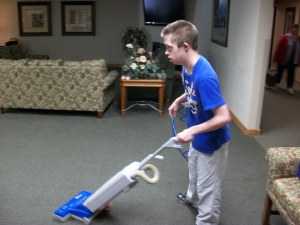
Nick vacumming_Tabor Hills (3)

  Assessing these 6 areas of needs and putting strategies in place will set your child up for success. It will also help those on the autism spectrum feel secure, valued, and connected and a part of the group/community.   I am always looking for ways to help my son.  Nick is 21 years old and has Down syndrome and autism.  After attending this presentation I’ve identified some areas I need strengthen within these strategies.  This includes getting a “Plan B” more consistently, continue to stretch his boundaries, listen to him when he tries to get attention inappropriately, and allow him to shine in what he does the best. 

Thank you Brian R. King, for shining a light on how to better communicate with those on the autism spectrum and provide strategies to support them. That’s what is in my noggin this week.

~Teresa 

Posted in Autism, Down syndrome, Education and Special Needs, Fun Side of Nick

Blog #126~Nick and the Varsity Football Team

Blog #126~Nick and the Varsity Football Team

Recently Nick and his respite worker Jodi were taking a walk around the Waubonsie Lake trail. Suddenly, Nick took off running towards the high school.  Jodi scanned past the trail to figure out what Nick was going after.  His face lights up.  Oh no, it’s the “KEY TREE!”

key tree

The football players hang their car keys here.

Nick is 21 years old and has Down syndrome and autism. Long before the 34 fire alarms he has pulled since third grade, he discovered car remotes.  He sought them out feverishly.  He’d even fish them out of babysitter’s purses, run to the front door, and set off their car alarms.

Back to the key tree…… Nick is cheetah fast when it comes to setting off alarms.  Jodi had no intention of letting Nick disrupt football practice so she sacrificed her own remote to distract him.  Hey, I’ve said it before.  Its Nick’s world, the rest of us are just trying to keep up. 🙂

When football practice was over, Jodi took Nick over to say hi to the team. Her son, Tyler plays center for the Waubonsie Valley High School football team.  Nick is about half his size standing 5’2 and weighing barely 110 pounds soaking wet.

Nick with Tyler….

Nick and Tyler

On Thursday nights after practice, the players get treated to a pasta dinner. Nick helps set up and pour drinks for all the players.  He elbow bumped each player as they came through to get their food.

Nick loves his pasta!

Nick meatballs

He also assisted in cleaning up afterwards…..

Nick and Dan

After dinner Nick helped the coaches pass out the senior’s white jerseys. He kissed each jersey before he tossed them at the players.  They would laugh and elbow bump him as each passed through the line.

Nick has a way of livening things up. The Warrior football players are always excited to see him at practices and dinner.  They have named Nick their “Warrior Dude”.  As a mom, it makes me so happy to know that Nick is getting out in the world, meeting new friends and bringing smiles (and chuckles) along the way.  That’s what is in my noggin this week.  Go Warriors!

Nick and Football team

~Teresa 🙂

Posted in Augmentative and Alternative Communication (AAC), Autism, Down syndrome, Education and Special Needs, Tech Stuff/Apps and Video Based Instruction

Blog #125~Success Stories with the AAC Talker Device

Blog #125~Success Stories with the AAC Talker Device

Nick has been using his new talker for about 5 months now. People with severe speech or language problems often use an AAC (Augmentative and Alternative Communication) to supplement existing speech or replace speech that is not functional. In addition, picture symbols called PECS (Picture Exchange System) and sign language are used to help individuals express themselves.

Nick’s PECS Book…..

IMG01 (13)

During the spring, the staff at Nick’s school along with his private speech therapists met to look at what type of device would work best for him to communicate. Nick is 21 years old and has Down syndrome and autism. A series of 3 meetings were held to address the student’s abilities, gather data and consider options for appropriate inclusive technology products. This process is called the SETT Framework. SETT is an acronym for Student, Environment, Tasks and Tools. To read more about this process go to the archives and read Blog #113~Ready, SETT, Go and Blog #116~A New Talker for Nick.

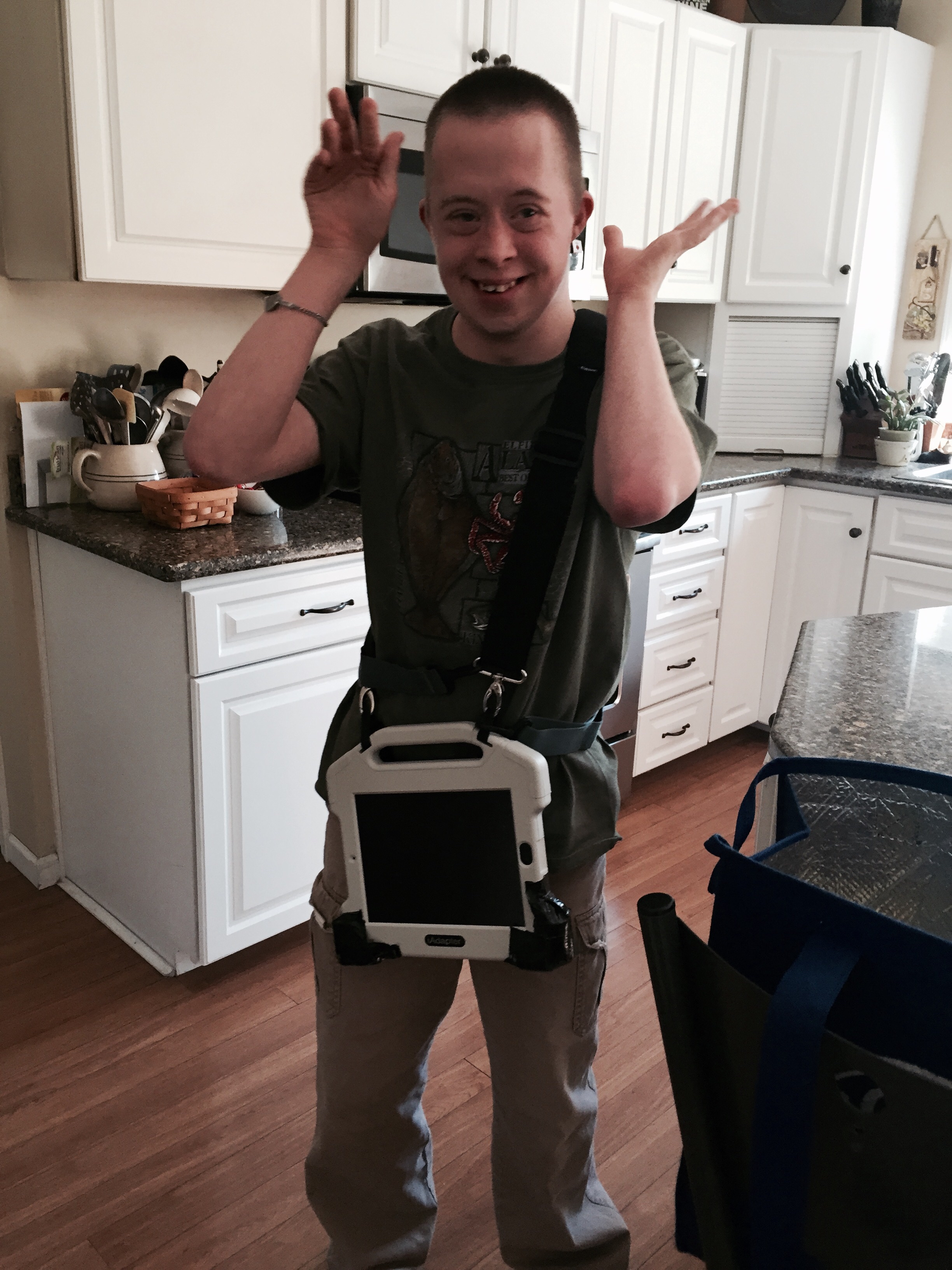
Since the SETT meetings, Nick has been using an iPad with and iAdapter case. The program installed is called, Touch Chat. The initial update I gave on this device is in the archives posted on 5/18/15.   We had a few goals in mind. One was to be able to request items like food, movies, music, going out into the community. Secondly we wanted Nick to use the talker to gain attention appropriately. Finally, we hoped that Nick would be able to express his feelings (happy, angry, and frustrated).

Nick has been requesting food items very well along with items of interest to him like tennis balls, sprite, music, people he wants to see, tired etc.. on a consistent basis. In addition, he has been using it to gain attention. When he burps or farts he pushes the “excuse me” or “that’s gross”. If you try and find a certain button on his talker, he will hit “excuse me” as if to say, back off this device is mine. Last week he pushed the button with a keyboard on it. He wanted me to know he had played the keyboard at school that day.

Brian, his private speech therapists spends a lot of time working with Nick and his AAC device. The two go trolling around the speech clinic looking for ladies. Brian added a new button which Nick has been pushing, “You look pretty today, hubba-hubba!” That one has been a big hit 🙂

Nick’s talker, note the bumper pads the team installed.  Nick likes to send it airborne on occasion 🙂

IMG_5231

Last week, there was a major breakthrough with Nick using his talker. One trigger that often leads to a major meltdown for Nick is a crying baby or child. He will begin to pinch himself on his cheeks, followed by pinching anyone near him when this happens. This happened at an airport, leading to a severe meltdown the summer before last. While on a community trip at IHOP on Friday, a child began to cry at a table near them and Nick began to pinch himself. His teacher pointed to the talker instructing Nick to use it. Nick immediately took it and began to push the “stop” button. The first two times he hit the stop button the child stopped screaming. The look on Nick’s face was priceless. It might have been just a coincidence, but in that moment Nick realized using the talker really does work. His teacher cheered and praised him. He was so proud. It was as if he realized that he had power over the situation.

Yay Nick!!!

IMG_5116

It reminds me of many years ago, when the staff got trained to use PECS with Nick. His world of limited speech left him frustrated in those days during puberty. This resulted in many horrific meltdowns.  Using the PECS pictures gave him power; it gave him a voice (much like the talker is starting to do now). The key to the AAC device being successful will be getting everybody on board. Everyone that works with Nick needs to encourage him to use it (and praise him when he does). I look forward to sharing more of his successes with the talker and building on to this. I know he has much more to tell us all. That’s what is in my noggin this week.

~Teresa 🙂


Posted in Down syndrome, Education and Special Needs

Back to School Tips for Special Needs Kids

Back-to-School

Back to School Tips for Special Needs Kids

This week, my top 5 back to school tips for special needs kids and their parents.  Click on this link to view @https://nickspecialneeds.wordpress.com/2012/08/27/blog-19-back-to-school/

Good luck with the new school year.  That’s what is in my noggin this week!

~Teresa 🙂

Posted in Autism, Down syndrome, Education and Special Needs, IEP (Indivdualized Education Plan)

Parent Tips for Better IEP Meetings

Parent Tips for Better IEP Meetings

It’s that time of year when parents hold their breath in anticipation of IEP meetings.  IEP stands for “Individualized Education Plan”.  An IEP is done for a student who has special needs. These meetings are held each year to update the student’s current level of functioning, progress and goal planning for the following year.

brace yourself IEP

Many parents dread these meetings. I was one of those parents who did for many years.  But after 21 years I’ve learned a few things on how to make these both productive and cooperative.  My son, Nick has Down syndrome and autism.  Here are some parent tips for better IEP meetings:

https://nickspecialneeds.wordpress.com/2014/03/17/blog-88-parent…r-iep-meetings/

Thank you for reading and sharing Nick’s world.  That’s what is in my noggin this week!

~Teresa

Posted in Augmentative and Alternative Communication (AAC), Autism, Down syndrome, Education and Special Needs

Blog #115~SETT to Talk

Blog #115~SETT to Talk  

For the past few weeks, I’ve been writing about the SETT meeting process.  Recently, we did a SETT meeting at Nick’s school to re-evaluate the device he uses to communicate. This is called an Augmentative and Alternative Communication device (AAC). Nick is 21 years old and has Down syndrome and autism.

SETT is an acronym for Student, Environment, Task and Tools. The team gathered to ask key questions and get information that will help to pinpoint what technologies would best suit the student.

S= Student (abilities, learning styles, concerns)

E= Environment (What places will the talker be used and how)

T=Tasks (What type of work and learning will the student be doing?)

T=Tools (What tools are needed on the device to make it a success for Nick?)

photo (120)

In Blog #114, I covered Nick’s abilities, learning style, needs and concerns.  The last three areas we brainstormed on were the Nick’s environment, tasks that we wanted Nick to be able to do on the talker and what tools would be needed to make this a success. Take a look at what the team came up with in these areas: 

Environment: 

* Uses a “change” visual

* PECS book at home – items to request, pictures of people, task strips

* Private SLP services – 1:1 for speech and occupational therapy

* Video modeling strategy successful

* Attends ESY (Extended School Year-summer school)

* Bowling, mall, library, out to lunch

* Church

* Job: delivery run to CEC for STEPS

* Shopping at Meijer and Wal-Mart

* Goes to movies, lunch/breakfast, and the park

*Has a respite worker at home

* Production class: shredding, sorting, bagging, cleaning

*Visits to family – grandparents, aunt and uncle

*Older brother, Hank, attends NIU

*Cooking

* Functional reading and math

* Yoga

* Dance party Fridays

* Uses classroom leisure choice board independently

* Small group or 1:1 instruction, especially for unfamiliar tasks

* Adult supervision for safety

* Visual supports

* Cues to stay on task for jobs he knows

* Needs to know expectations, both visually and auditorally- what to do, how many to   do, how many are left

* Does visual schedule for the day

* Benefits from hand‐over‐hand and modeling for fine motor tasks

* Looks for peer models

* Task strip for hygiene routines, with point  prompts, at home

* Visual learner

* Flexible with symbol sets – familiar with PCS, SymbolStix, Proloquo2Go

* 15 buttons on current AAC home page

* Uses visual support to order at restaurants instead of his AAC device

Picture14

Tasks: 

*“That’s gross”

* “I like that”, “I don’t like that”

* “That’s crazy”

* Flirting

* Gain attention

*Need help

* “Stop”

* “I need a break”

* Emotions

* Preferred items and activities

* Requesting

* Sharing his humor

* Order at restaurants

* Communicate what’s bothering him

* Sensory vocabulary – “hot”, “loud”, “crowded”

* “Where is the fire alarm?”

* “I’m tired”

* “I’m mad”

* Ask questions

* Share personal information

*Basic needs – bathroom, drink/thirsty, hungry

* Greetings

* Age‐appropriate vocabulary

* Comments

* Weather and calendar vocabulary

* Names – People past and present

The team looked at what tools would be needed on the device that would work for Nick.  Each member could choose the top three most important aspects to focus on in particular (these have 3 *** by them):

IMG_4318

Tools:

* Portable

* Shoulder or waist strap

* Durable

* Waterproof

* Loud enough for all environments

* Ability to add vocabulary

* Combination of single words and phrases***

* Import photographs

* Easy to program

* Ability to program on the fly

* 7‐8” screen size

* Sturdy case (“bounceproof”)****

* Quick and consistent response from AAC device***

* Category‐based******

* 2‐3 hits to communicate message**

* Online tech support

*Cloud or USB backup

* Warranty

* Cost

*Dedicated communication device

* Ability to hide buttons

* 8‐12 buttons per page

* Keyboard‐sized buttons or larger

*Long battery life

* 1 charger for whole system

* No replacing batteries

The SETT process was enlightening.  The team covered a lot of ground in looking at many aspects of communication for Nick.   As you can see, there are so many things to consider when looking into a voice output device.  Nick just got his new AAC device last Thursday.  I can’t wait to share with you how he is navigating it!  That’s what is in my noggin this week!

~Teresa 🙂


Posted in Autism, Down syndrome, Education and Special Needs

Blog #103~Vocations for a Person with Special Needs

Blog #103~Vocations for a Person with Special Needs

Some 20 years ago when my son was born with Down syndrome, I wondered what kind of job Nick could do when he became an adult. I found myself gravitating to the checkout lines with the baggers who had Down syndrome.  Like a stalker I watched them work and interact with customers.   I’d ask for a carry out so I could chat more and offer up a huge tip.  I found a lot of hope in such moments.

Those dreams were crushed when autism ravaged my son’s mind and body. His speech would not come as it should have.  His behaviors were strange with all the stimming and worst yet, they became unpredictable.  Autism robbed his chance of being the best that he could have been with just Down syndrome.

Hope came back while Nick was in high school. In Blog #57~Community Jobs and Nick,  I wrote about what jobs he held out in the community. The link is @https://nickspecialneeds.wordpress.com/2012/04/17/blog-3-getting-your-goat/

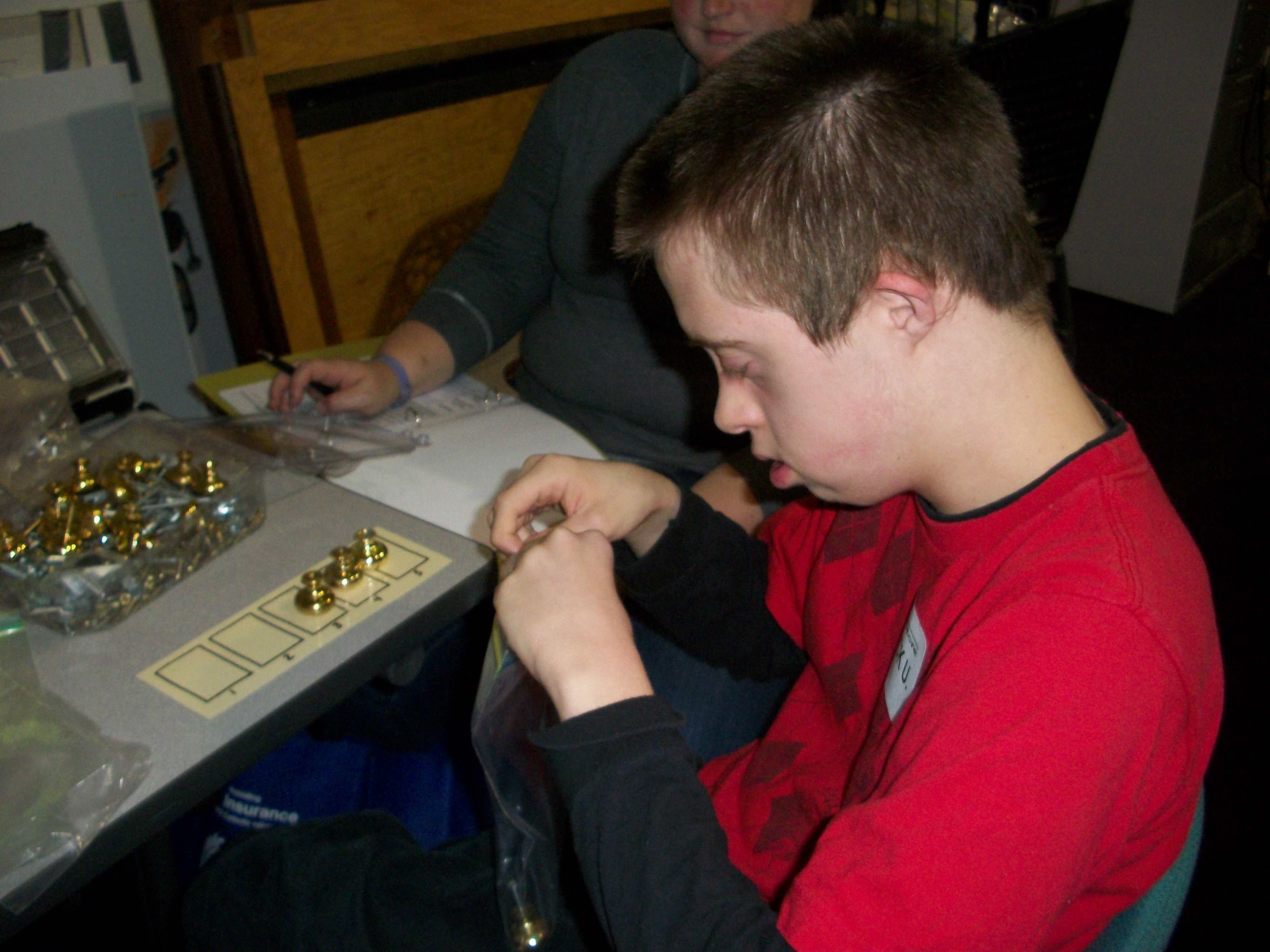
Nick working at Re-Store (Habitat for Humanity)…..

Nick packaging door knobs_Habitat_4 (2)

Nick takes a lot of pride in his work.  Okay so, he might have pulled a fire alarm at his vacuuming job at a nursing home (woopsie).But for the most part he participated well in all his jobs.

Nick working at Tabor Hills 🙂 ………..

Nick tabor hills

Fast forward to the present, Nick finished high school and attends a post-secondary transition program. In this program the students work in house on job skills, are employed in the community, and some take college classes.  While Nick participates in production and vocational work in the school building, he no longer works out in the community.  His unpredictable behavior, especially the fire alarm pulls (30 since third grade) put him at too much risk to hold a job.  Reality has sunk in. 😦

I’m not going to lie. It’s a kick in the gut. The daunting task now is to come up with a plan.  How will Nick occupy his days once the bus stops coming to the door (at age 22)? I reached out to some of his teachers from high school awhile back.  (Originally I planned to make Blog #100 to be “100 Cool Things About Nick” That was way too ambitious and long.)  But here are a few things they sent to me that fit nicely here:

From Mrs. Hunt (his primary teacher and case worker):

Nick has great functional skills! I’ve seen him help with a variety of chores and complete personal care routines better than some typical teens! Nick is a hard worker and loves to vacuum. Nick has a hilarious sense of humor! His laugh and smile are contagious, even when he’s being a stinker- which makes behavior management even tougher. Nick is clever and perseveres. When he’s determined, he’s going to have his way. Elbow bumps- this is how I know who has a good relationship with Nick. His elbow bumps make a person feel awesome.  I love that the last time I saw him, he still gave me one.  I love that Nick is a typical young man at heart- burps and fart jokes so funny.” 

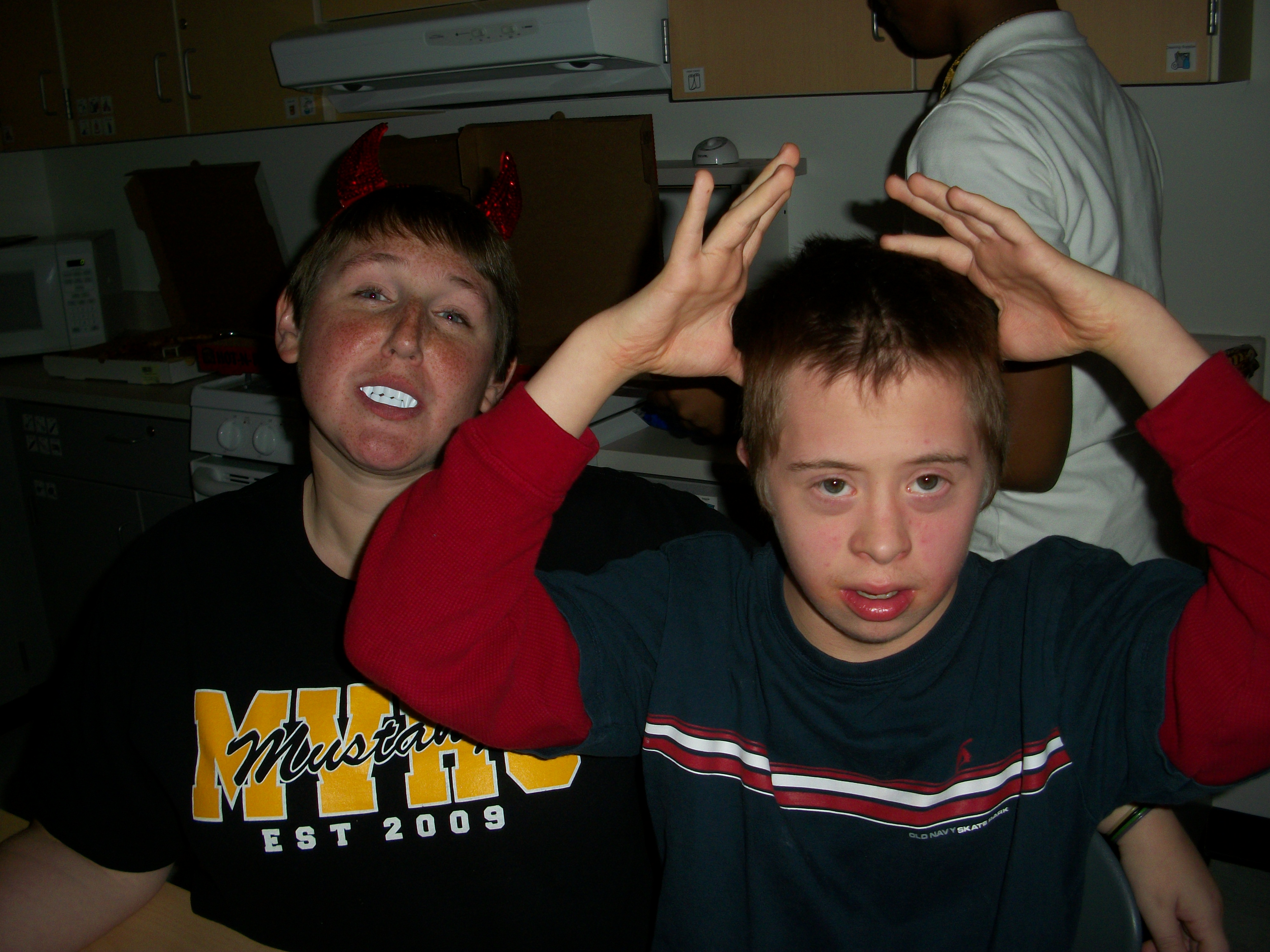
Being silly with Ms. R, his aide in high school 🙂

Devil horns

His vocational teacher, Ms. Stoodley offered up some ideas for possible jobs for Nick: 

  • Dancer
  • Happiness Creator
  • Adult Education Educator (all of us that he has taught and made better)
  • Vacuuming expert
  • Fire alarm Coordinator
  • Siren Director 
  • Professor of Dumping
  • Screw Sorter Assistant


I am slowly digesting the fact that Nick may not be able to work in the community. We need to look at his strengths, then create a meaningful day for him where he is productive and happy.  He is a “happiness creator” even in the midst of creating chaos. So yes, there is uncertainty regarding his future.  We have 17 month to figure things out.  Stay tuned……

That’s what is in my noggin’ this week,

~Teresa

Posted in Autism, Down syndrome, Education and Special Needs, IEP (Indivdualized Education Plan)

Blog #102~Special Needs Summer School- ESY


Blog #102~Special Needs Summer School~ESY

During the summer months, a child who has special needs may qualify for ESY (which stands for “Extended School Year”).  ESY is usually a half day program which allows someone like Nick who has Down syndrome and autism to continue working on IEP goals.  This benefits the student with special needs by keeping the momentum and daily structure which is so vital.

Nick’s teacher, Andrea Lawler put together a montage of his summer school program. Flipping through the pages of this book made me smile. It also put a lens on all the cool things Nick gets to do in the ESY program.  Take a look……….

Nick’s ESY Yearbook 2014 at Neuqua Valley High School:

Part of our morning routine was our “Morning Meeting.” Here Nick is letting us know that he is happy, however, he usually loved to be a goof and always point to sad! 🙂

Picture1

Nick’s version of yoga! Everyday we did a yoga routine with the “Let’s Get Ready to Learn” program.

Picture2

Who doesn’t love fireworks! Celebrating the upcoming 4th of July with a little fireworks show!

Picture4

Nick thinks this is way cool 🙂

Picture5

Mid-rock, one of Nick’s favorite dance moves. Who doesn’t love a dance party every now and then!?!

Picture6

Enjoying his snack time.

Picture7

Once a week we would go to the computer lab.

Picture8

Bingo game with some augmentative-communication during speech group!

Picture9

Being silly while working in the production room sorting sugar packets.

Picture10

The students went to the production room on Mondays! No fire alarms in the room though. 🙂

Picture11

Watching and listening to our book during reading group. This was Nick’s favorite spot to stand in during group time. He’s doing “elbow” which is his version of a high five.

Picture12

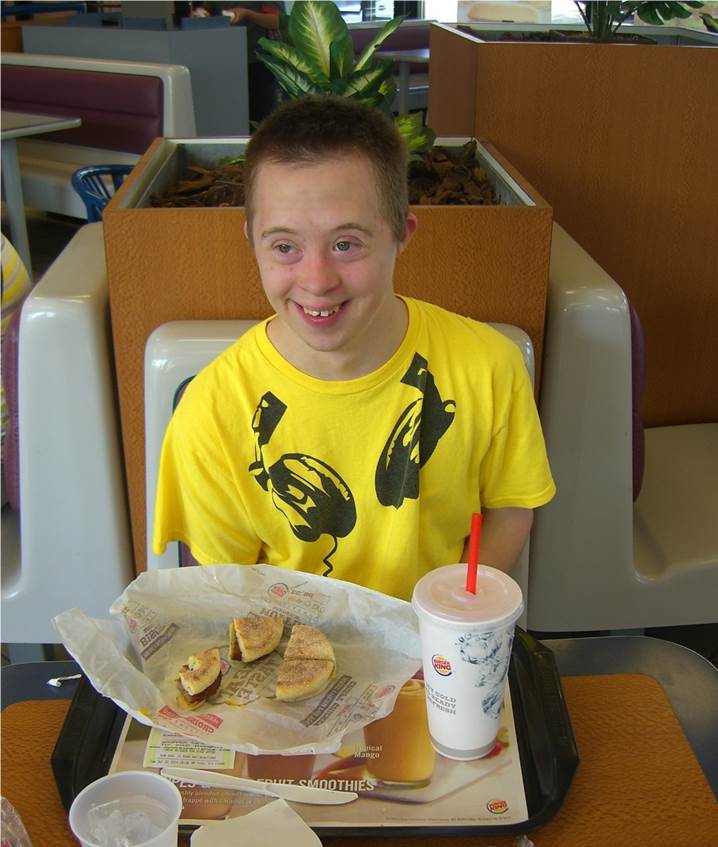
Placing his order during one of our weekly community trips. This trip was to Burger King.

Picture13

Who doesn’t love Burger King breakfast!?!

Picture14

This smile says it all!

I hope you enjoyed a glimpse into Nick’s world at ESY. A BIG thank you to Nick’s teacher, Andrea Lawler for putting together this awesome summer school yearbook.  In addition, I want to thank  all the teachers and aides for taking the time out of your summer break to continue to teach Nick. This allowed me to continue going to work without having to hire respite care. It also kept me from going bonkers with him home all day.  That’s what is in my noggin this week.

~Teresa 🙂


Posted in Autism, Down syndrome, Education and Special Needs

Re-Post~ Back to School Tips and Your Special Needs Child

Re-Post~ Back to School Tips and Your Special Needs Child

Back to School Mom quote

This week’s blog was written as Nick was about to start his senior year of high school.  I am doing this re-post in case some of you missed it or might be new to Down Syndrome With a Slice of Autism.  You can click here to view @https://nickspecialneeds.wordpress.com/2012/08/27/blog-19-back-to-school/

That’s what is in my noggin this week.  Thank you for reading and sharing Nick’s world! 🙂

~Teresa