Posted in Autism, Behavior/ ABA, Education and Special Needs, Feeding, Personal Hygiene, Toileting, Tech Stuff/Apps and Video Based Instruction

Blog #52~ Tech Time

geek pic

Blog #52~Tech Time

A few weeks ago at the National Association for Down Syndrome (NADS) Retreat the guest speaker did a presentation on using video based instruction and mobile technologies to support learners with Down syndrome and other developmental disabilities.  Toni Van Laarhoven, an associate professor in the Department of Special and Early Education at Northern Illinois University (NIU) gave us some great information on how to implement it.

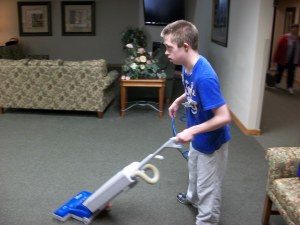
Video modeling for can be used for teaching a variety of social, academic, and functional skills.  In the April 2012 archives, Blog #5~Ready, Set, Action, I wrote about how effective these have been in teaching Nick a variety of job skills.  He learned how to unload the dishwasher, load the washing machine and how to use the vacuum cleaner.

Nick vacumming_Tabor Hills (5)

Before video modeling we used social stories.  Basically this is like a script that you want the child to follow.  With Nick also having autism, it helps him to see it in picture form so he can better understand.  Nick has a thing for sneezing right in your face on purpose.  His teacher made this social story, here is part of it…….. aaaaachoooooo 🙂

photo (115)

These visual supports were effective, but his interest level when reading social stories was nothing compared to when he started watching the video models.

Here are a few ideas  I came up with for video modeling:

Teach a job skill

Teach a fine motor skill (cutting food, buttoning a shirt, pour milk, handwriting)

Teach a gross motor skill (swimming strokes, riding a bike, yoga positions.)

Grooming routines (brushing teeth, washing face, dressing.)

Bedtime routine

Change in routine (picture day at school, new curriculum unit in P.E., new school)

Visit to doctor, dentist, blood draws, and haircuts

Trip to the zoo, baseball game, mall, movie theater

Appropriate leisure activities to do at home (watch a movie, computer/X-Box)

Teach social skills (playing games with peers, turn taking)

It’s best to choose one behavior or skill to work on at a time.  Have the child watch the movie before engaging in the activity on a consistent basis.  For a job skill, many students have a video on their hand held device (iPod) and can follow the prompts as they work.  Ultimately, using video models can foster greater independence.

Shooting the videos can be done using an adult or peer model going through the sequence.  Simple verbal prompts should be provided.  For example, for pouring milk you can script it like this.

  1. Go to cabinet and get a cup.
  2. Go to the refrigerator and get milk.
  3. Open cap and pour milk in cup.
  4. Put cap on milk.
  5. Put milk container back in the refrigerator.

Another way to use video modeling is to make a video resume.  Toni made one of her sister who has significant disabilities.  This video showed in detail her routine.  The narrator pointed out specific details, likes, dislikes that added clarity to how she navigates her day.  This would be extremely helpful for a new staff, teacher, and direct care provider.  A few years ago, Toni’s NIU students put together a video resume of Nick called Project MY VOICE.  Like Toni’s sister, his showed what he did at school, his likes (music, community outings, etc..) and pointed out things that might upset him (saying “no” to him, changes in schedule, etc…)  Nick was very proud to show the video at his IEP meeting that year. 🙂

There tons of programs and apps that are available for assisting persons with special needs.  Here are just a few that have been recommended to me:

*Follow a schedule with Picture Scheduler:

picture schedule app

*iPrompts- Visual support, schedules, picture prompting for autism and special education.

*Artiks Pics-Vocabulary flashcards, memory games

*www.autismspeaks.org/autism-apps

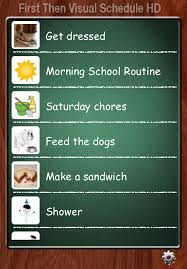
*First Then Visual Schedule:

first then app

*ABA (Applied Behavior Analysis) and educational apps:

fruit app

happy sad app pic

Alphabet Tracing:

alphabet tracing

Sensory Fun, Light Box App:

light box app

Silly Fun, Talking Tom 2 (Nick’s going to love this one. Tom just cut one here, stinky) 🙂

talking tom

The list goes on and on, you get the idea.  There’s an app for just about everything.

Video based instruction, using mobile devices and prompting systems are effective tools in helping our kids navigate their world to become more independent. Put the power in their hands! That’s what is in my noggin this week.

~Teresa 🙂

Posted in Autism, Behavior/ ABA, Feeding, Personal Hygiene, Toileting

Blog #51~Pushing My Buttons

Blog #51~Pushing My Buttons

Pushing the microwave and phone intercom buttons, running water faucets full blast, dumping out coffee mugs…. You name it Nick does it. I try to ignore the behavior and not give him any attention which is what he desires.  This tactic isn’t really working.  Now what?  Enter Toni Van Laarhoven, Associate Professor at Northern Illinois University.  She spoke at the NADS Behavior Retreat a few weekends ago.  Before she did her presentation on using video modeling to teach behaviors she spent some time talking about the struggles that we as parents were going through. The NADS (National Down Syndrome Association) retreat families all have children with Down syndrome and autism.  I sat up in my chair, she had my full attention. I began jotting notes in my journal frantically as she spoke.  I am always looking for solutions, she had me at DRO.  

It’s been a long time since my days of taking psychology classes at The University of Texas.

Longhorn logo

I remember the basics but this technique I have never tried with Nick.  What is DRO?  It stands for Differential Reinforcement of Other Behavior, and it is the delivery of reinforcement. This reinforcement procedure is designed to reduce a given behavior by increasing alternative behavior while withholding reinforcement for the unwanted response.

 I did a little research and have to give credit to Toni Van Laarhoven and these two resources: 

Cooper, J.O., Heron, T.E., & Heward, W.L. (2007). Applied Behavior Analysis (Second Edition). Upper Saddle River, NJ: Pearson Education, Inc.

Sulzer-Azaroff, B. & Mayer G.R. (1991). Behavior Analysis for Lasting Change. Belmont, CA: Wadsworth/Thomson

Here is my take on this technique and how I might apply it to help with some of Nick’s behaviors.  DRO is a specific schedule of reinforcement that is used to decrease the rate of behaviors that are inappropriate.  It is time-dependent, so rather than responding to a behavior after the fact you reinforce the time that the child is NOT engaging in the inappropriate behavior. In essence, you catch them being good. 🙂

angel pic

Advantages of using DRO: 

* Decreases inappropriate behaviors rapidly

* Positive approach to change inappropriate behaviors

* Used to reduce a wide variety of behaviors

* Easy to implement

Guidelines for implementing a DRO Program: 

* Define the target behavior.

* Determine highly preferred items or activities to be used as reinforcement.

* Collect baseline data of current behavior, how often does this occur?

* Set initial DRO intervals just below the average period of time that the child  emits the inappropriate behavior. (5, 10, 15 minutes?)

* Explain rules to earn reinforcement.  Child will earn reinforcement if they do not engage in the target behavior during each interval.

*DRO may be more effective when combined reinforcing replacement behaviors.

*Use visual supports (tokens, picture of reward)

*At the end of the time period, provide the child with the reward if the target  behavior was not emitted.

* If the child engages in the target behavior, inform them that there will be no reward at that time.

* Start time period and continue sequence above.

*Implement daily and consistently.

* As the student makes progress, increase the time period.

Here is what I picture with Nick.  The target behavior will be pushing the phone intercom button.  I will do some data keeping on how often he does this.  In addition, I will see what is occurring in the environment that might trigger him doing this and make a note in the behavior journal.  Once a pattern is established I will set the interval schedule.  Next will be determining what motivates Nick.  Normally he is rewarded with a Sprite when he does his work bins well.  However I am going to use a different reward specific to this DRO project.  Nick enjoys watching Funny Cats on You Tube and the laptop is right by the phone.  Right now I am thinking this might work.  I like the idea of doing a visual token system for Nick.  Toni mentioned making a puzzle of the highly preferred item.  For each successful interval you put a piece in the puzzle.  Once the puzzle is filled in then Nick would get his reward  🙂

you tube cat pic

The DRO technique could be used in home and in the classroom as well.  One instance might be a child who interrupts the teacher during classroom instruction. The end result is to have the child learn to exercise more self control.  This may sound like a lot of work.  The data keeping and setting of the interval schedule can be tedious.  Flashback to the toilet training days….. this is when I use to put Nick on the throne every 30 minutes and do a dry pants check.  I also kept data on how often he took in food and drinks. Over time I saw a pattern of two things.  First,  was how long he could stay dry and clean.  Secondly I figured out what amount of time it took him to digest what he ate and drank thus needing to use the bathroom. This is how I habit trained him.  As he matured he was able to self-monitor toileting on his own. Put the time and effort on the front end (so to speak 😉 ) and there will be a payoff.  That’s what is in my noggin this week….. Stay tuned…..

~Teresa 🙂

Posted in Autism, Behavior/ ABA

Blog #50~Up, Down and Somewhere in Between

Blog #50~ Up, Down and Somewhere in Between

Life has its ups and downs like a roller coaster. The highs from a peak adrenaline rush don’t last forever. What goes up must come down. Then there are those periods of in between. Over the weekend we attended the National Down Syndrome Association (NADS) Behavior Retreat. This is unique group of kindred spirits all which have children with Down syndrome and autism. This support group always divulges uncanny stories that are frighteningly similar. Some are on a high, others are on a low and a few are somewhere in between.

The retreat opens with sharing of stories. The first was a success story of a boy the same age as Nick. He is navigating his schedule independently using his iPad and a scheduler app. The next mom had poured out tears last year. At that time her son plopped down outside in a busy parking lot. She physically couldn’t get him to move. We call that the “stop, drop and plop.” This year she said they were in a honeymoon period experiencing much success and growth with their son. Another parent was struggling with many things. Her son was now a one man wrecking crew. He’s on a dumping rampage like Nick.  The only pictures she had were up on the high shelves in her home.  He found a way to hurl objects way up on the shelves and successfully knock down the last remaining picture frames. Why? He likes to stare into the frame because it’s reflective. His sensory need was desperately craving shiny objects. Crafty little guy. 😉

Nick likes reflective objects too…..

photo (112)
The gal next to me was on a high. She had grasped the Holy Grail. Her child was finally potty trained. The group broke out clapping and cheering. This is no easy feat with our kids. Al and I spoke next. Right now we are somewhere in between. Nothing horrible is going on with Nick. Yes, he is still pushing the microwave and phone intercom buttons. The water faucets  run full blast from time to time. He’s still dumping and dropping things. On the flip side, his meltdowns have been minimal and he hasn’t pulled a fire alarm in a while.

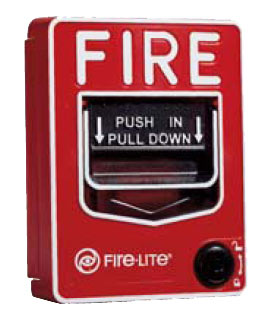
Nick’s last alarm pull was at this retreat six months ago, that was #27….

firelite-pull-station
While these things are bad, I don’t see it as unmanageable right now. I know what rock bottom looks like. We hit it hard while he was going through puberty. This ride is wild and often met by hitting a breaking point. We came close. Over the years during these retreats, some families had to come to the realization that the support at home just wasn’t enough. You can see the pain in their eyes. You can tell by the body language as they sit with their arms crossed wound up tight as a ball of yarn. You can feel it as they speak of their hopelessness and guilt with tears flooding their down their faces.

At some point we as parents have to make the difficult decision to put our kids into a group home. Over the years many families expressed their relief of having done so and reported that their child not only adjusted but thrived. It’s a personal decision. I am guessing that when the time and situation is right, you will know it.

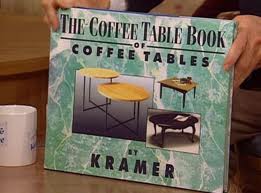
Listening to all the stories got me thinking that it’s like that Seinfeld episode with the coffee table book….

Seinfeld coffee table book
George who had no job and living with his parents adopts a new mantra, to do everything the exact opposite. Elaine is up, landing the job at Pendant Publishing but then things come crashing down. Damn those Jujyfruits. 😉

Seinfeld Jujyfruits
Meanwhile, Jerry loses a stand-up gig and five minutes later is asked to perform another one on the same night. This prompts Kramer to call him “*Even-Steven”. This causes Jerry to start noticing how everything always ends up turning out exactly the same for him as originally planned, never losing or gaining. By the end of the episode, Elaine claims that she has “become George,” but Jerry marvels at how things always even out for him: first, Elaine was up and George was down; now, George is up and Elaine is down, but Jerry’s life is exactly the same.

Seinfeld cast
Besides the successes and war stories, the retreat offered some great information. Toni Van Laarhoven, an Associate Professor from Northern Illinois University gave  a fantastic presentation. We learned about using video modeling to teach new skills and behaviors. I can testify this works. Check the April 2012 archives for my story on this in Blog#5~ Ready, Set, Action. Toni also provided some helpful information regarding behavior problems. Stay tuned for more on this in the next two weeks.

In life sometimes you are up, other times down, and sometimes in between. I am okay with being “Jerry” right now. I’ll take even-steven. I think TODAY, most of us would.
tax day
That’s what is in my noggin this week and don’t forget to ask for those tax day specials! AMC (free popcorn), Sonic, Arby’s, Cinnabon and many other businesses are offering some sweet deals today. 🙂

~Teresa
*even- steven: According to Dictionary.com it means exactly equal; also, with nothing due or owed on either side. For example, I’ve paid it all back, so now we’re even-steven. This rhyming phrase is used as an intensive for even. Random house.com states that the noun steuen/steven originally meant ‘a time or place’, but later took on the meaning of ‘a condition, situation, or circumstance’. So the phrases set steven and even-steven both meant ‘settled circumstances; settled accounts’.

Posted in Autism, Behavior/ ABA, Education and Special Needs

Blog #49~April is what?

Blog # 49~April is what? 

April 2nd was “Autism Awareness Day.”  Nick and I didn’t wear blue to show support or acceptance.  Quite frankly, I forgot.  I am down in the trenches trying to keep him from running the faucets full blast, pushing the popcorn button on the microwave and dumping out my cup of coffee all over the floor every single day.  Seems to me they should have kicked it off on April fool’s Day. 🙂

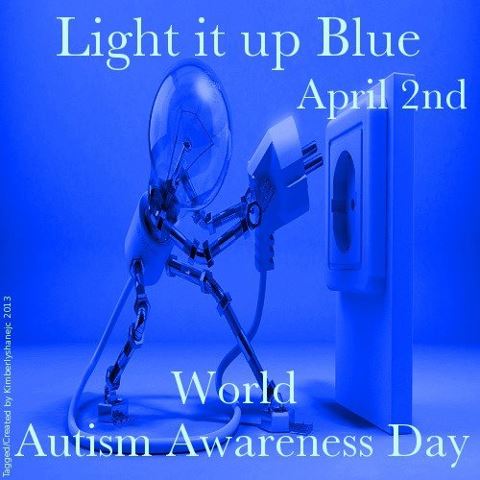
April and autism awareness…..

light it up blue

I applaud these gestures.  In the October archives (Blog #26~Down syndrome Awareness Month), I posted some pictures of iconic places lit up pink in support of breast cancer and shared some ways to support Down syndrome which is also during that month.

Here are a few light it up blue pictures…..

blue eiffel tower

Chicago lights it up blue…..

photo (119)

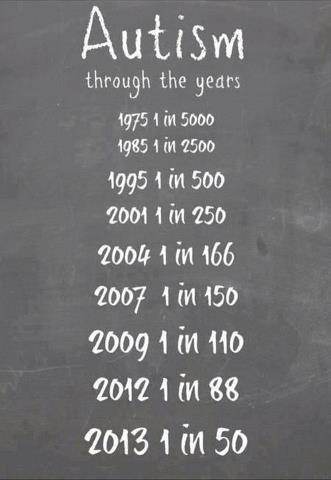
The CDC estimates that about 1 in 88 children has been identified with an autism spectrum disorder (ASD), and a study released just last week suggests that number may be even higher. In the Medical Daily article it stated: “A recent government survey as report of more than 95,000 parents in U.S. exceeds previously recorded accounts.  Now 1 in 50 schoolchildren between the ages of 6 and 17 are diagnosed with autism.  The CDC found that boys are four times likely to have autism than girls which has remained true since it was first discovered.”

An epidemic………

autism through the years

Personally I would like to see the focus on more educational, behavioral supports and other treatment options.  What is going to happen to our kids when they age out of the school system?  There aren’t near enough employment opportunities, day programs or group homes for this rapidly growing population.  In addition, I’d like there to be an easier path to obtain funding through the government.

I have spent the last year writing about Nick in this blog so that you can better understand the way he functions having Down syndrome and autism. I have crawled through the gutter like so many other parents.  What I think we all want most is support.  We also need understanding and compassion without judgment.  That along with a night of uninterrupted sleep. 🙂

autism and sleep cartoon

Yes my child is loud, try living with it 24/7…..

autism mute button saying

Yup…….

photo

No, I didn’t change the light bulbs to blue on the porch or add lawn decorations like this person…..

photo (115)

I didn’t go out and get a *puzzle piece manicure.  It wouldn’t last anyway with all the cleaning up of stuff Nick has dumped out… April archives, Blog #3~ Getting your Goat for the full list.

autism manicure

But I do have a salon appointment to cover the grays Nick has put in my hair this Friday. 🙂  That’s what is in my noggin this week.  I will leave the lighting up campaign for everyone else and Nick with his flashing blue stim toy and blue water bottle… while I try to keep up in his world.

photo (121)

Seeing the world in blue, cool ……

scan0007

~Teresa

autism ribbon

*The puzzle pieces are used to reflect the mystery and complexity of Autism Spectrum Disorder (ASD.)  It’s a puzzle that has yet to be solved.

Posted in Autism, Down syndrome

Blog #48~Joy and Sorrow

Blog #48~Joy and Sorrow

Yesterday during the homily at mass the message began with the feeling of true sadness for those who witnessed Jesus dying on the cross.   Then just imagine days later what it must have felt like to see the rock pushed way from the tomb and find it empty.  But then Jesus reveals himself as having risen and bringing the great message of eternal life. What an array of emotions.  The depth in which we experience a range of feelings can be overwhelming. The homily message was this…..  Life is like that with the ebb and flow of joy and sorrow.

Rewind 19 years ago to the moment Nick was born.  “It’s a boy!  Does he have all his fingers and toes?”  He did and he was beautiful.  He was smaller than his brother and his hair was lighter. He was perfect. 🙂 We were elated!  Within ten minutes, they whisked him out of the room for further examination.  He was having breathing difficulties.  The room became silent.

Like a light switch the emotions flipped from joy to fear.  Time ticked away as I sat there deserted waiting to find out if my baby was okay.  Cold and alone under a bare sheet and thin blanket, I braced myself.  It seemed like forever until the doctors came back with Al.  Fear was replaced by sorrow.  I saw it all over their faces.  I could tell the news was not going to be good.  Two words:  Down syndrome.  These two words would change our lives forever.

I never saw Down syndrome as the end of the world. After a week in ICU, the breathing tube and monitors were unplugged and we were able to bring him home.   It was more like entering a different world.  Emily Pearl Kingsley wrote this poem about her experience.  She has a son who has Down syndrome.

“Welcome to Holland”
I am often asked to describe the experience of raising a child with a disability – to try to help people who have not shared that unique experience to understand it, to imagine how it would feel. It’s like this: When you’re going to have a baby, it’s like planning a fabulous vacation trip – to Italy. You buy a bunch of guide books and make your wonderful plans. The Coliseum. The Michelangelo David. The gondolas in Venice. You may learn some handy phrases in Italian. It’s all very exciting. After months of eager anticipation, the day finally arrives. You pack your bags and off you go. Several hours later, the plane lands. The stewardess comes in and says, “Welcome to Holland.” “Holland?!?” you say. “What do you mean Holland?? I signed up for Italy! I’m supposed to be in Italy. All my life I’ve dreamed of going to Italy.” But there’s been a change in the flight plan. They’ve landed in Holland and there you must stay. The important thing is that they haven’t taken you to a horrible, disgusting, filthy place, full of pestilence, famine and disease. It’s just a different place. So you must go out and buy new guide books. And you must learn a whole new language. And you will meet a whole new group of people you would never have met. It’s just a different place. It’s slower-paced than Italy, less flashy than Italy. But after you’ve been there for a while and you catch your breath, you look around…. and you begin to notice that Holland has windmills….and Holland has tulips. Holland even has Rembrandts. But everyone you know is busy coming and going from Italy… and they’re all bragging about what a wonderful time they had there. And for the rest of your life, you will say “Yes, that’s where I was supposed to go. That’s what I had planned.” And the pain of that will never, ever, ever, ever go away… because the loss of that dream is a very, very significant loss. But… if you spend your life mourning the fact that you didn’t get to Italy, you may never be free to enjoy the very special, the very lovely things … about Holland. – Emily Pearl Kingsley

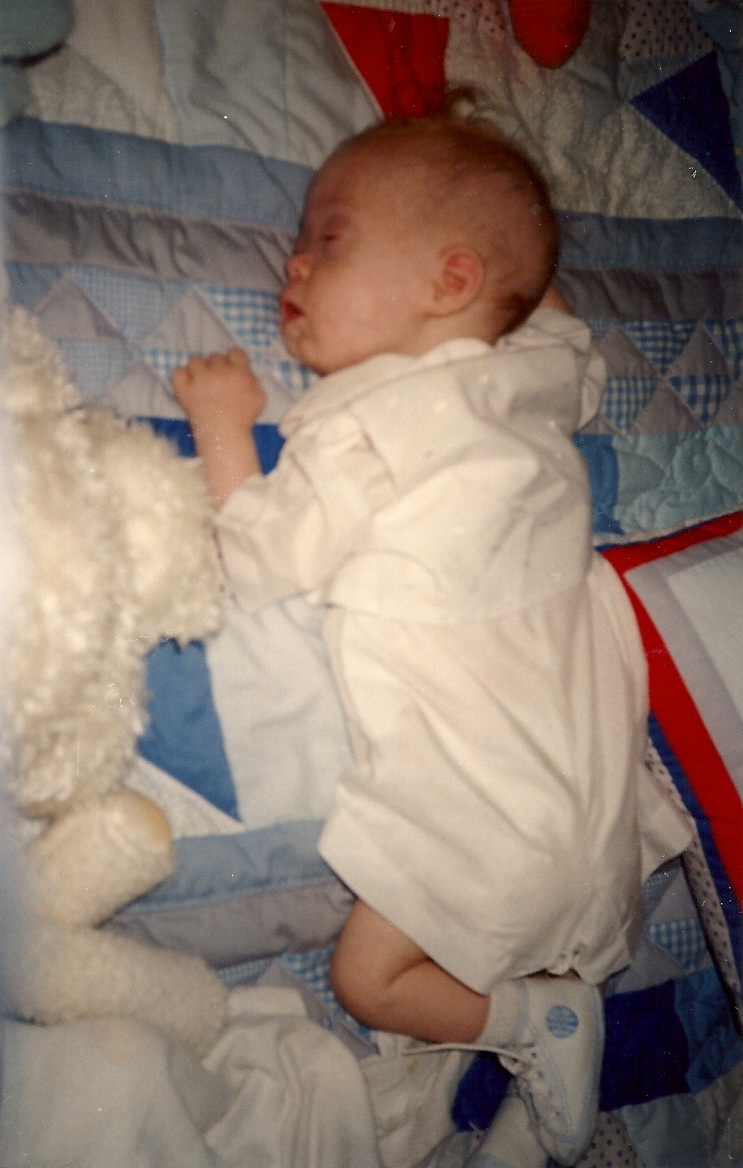
Baby Nick sleeps contently after his christening.  See how baggy his white jumper looks with his low muscle tone………

scan0001

Our trip to Holland, while unexpected was filled with joy and sprinkled with sorrow.  There were twinges of jealousy on occasion wishing my child could do the normal things that most children naturally did. But what was much more devastating was the second diagnosis of autism.  The trip to Holland took a bad turn to what resembled Siberia. This change in flight plans changed the game entirely.  For me, this is when sorrow took over.  This new world felt isolated.  My son didn’t fit in with the Down syndrome support group anymore.  The autism groups all seem to have children who were higher functioning both academically and stronger verbal skills.  I felt lost and found myself pulling inward.

Eventually, I plucked myself up, got out of the funk and sought support.  Little Friends Center for Autism helped me educate myself and offered trainings to help my son navigate his world better.  The National Association for Down Syndrome (NADS) offered a retreat for families with a dual diagnosis.  This is where we found parents who “got it.”  We all shared similar stories.  Some which we dared not to tell anyone else before as it would be too shocking.  We laughed and cried as we commiserated.  We found a new home.

Right now the days are filled with more joy than sorrow.  But like all of us there are times where I feel overwhelmed and sad.  I try to remember what saved me. Stay plugged in and ask for help. Always keep the faith that there will be better days ahead.  That’s what is in my noggin this week.

~Teresa

This smile brings me great joy…….. 🙂

060406_19341


Posted in Autism, Down syndrome, Education and Special Needs

Blog #46~A Day in the Life of Nick

Blog #46~A Day in the Life of Nick

This morning I am prepping for Nick’s IEP meeting to be held at 11:51 a.m.  I review all of the progress reports that I requested ahead of time. It is essential to get those reports early so you know what is going on.  Plus it saves time during the meeting.  I have more tips in Blog #24~Top Ten Things I have Learned While Navigating Nick through School, (located in the October archives). I want to give you a glimpse into the day in the life of Nick’s world at school.  What does someone like Nick who has Down syndrome and autism (lacking reading and writing skills) work on in school?

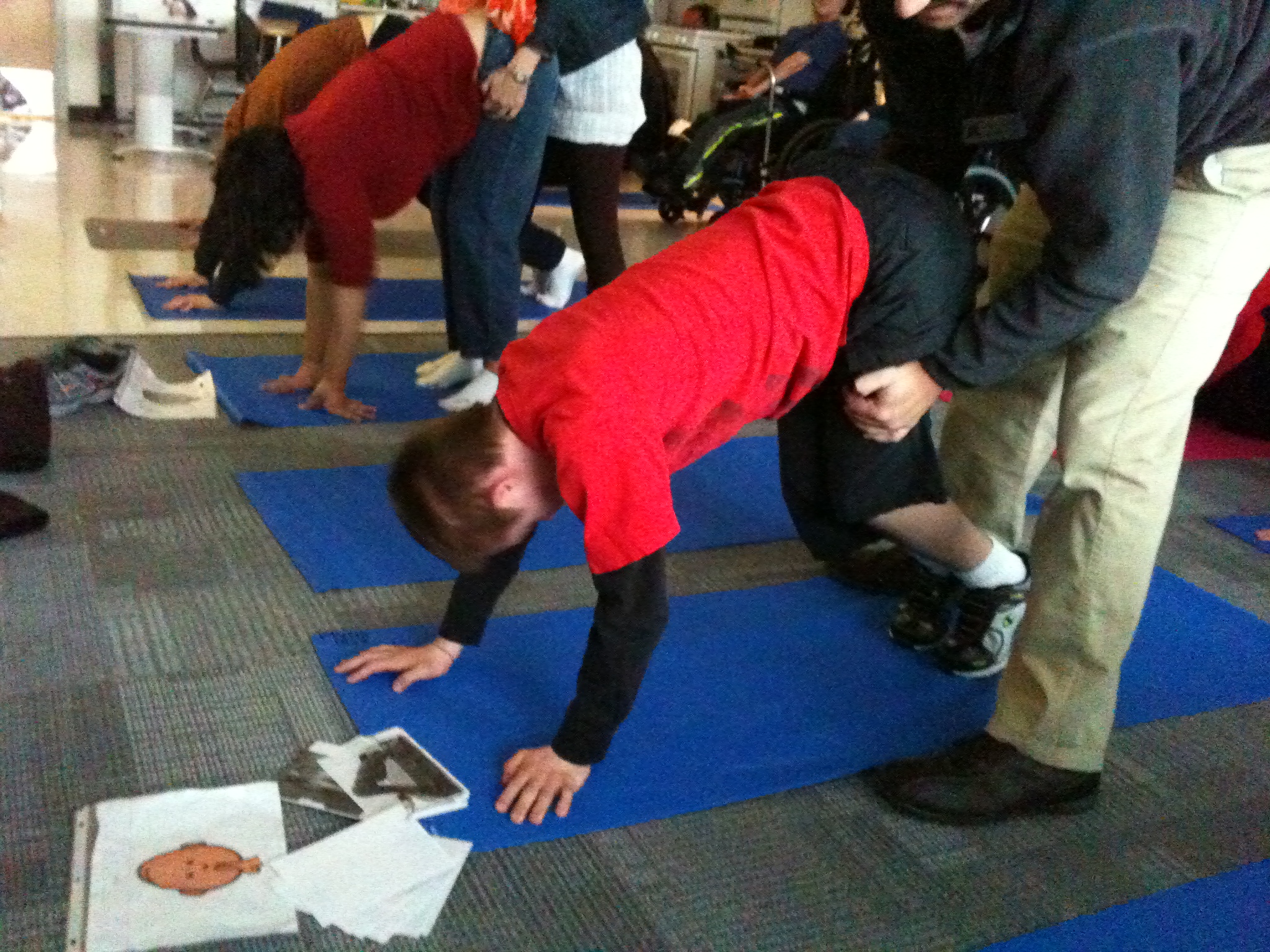
His day starts early, the skies are still dark when the bus rolls up at 6:30 a.m.  Most mornings Nick is dragging but when I mention it’s a community day he tends to perk up a little quicker.  The first two periods of Nick’s day are called “Life Skills.”  The class looks at the calendar, works on dates, upcoming events and the weather.  Nick enjoys telling others about the weather and is consistent in picking out the correct icon and working the weather page on his iPod Touch Chat program. After calendar, the students practice yoga.  They are following the “Get Ready to Learn Yoga Program.”

nick_yoga2

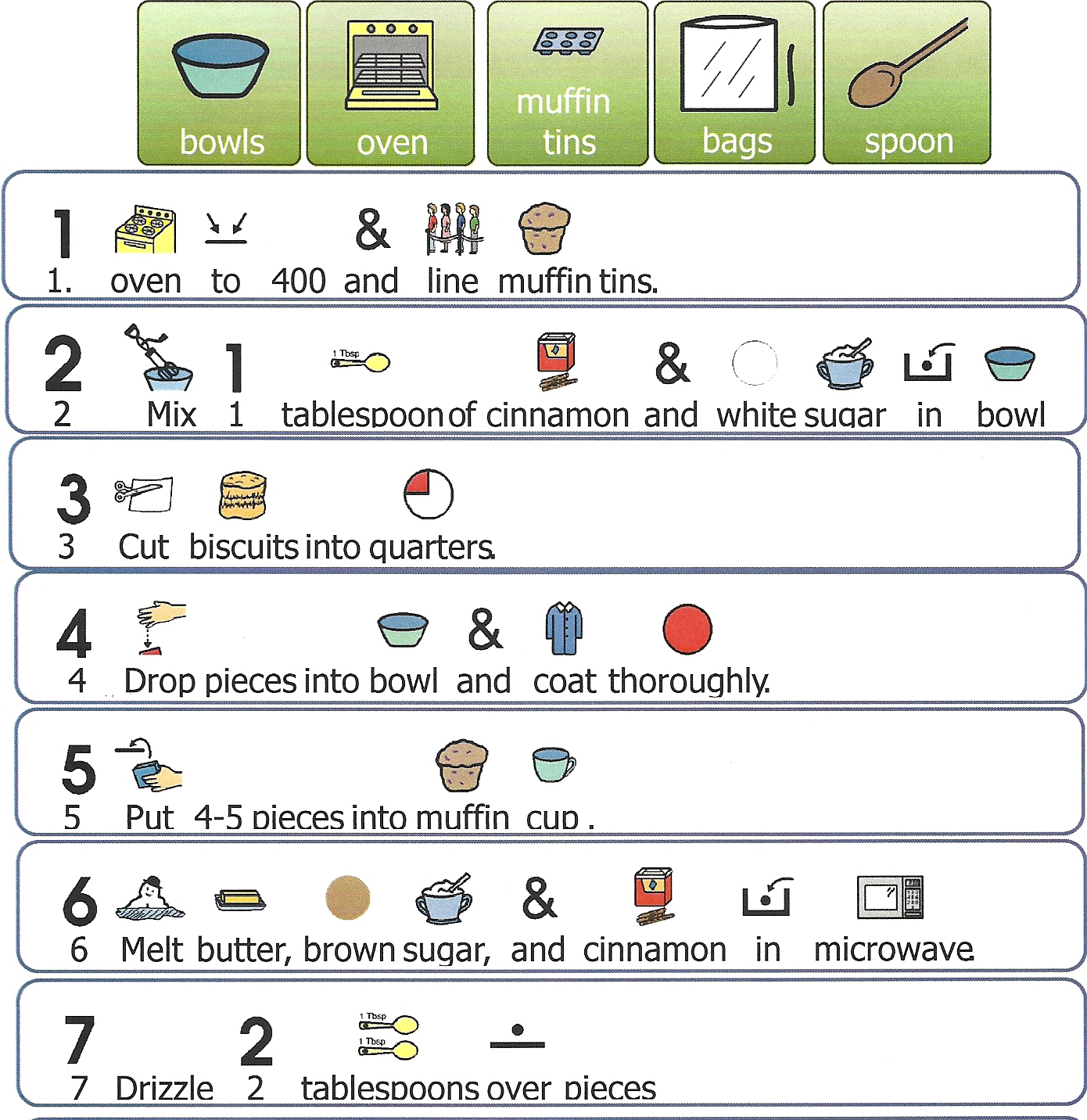
This is followed up with reading skills working on IEP goals of community safety words and pictures, computer programs and group news sharing session of current events.  On Thursdays there is a cooking unit.  Nick loves it and has tried several new foods this year including chili mac, waffles, pancakes, chocolate chip cookies and spaghetti tacos.  Now I am hungry! 🙂

Here’s an example of a recipe they use at school for monkey bread…….

scan0002

Third period is called “Home Maintenance.” During this time Nick prepares a simple snack.  He makes a choice using either his picture icons or iPod Touch Chat.  He likes Cheezits, pretzels, popcorn, salami and cheese. Here he is able to practice fine motor skills like cutting and opening packages with the occupational therapist.  He also works on hygiene skills, (brushing teeth, putting on deodorant and body spray, etc…).  For practical information and visual supports about hygiene and dressing be sure to read  Blog #22~Grooming 101 (located in the September archives).

Nick takes adapted physical education in fourth period.  Units include soccer, swimming, basketball, volleyball, badminton, kickball, adventure education and walking.  He really enjoys the interaction with peer buddies in class.  Period five is lunch time. 🙂

APE swimming 006 (4)

In the afternoon for periods six through eight, Nick has “Vocational and Community” skill building. Nick is working at job training sites three days a week.   These include Tabor Hills (retirement home) and Re-Store (Habitat for Humanity) where is responsible for vacuuming.

Nick vacumming_Tabor Hills (3)

His third job is at Adopt (animal shelter) where he removes leaflets from stacks of newspapers for cages.  On the other days he has school jobs which include shredding, work bins, rental laundry.  Wednesdays I have no problem getting Nick out of bed. It’s community day. 🙂 He enjoys it and is so happy being out and about.  The activities include dining out both at fast food and sit down restaurants, mall walking and shopping at Wal-Mart for groceries to use in the cooking unit.  Here he works on his goal to pay with a debit card.

Nick trying on sunglasses at the store…… He’s looking pretty fly!

018 (2)

He can manage a grocery cart (with reminders to not purposefully run into items or people)

Ramming speed ahead! You should see Nick barreling through Costco 🙂

grocery cart

That is the day in the life of Nick in high school.  His days are filled and structured during the week from 6:30 a.m. until 2:30 p.m. He loves going to school and enjoys the staff (and giving them a run for their money.) That’s what is in my noggin this week.

~Teresa

Posted in Autism, Down syndrome, Fun Side of Nick

Blog #39~Hardy har har Nick

Blog # 39~Hardy har har Nick

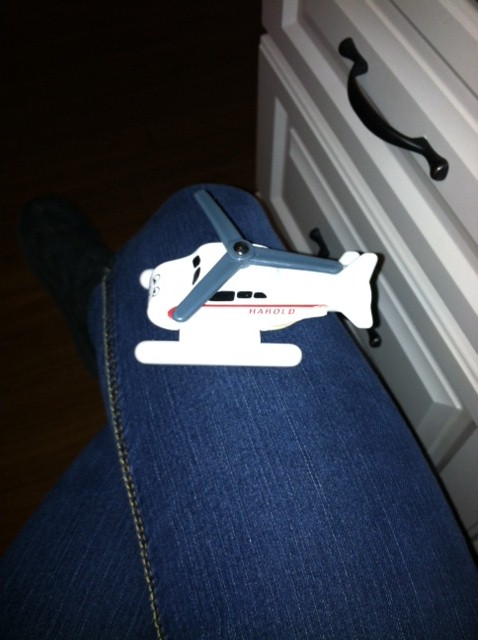
I spent a lot of time just observing Nick this weekend. The frigid temperatures begged us to stay hunkered down at home layered up in sweats and bulky sweaters. I thought a lot about what I have already written since I started the blog last March. One thing about Nick that stands out is that he is a funny guy (even when he is being a pain in the butt.) As soon as I sat down to the computer, he came over and carefully balanced this on my thigh. Then he ran away laughing. 🙂

photo (119)

Harold the Helicopter is using my thigh as a landing strip.

He loves playing jokes on us. There is a signature sound he makes, it’s a stimmy sound like his is saying “geeeeeehhh,” while he flaps his hands by his ears. I stop, look and listen to see what he has been up to. Oh hardy har har, he turned on the faucets in the bathroom full blast and ran out quickly. Sometimes while showering, he will turn the lights off on you too. Now that’s funny stuff. 🙂 After his shower last night, I saw him out of the corner of my eye putting something underneath the covers on my side of the bed. He pulled the covers up quickly and took off all excited. Underneath here is what I found.

Sneaking Mr. Platypus under the comforter……….

photo (121)

Then a little while later…….. He’s on a roll….

photo (115)

He also likes to mess with our cat. I am not so sure that Miss Mellie appreciates the *propinquity of Nick’s stuffed animals on top of her…….

photo (116)

Poor kitty, I don’t think she wants to be a velcro icon strip.

photo (117)
There are a lot more pictures in Blog#33~Stuff on my Cat located in the December archives!
I admire his cheerful spirit. He wakes up each morning with a big smile and first thing he does is let out a big fart while gleaming proudly might I add. What a great wakeup call. 🙂 In the same sophomoric vein, that boy can rip out the loudest and longest burps all from just a mini eight once can of Sprite. If you want to get a better sense of Nick’s funny side you’ve got to read Blog #6~The Nick Connection (in the May archives) and Blog #14~PB Unnerstall (June archives.)
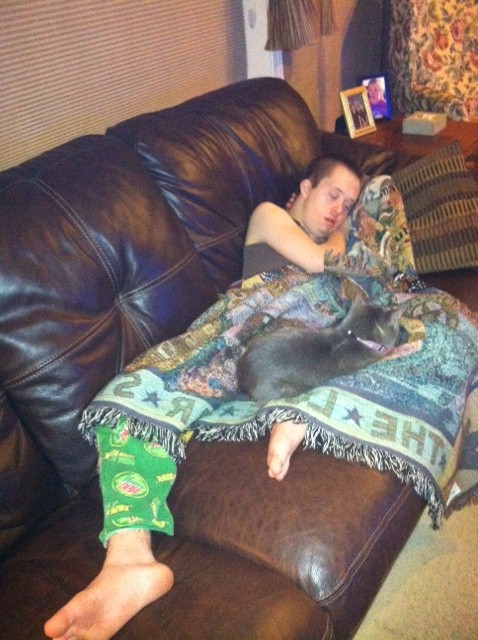
Yesterday morning I watched him cheerily dancing side to side with his headphones on. He was in the zone. As a mother there is nothing better than seeing your child happy and hearing them laugh. Well wait a minute…. maybe when they sleeping like angels. Now that supersedes everything else. 🙂

Oh yes the sound of silence, zzzzzzzzzzzzzzzzzzzzzzz…..

photo (118)

Looks like the cat isn’t holding any grudges.

Here are a few other examples of his sense of humor. He thinks it’s funny when he bangs or bonks himself accidentally. Anytime he drops something or someone else does he busts out laughing. He enjoys watching You Tube videos of funny cats, epic fails like the ones you see on the show America’s Funniest Videos, and people sneezing. Many of his favorite movies are comedies. Eddie Murphy is his favorite (Dr. Doolittle series, Norbit, The Nutty Professor) along with Mrs. Doubtfire and Little Man.

norbit
My funny guy, that’s what is in my noggin this week.

IMG_0026

I think humor is what has kept us afloat all these years.

humor quote

Have a great week, and keep that sense of humor with you!
~Teresa

*According to Ask.com, the word propinquity means a close kinship or similarity. It can also mean being close to someone or something, either physically or similar in nature.

Posted in Autism, Down syndrome, Fun Side of Nick

Blog #33~ Stuff on my Cat

Blog #33~ Stuff on my Cat

December is such a crazy, busy month so I am going to keep the posts light and quick.  I have yet to talk about one important member of the family.  That is Miss Mellie, our 16 year grey tabby.  She has a rough life following the sun coming into the house and basking in the glow……

photo (117)

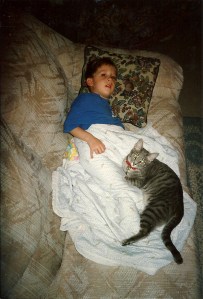
When she’s not soaking up the rays she is usually on somebody’s lap.  Here she is not quite a year old with Hank, age 4……

scan0002

When the boys were toddlers I had an orange tabby named Woody who lived to the ripe old age of 17.  Woody didn’t have much to do with the boys. Note Nick again leaning on his brother.  You can see his low muscle tone which is a characteristic of Down syndrome…

scan0001

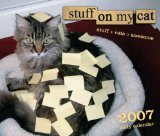
My sister, Laura pointed out a great website called “Stuff on my Cat” a few years back.  This site is a hoot, check it out at www.stuffonmycat.com.

stuff on my cat post its

For as long as I can remember we have been putting random things on our cats.  By the way cat lovers, they also have a book and calendar too. We’ve had a lot of fun with this.  So have Hank and Nick!

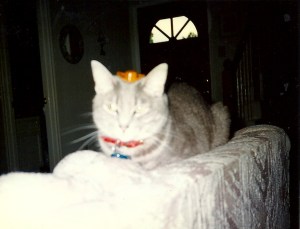
Hank put a toy cowboy hat on top of Miss Mellie. Howdy partner…… 🙂

scan0005

Then he put a Superman cape on my sister’s cat, Paco……It’s a bird, it’s a plane, no its Super Cat!

scan0004

Nick has followed suit with putting stuff on our cat… not always to Miss Mellie’s liking.  He likes to give her love pats and he thinks it’s hilarious to sneeze on her too.  Nick has Down syndrome and autism.

photo (121)

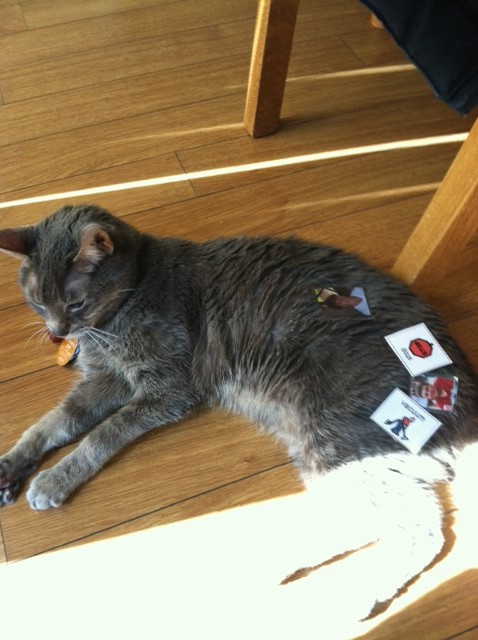
Poor Mellie has fallen victim to some of Nick’s dumping (Blog #3 Getting your Goat has the complete list of dumps!)  Let’s see…. baby powder, fajita seasoning, PEC icons, then splat…. Head and Shoulders shampoo….

photo (112) 

Nick thought that was so cool he gave himself a couple of dollops…… 🙂

photo (108)

Here kitty, hope you enjoy one of my stim toys…..

photo (118)

Who needs a Velcro strip, Nick just uses the cat…..

photo (123)

If there are no other laps available she will get desperate and settle for Nick.

002

Mellie is pretty lazy but there are two things she will jump up for.  The sound of the can opener sends her sprinting to the kitchen.  “Oh yes it must be tuna!”

photo (119)

The other is the dryer door closing.  That means warm laundry and maybe a dryer sheet on her head………

photo (116)

Meow to the Easter Kitty…..

mellie with ears

Mellie stoned on Christmas cat nip…..

024


IMG951590

She seems to be doing well despite the stuff we put on her.  That’s what is in my noggin this week.  Until next Monday may you take time during the holiday hustle and bustle to enjoy what makes you happy like a good cozy lap!

~Teresa

Meow….. 🙂

0516091435

Posted in Autism, Speech and Occupational Therapy

Blog #30~ 7 Senses of the World

Blog #30~ 7 Senses of the World

This week I want to expand more beyond the one aspect of “stimming” which I wrote about last Monday.  I want to dive in deeper into the sensory processing machine.  Admittedly, this subject has always turned me on.  Over the weekend Nick and I attended the NADS (National Association for Down Syndrome) Retreat that targets a special group that deals with more than just Down syndrome.  The hot topic was Sensory Processing Disorder (SPD) was formally called Sensory Integration Disorder.  Katie Frank, MHS ORT/L who works at UIC Family Clinic in Chicago was our presenter who outlined a summary for us.  Thanks Katie for shedding more light to this topic.  Here is my perspective about this subject.

In a nutshell, SPD happens in the central nervous system.  Imagine the pathway from the brain to the 7 senses as a superhighway.  We actually do have 7 senses which include sight, hearing, smell, taste, touch and two others.  No one talks about the other two senses, but they are so important. They are movement-based senses and are known as Proprioception (feedback from the muscles and the joints) and Vestibular Processing (feedback from movement of the head which tells us whether we are right side up or down in orientation.)

When a person has SPD, the flow is disjointed and the brain is unable to do the job of organizing sensory messages. Imagine a superhighway… You know that wide solid blue line on the map that flows effortlessly at 70mph+.  That is how the messages should transmit from the brain to the body. But what if it looks like the tiny grey line on the crumbled map you are trying to unfold and read.  That crooked road that breaks off and leads you into a desolate farm land area trundling at 15 mph…… THAT is SPD!  A formal diagnosis cannot be given by an occupational therapist but they can do assessments and make recommendations to a doctor.  The diagnosis is given when the problems impact the ability for a person to function in daily life.

Now that I have the scientific stuff laid out, the rest will be some concrete examples of what having SPD can look like and what supports can be put in place to help a person who has these issues.  There are three types of sensory modulation problems:

Over-Responsive (formerly known as Hyper sensitive) a person may avoid touching, sights, sounds, smells and certain tastes as they register them too intensely.  If you have ever seen a child with autism walking in a noisy venue like the mall with headphones on or their hands over their ears they are most likely trying to block out the noise for this reason. Their threshold of handling stimuli is much lower. I picture the character of Cameron Diaz’s brother in the movie “Something about Mary.”  He sported headphones all the time and banged his head when confronted with too much stimuli.  For Nick it’s not sound but rather the sense of touch when it comes to haircuts and toenail trimming (see Blog #22~  Grooming 101 for specific information about this topic.)

Under-responsive (formerly known as Hypo sensitive) is where a person may take longer to feel input, aka a sensory disregarder.  They may be unaware of the feeling of messy face or hands and not recognize touch or the feel of an object being dropped.  This person may be more socially withdrawn and may need coaxing to get engaged into the world.

Sensory Seeking   a person goes out of their way to find more input in their world.  They crave stimulus.  This for the most part IS Nick’s world.  🙂 Often when he walks his feet will hit the ground loudly.  His “heavy walking” as we have termed it is seeking extra feedback.  If there is a puddle he will step hard into it to get the splash to seek input.  He chews on inedible objects in particular his sleeves.) Nick also likes to push buttons on the phone intercom, microwave and often turns up the volume on the TV to 96!  He delights in turning on the water faucets full blast.  So you see he is looking for more input in various ways. Check out Blog # 3~ “Getting your Goat” to get a complete picture and list of things that he has gotten his hands on and dumped out.

So knowing the types of Sensory Modulation is all fine and dandy. But what can be done to address these problems?  That is where the Sensory Diet comes in.  An occupational therapist can assist with putting supports in place to help with this.  In a typical day we all strive to stay at a certain level of function where the keel sails evenly through the water.  Not too hyped up or sluggishly dragging, right?

If a person is under-responsive it is necessary to include “alerting activities” which will give them a boost.  These might include bouncing, jumping, hanging from monkey bars.   In Nick’s day he may need to take a motor break and go jump on the trampoline or get on a swing to rev him back up.  Using a special nubby cushion can help keep a person alert while working at a desk.
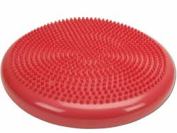
Organizing activities  can also help a person who is having trouble attending to a task.  For some people it may be deep pressure or heavy work that helps.  Others may need something more oral motor related.  “Calming activities”  help decrease the sensory over-responsiveness and might include deep pressure, joint compressions, massage, gentle rocking, rhythmic movement, taking a bath, muted light, etc.  Bottom line, it depends on the individual. Some senses may/or may not be more sensitive than others.  The parent can do some detective work to see what is needed and how their child reacts then work with an occupational therapist who will tailor a sensory diet to fit their needs.

Here is a list of heavy work activities/proprioceptive activities that may help regulate a child’s arousal level, concentration, ability to sit still and attend to a task or fall asleep.

Gross Motor Activities:
Carrying objects such as groceries, animal backpacks, a fanny pack, stacking or moving chairs/books, and a full watering can/hose, basically ANYTHING with weight to it.

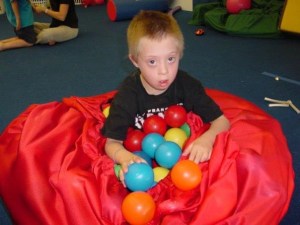
Thanks Kendra Convery, (Nick’s OT from California) for sending this picture of Nick in the balls. Isn’t he cute 🙂 A ball pit can awaken the senses and provide good input on their body position and balance (which addresses proprioception and the vestibular processing.)   
Deep Pressure ideas:
Wearing a weighted vest, weighted hat, or weighted shorts, wearing wrist or ankle weights, using a weighted pad on lap or across the shoulders.  It could also be something like a long door draft or even a toy snake…….


Pushing or pulling objects and activities:
Toy/regular shopping cart, laundry basket, kid’s wagon, raise/lower flag at school, tug of war rope, toy/regular vacuum, wrestling, hippity hop ball.

Sandwich/ Squishing activities:
Make a child “sandwich” between floor pillows, cushions or bean bag chair, roll child up in mat or heavy blanket as a “hot dog” – bear hugs.

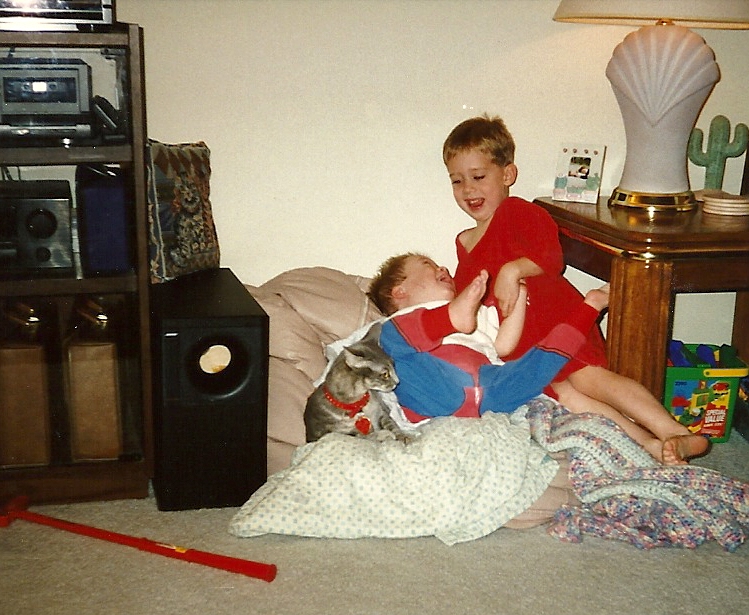
Siblings and pets make great deep pressure and wrestling pals…..
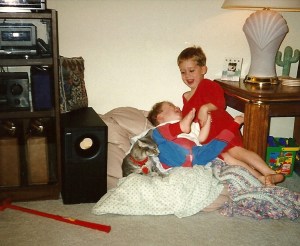
Nice stereo system….. and all those cases filled with my fitness cassettes 🙂

Oral Motor Activities:
Resistive sucking using items such as through thin curly straws/krazy straws sports bottle with long straw, lollipops, blowing bubbles, sour/citrus or salty flavors can alert the mouth.

We all have aversions certain senses. It might be something tactile like tags on clothing that personally drives me nuts.  Tactile issues can be addressed with the Wilbarger Protocol technique (most known as the brushing program.) Many parents of children with autism have reported that their children have responded positively to the Wilbarger Protocol technique.  This is a brushing program that should be administered by an occupational therapist.  Reports have shown a reduction in sensory defensiveness, as well as improved behavior and interaction. Many adults with autism have also reported reduction in sensory defensiveness, decreased anxiety, and increased comfort in the environment through the use of this technique.

We did this program with Nick for many years when he was little….

Certain textures may be unpleasant or down right unbearable.  Personally I can’t stand anything globby and lumpy like tapioca pudding, cottage cheese and flan….. blech!  My sister in law, Ali cringes at anything in the green slimy family like olives, artichokes, avocados, anchovies or hearts of palm. So what is it that you can barely tolerate?  Is it tactile, a certain smell or noises? Do you love loud music or does it overwhelm you? Do you sprint to the roller coaster rides or shy away from them?

The faces say it all…. Hank looks like he is facing the jaws of death up front while Nick is experiencing pure joy!  The rest of us are somewhere in between.  That’s Ali and my niece Anna in the back on the Splash Mountain ride….. 🙂

Is there a type of clothing that you are sensitive too? What calms you….. any certain genre of music, exercise, maybe the sound of a fountain? I would love to hear from you on this.  I plan to write another story closer to the holidays when we are all bombarded by stimulus overload.  I hope this week you gained some insight into how the senses are such a huge part of how we navigate the world.  That’s what is in my noggin this week.  Take a look around your world and let me know what you see that overwelms you or helps to keep you calm. You can e-mail them to me at: tjunnerstall@comcast.net.  Cheers and see you next Monday!

~Teresa

****** News flash********** OOOOPS he did it again.  #27 Fire alarm pull over the weekend in the hotel at the NADS Retreat. 

It was like a land mind in the corridor of that hotel, how could ne not resist…. and speaking of the ultimate sensory seeking…. yup that would be Nick’s….. The rest of us are just trying to keep up! 🙂

Posted in Autism, Behavior/ ABA, Speech and Occupational Therapy

Blog #29~Curious Stims

Blog #29~Curious Stims

Stimming is awesome, admit it we all really enjoy it!

Now that I have your attention I thought I would share a little bit about Nick’s world and what turns him on.

So just what is stimming? When you see someone like Nick who might be rocking and bobbing, tapping and making odd noises you probably look over and think “What the…?”  I dedicate this week’s blog to the need to stim! Here is a good explanation from www. About.com/autism spectrum disorders:

What Is Stimming and Why Is It Common In Autistic People? 

Answer: The term “stimming” is short for self-stimulatory behavior, sometimes also called “stereotypic” behavior. In a person with autism, stimming usually refers to specific behaviors such as flapping, rocking, spinning, or repetition of words and phrases.

Stimming is almost always a symptom of autism, but it’s important to note that stimming is also a part of most people’s behavior patterns. If you’ve ever tapped your pencil, bitten your nails, twirled your hair, or paced, you’ve engaged in stimming.

The biggest differences between autistic and typical stimming are the choice of stim and the quantity of stim. While it’s at least moderately acceptable to bite one’s nails, for example, it’s considered unacceptable to wander around flapping one’s hands. There’s really no good reason why flapping should be less acceptable than nail biting (it’s certainly more hygienic!). But in our world, the hand flappers receive negative attention while the nail biters are tolerated.

Like anyone else, people with autism stim to help them to manage anxiety, fear, anger, and other negative emotions. Like many people, people with autism may stim to help themselves handle overwhelming sensory input (too much noise, light, heat, etc.).

Unlike most people, though, individuals with autism may also self-stimulate constantly, and stimming may stand between them and their ability to interact with others, take part in ordinary activities, or even be included in typical classrooms. A child who regularly needs to pace the floor or slap himself in the head is certain to be a distraction for typical students.

It’s not completely clear why stimming almost always goes with autism, though it’s often called a tool for “self regulation.” As such, it may well be an outgrowth of the sensory processing dysfunction that often goes along with autism. At times, stimming can be a useful accommodation, making it possible for the autistic person to manage challenging situations. When it becomes a distraction or causes physical harm to self or others, though, it must be modified.

Lessening or modifying stims can be tricky, but several approaches may be helpful. Applied Behavior Analysis (ABA) may help individuals to eliminate or modify some of their stimming. Occupational therapy is another useful tool.

In some cases, stimming can be reduced with medications that address underlying issues of anxiety. Finally, some people with autism can learn through practice and coaching to either change their stims (squeeze a stress ball rather than flap, for example) or engage in excessive stimming only in the privacy of their own homes.

We try to limit the stim activities to home.  But we respect Nick’s need to manage the excess sensory input that comes into his world.  He will always grab up a few things for a car ride but knows that they need to stay in the car once we reach our destination.

Here are some of Nick’s “tappers” that he raps against his mouth.  The foam pieces are much quieter.

The Bloody hand is joining Nick for dinner 🙂

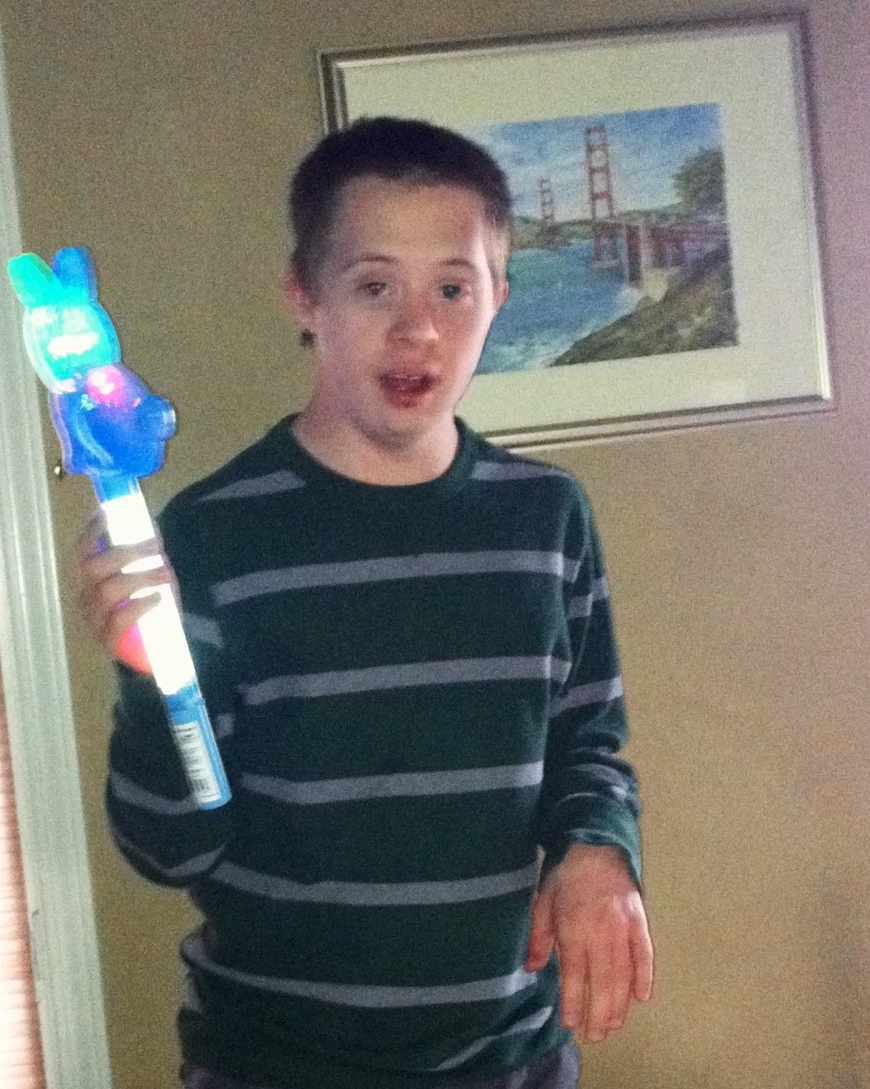
Here Nick enjoys a small music toy that lights up.  Notice the basket filled with more stim toys and guess who that is on the floor in front of Nick’s feet?

That’s right Yukon Cornelius….. “Sil-ver!”

Nothing beats a good time for Nick than a doorbell…..ding dong, ding dong, ding dong…..ha, ha ha!  🙂

At school he is given down time after his work sessions.  Here are some of Nick’s favorite stims at school. The first one is a small baby toy that is totally not age appropriate. But toys such as these are like that stuffed animal or woobie blanket we hold onto for some reason. Nick likes the music and dances with it.  It also serves for tapping.

Here’s another one he enjoys.  The frog sings “Celebrate” and there’s a party going on right here for Nick…….

This is a new acquisition.  The rat wheels across the table and floor when you pull his tail/string.  Nick loves this and enjoys pulling the string and listening to his ear…….

And of course the good ole stand by that has stood the generations of time……

Who doesn’t love a good Whoopee cushion?  🙂 I buy them anytime I see them at Walgreens and now they make them self-inflating!

Last but not least, his favorite go to stim is a can of tennis balls, tap, tap, tap and he is a happy guy 🙂

The need to stim is part of our nature.  A classic example is my brother.  Tom’s legs would rock back and forth while his hand was on the helm during a sailboat race.  The tighter the race, the faster those legs banged together.  My Mom never forgot the Carefree bubblegum otherwise he would chew the inside of his cheeks raw.  Those were his coping mechanisms to stay calm under pressure. What is your stim of choice, whether it is to keep you calm or to rev you up?

I hope this gives you some insight into the sensory world that is complex and fascinating.  Perhaps when you see a person with autism exhibiting these behaviors it will make more sense to you.  That’s what is in my noggin this week. And remember there is nothing wrong with a stim or woobie blanket to help us cope in a world that can be chaotic!  Just ask Nick………

This is how he tunes out the barrage of political ads……

Linus has it figured out too……

~Teresa

******News flash for those of you keeping score at home.  The fire alarm count is now at 26 pulls! Nick decided to put the “trick” in trick or treat on Halloween.  Yes, it’s Nick’s world, the rest of us are just trying to keep up!