Posted in Autism, Down syndrome, Fun Side of Nick

Blog #75~ 5 Reasons I am Thankful for Nick

Blog #75~ 5 Reasons I am Thankful for Nick
thankful
The road I have travelled with Nick was not in the plan.  It’s the thin, grey line on the map that is bumpy and full of twists and turns.  Nick has Down syndrome and autism.  The pace was bogged down as he struggled to hit developmental milestones. Other times it has been lightning fast, (like when you are racing to beat him to an exposed fire alarm). After 19 years and 30 fire alarm pulls, I am very thankful for Nick and here is why:

IMG01 (6)

1. I appreciate the small successes much more now. I don’t take anything for granted that a child has to learn like sitting, eating, crawling, walking, talking and especially toilet training. Each victory has been sweeter when Nick hit the marks.

2. I am more grounded because of Nick. He has taught our family to stay humble. While other moms were bragging about their child getting A’s in honors classes, being the star athlete and what colleges they were looking at, I smiled politely.  In my mind I was thinking, “At least Nick didn’t pee in his pants at school this week.”

3. I’ve become some what of an expert on Down syndrome and autism. Through trial and error along with wonderful teachers, therapists and mentors I have learned what works best for Nick. I am now able to pay it forward in my writing, speaking engagements and helping other parents out.

4. Life is never boring with Nick. He cracks me up with his mischievous ways.  He generates  laughter and tons of  “Likes” on my Facebook page: Down syndrome With A Slice Of Autism”.

like button

Here’s Nick’s signature elbow bump, (his version of a high five) with his Dad and Aunt Laura  🙂

IMG02

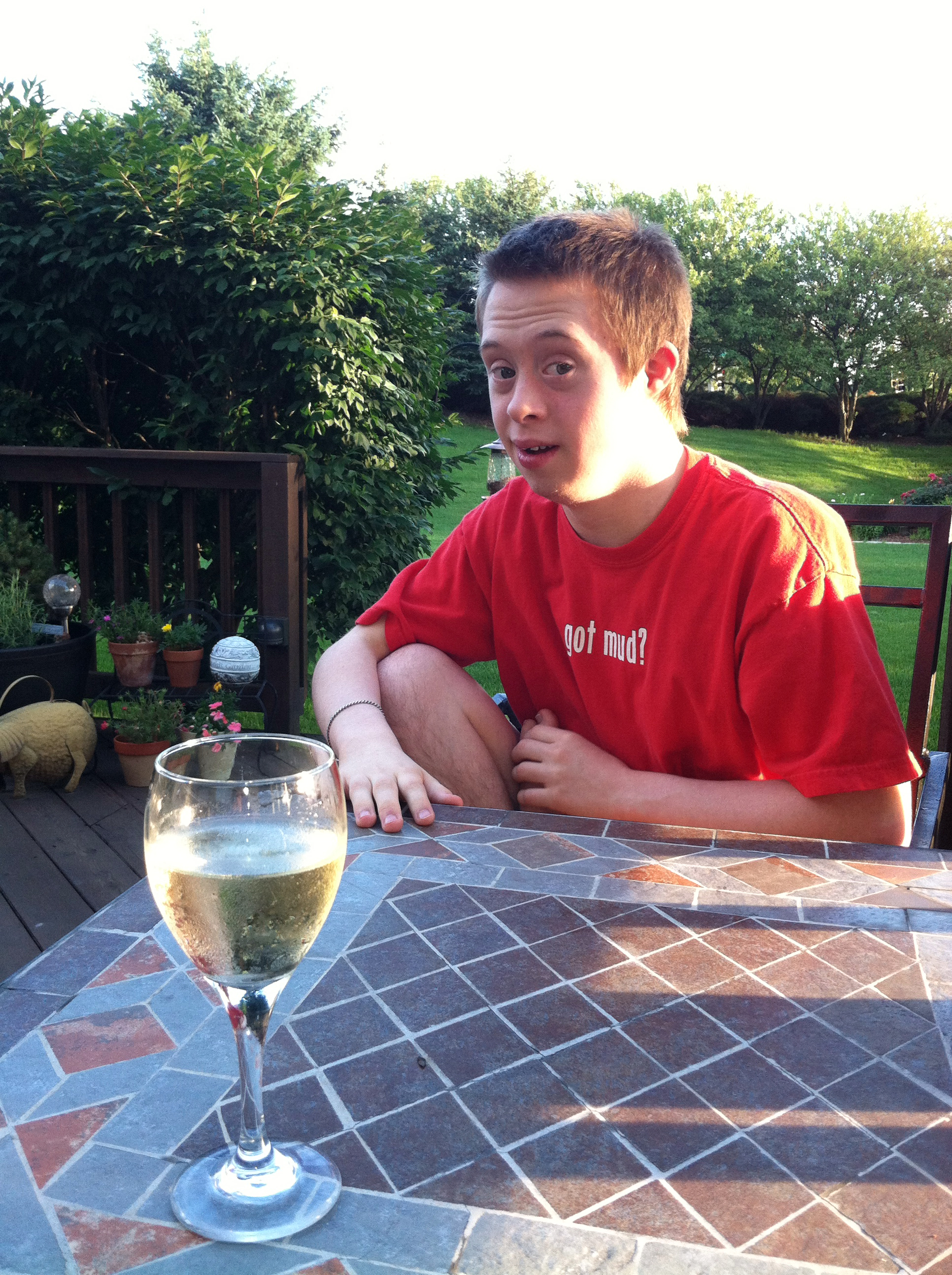
He’s got that look on his face like, I’m going to grab your wine)  🙂

IMG01 (3)

What a jokester, hardy har har Nick……

photo (40)

5. Nick gives unconditional love so freely. Each morning he wakes up, lets out a fart and smiles. All through the day he showers me with kisses, elbow bumps and hugs.

photo (33)
I am truly thankful to have travelled down this road with Nick.  It has been a blessing to be his mom.  That’s what is in my noggin this week. Have a wonderful Thanksgiving!
~Teresa

snoopy thanksgiving

Posted in Autism, Down syndrome, Dual Diagnosis Down syndrome and autism

Blog #74~ Teaching to 21

Blog #73~ Teaching to 21
Last week, I was a guest lecturer at Northern Illinois University. The graduate level class topic was “Functional Communication and Social Skills” as it relates to autism. I presented a parent’s perspective.

NIU logo

One of the greatest gifts we can give our kids is teaching personal independence. It’s never too early to start working on these skills. One concept brought to my attention by Nick’s support teacher from elementary school is called, “Teaching to 21.” What skills will an individual with special needs require to lead a successful life after school is finished? Here is a list of skills that should be addressed both in school and at home for students with special needs:

 Assessment of Functional Living Skills (AFLS)

Source: http://autismbeacon.com/topics/article/functional_skills_for_people_on_the_autism_spectrum

“Functional skills” are those skills that if learners cannot do for themselves, someone will have to do for them. Functional skills are immediately useful and important. They increase self-help and independence and are present in every setting and throughout every stage of life:

Basic skills:
Self-management
Basic Communication
Dressing
Toileting
Grooming
Bathing
Health, safety, first aid
Night time routines

Home Skills Module:
Meals at home
Dishes
Clothing
Laundry
Housekeeping
Chores
Household mechanics
Leisure
Kitchen
Cooking

Community Participation:
Basic mobility
Community knowledge
Shopping
Meals in public
Money handling
Phone
Time
Social awareness
Manners

School Skills:
School waiting and transitions
Classroom routines
Meals at school
Classroom people, places and objects
Classroom mechanics
Outside school
Functional academics
Classroom leisure and independence

The IEP team should address these skills in goal planning and daily schedules of the student. In addition, supports should be put in place that will assist the student in reaching these goals. Here are some of the supports that Nick has used in school. Since Nick has a dual diagnosis of Down syndrome and autism, these tangible provisions give him clarity and focus in doing his tasks.

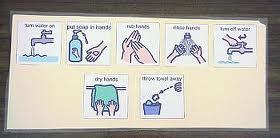
*Visual supports such as task strips, social stories, picture schedules and video modeling:
task strip
*First-then visual or app to remind student what they are working for:
first then

first then app
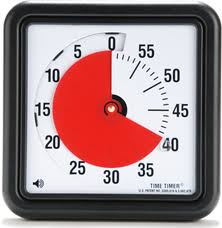
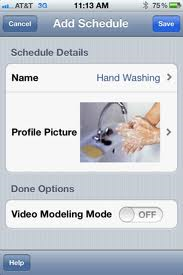
*Timed Timer clock or app and Picture Scheduler app:

timed timer

picture schedule app
*Physical prompting-teacher may do hand over hand to teach a school and fade back to just pointing to direct student.

*Guiding student with visual cues (putting stickers on washcloths to teach folding sequence, sprinkle hole punch paper dots on floor to teach vacuuming, using counting templates, etc…)

Nick packaging door knobs_Habitat_4 (2)

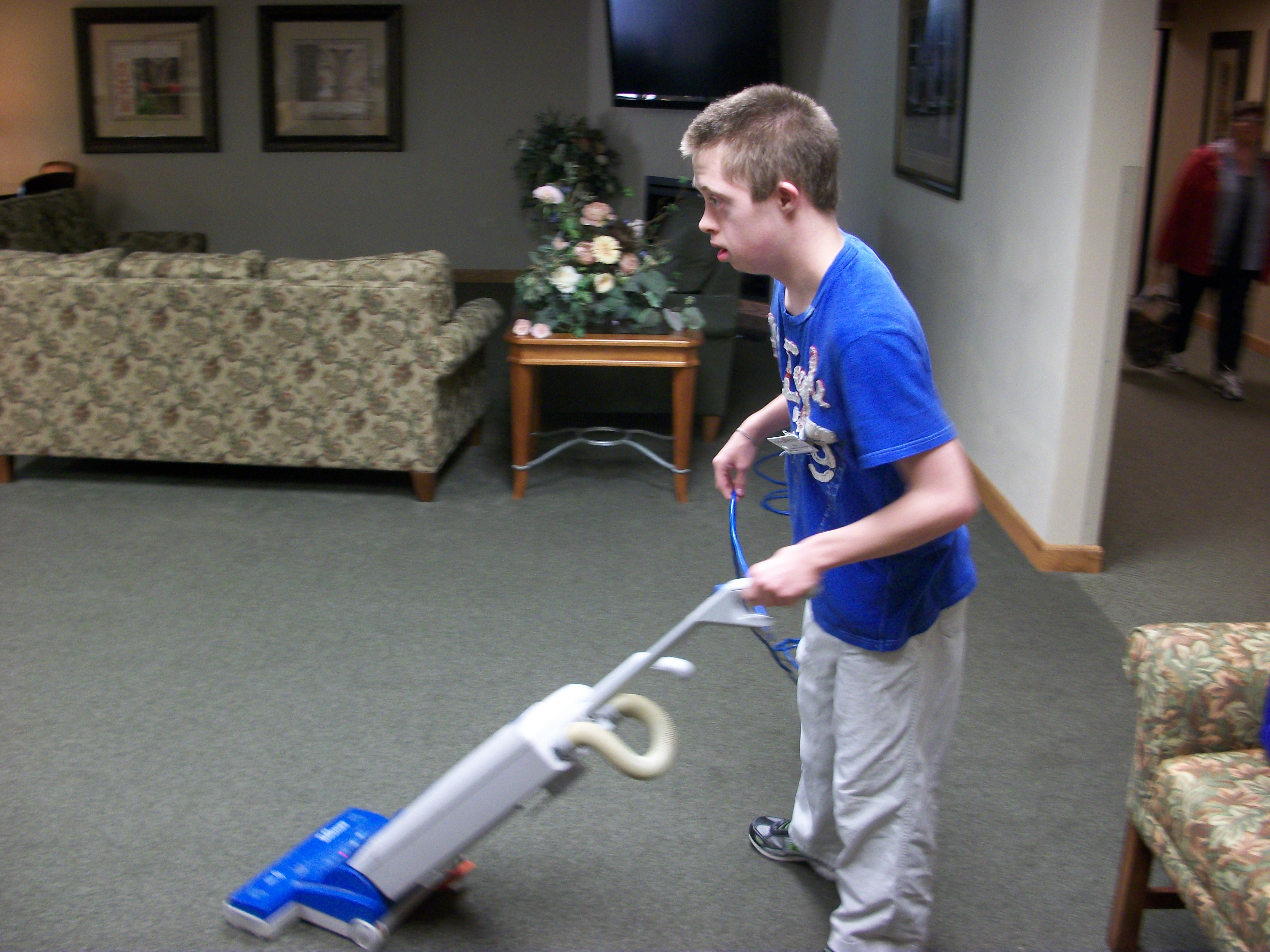
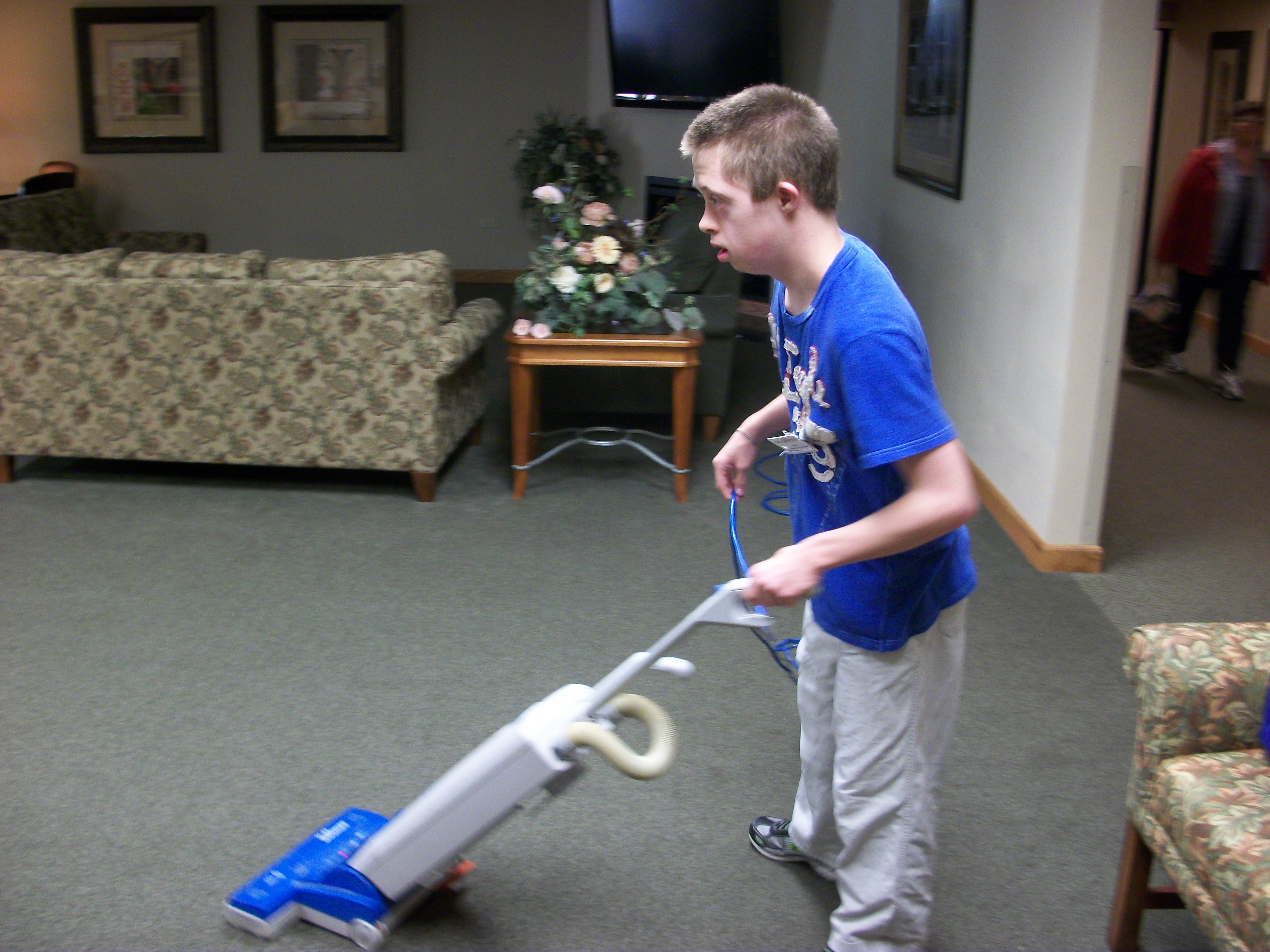
For students with autism, if they can see it…. they can understand it. In Blog #5~Ready, Set, Action (located in April 2012 Archives) I wrote about how successful video modeling was in teaching Nick skills around the house. He responds to and is motivated by seeing the footage in a video format. It also landed him a community job at a local elder residence care facility.

Nick hard at work 🙂
Nick vacumming_Tabor Hills (3).

Nick takes great pride in his jobs both in the community, school and at home. We continue to work on the skills needed for him to be as independent in all areas of his life so he is ready to manage things when he is finished with school. It’s all about starting early and teaching to 21! That’s what is in my noggin this week. 🙂

~Teresa

Follow Nick on Social Media:

Facebook and Pinterest @Down Syndrome With A Slice Of Autism

Instagram @nickdsautism

Twitter @tjunnerstall

Posted in Autism, Fun Side of Nick

Update~ Under Construction Part II

under construction
Update~ Under Construction Part II

We survived “Carpet-Palooza” last week.  It was a long day and I felt like a giant Swiffer dust rag when it all wrapped up shortly after 7pm.  Last June, in Blog #59~The Sleuth Detective, I wrote about things that just disappeared into a black hole around the house.  I do have some good news of some recovered items!

black hole

Two Nick’s iPods were recovered from the deep recesses 🙂 Oh and a bunch of toys that our cat, Miss Mellie had batted around and got trapped behind the settee in the dining room.

Now you see why I felt like a giant Swiffer cloth 🙂

IMG950314

Nick got home from school and saw the mayhem, his first reaction was to say, “Wow!”

IMG950319

The foreman of the Lowes carpet crew took one look at Nick and said, “I remember, doing this house now.” (He had done the basement after the reconstruction from the flooding in April.) I wasn’t surprised, Nick can leave a lasting impression.

Nick squeezed his way into the kitchen and was delighted to see all the treasures that had been buried…….

IMG950316

As I continued to clean up the silk plants that pretty much serve the function of being dust catchers, I caught Nick out of the corner of my eye.  He was throwing the cat toys at the carpet crew.  As my friend, Kendra put it, “Nothing says welcome to my crib like getting hit upside the head with a cat toy.”  As I mentioned, Nick can leave a lasting impression. Down syndrome and autism can be so much fun! 🙂  The Lowes carpet crew had a good laugh and appreciated his lively spirit.

The day rolled out nicely and the carpet looks wonderful!  Here’s Nick’s crib, it looks brand new……

IMG950324

I am slowly peeling away through the boxes that I had to shove into the guest bathroom and out in the garage.  They are filled with the breakables, knick knacks and all the stuff that was on the closet floors. I’m taking it one box at a time and will be making my third trip to AMVETS with donations.  The silver lining; getting new carpeting does make you organize and clean out unwanted items.  Speaking of AMVETS, here’s to our brave veterans today!

veterans day

That’s what is in my noggin this week.  Stay tuned for next week’s topic about communication and social skills as it relates to autism! 🙂

~Teresa

Posted in Autism

Update~ Under Construction

Update~ Under Construction

under construction

It all started with the heavy rains earlier this spring which lead to flooding in the basement.

photo (5)

The basement is put back together and looking pristine with fresh paint and carpeting.  But guess what?  Now I want the rest of the house done.  Twelve years and two boys can really beat up a house. Nick’s autism and raging meltdowns have put a lot of dents in the walls.  Both of their rooms have seen better days.

The ugly side of autism….Nick use to hurl all kinds of stuff at his bedroom wall.  Here it is all patched up…….

photo (16)

Next stop, fresh paint in the boys rooms followed by the new carpet installation in the rest of the house.  I think I just opened up a huge *can of worms!  🙂

can of worms

I have three days to get all of the knick knacks and breakables packed up and clean out the bottom of all the closets in preparation for the carpet installation. Oh, and there is the sitting room…..one corner stacked with clutter, ughhhh. This area could be featured on the show “Hoarders”.

In the words of Scarlett O’Hara, “I’ll think about that tomorrow.

Scarlet o'Hara

My sister in law, Ali saved the day bringing me boxes, wrap and wine!  Thanks dear Ali for all of this and helping me haul the heavy boxes of china, stemware and crystal that I packed up over the weekend out to the garage.  Home renovation is one sure fire way to get rid of clutter and organize.  🙂

Stay tuned for more about Nick’s world after this construction site gets completed!  That’s what is in my noggin today. 🙂

~Teresa

*Open up a can of worms idiom~

According to Wiki.answers and Wise geek: “To open a can of worms” usually means to bring a new set of distracting complications and difficulties to a discussion or a problem. As a “can of worms” is a wriggly mass of confusion, a topic may have many detailed and involved aspects, whether you realize them or not.

Metaphorically speaking, to open a can of worms means to inadvertently create numerous new problems while trying to solve one. Experts disagree on the origin of the phrase, but it is generally believed to be a Canadian or American metaphor coined sometime in the 1950s. Bait stores routinely sold cans of worms and other popular live baits to fishermen, who often discovered how easy it was to open them and how difficult it was to close them. Once the worms discovered an opportunity to escape, it became nearly impossible to keep them contained.

Posted in Down syndrome

Blog #73~ Feeding Issues and Down Syndrome

Blog #73~ Feeding Issues and Down Syndrome

Last week I wrote about Down syndrome and low muscle tone.  Not only does it affect gross motor areas of development but also oral motor and speech as well.

There are studies that have suggested these factors contribute to feeding problems in infants with Down syndrome: 

“The problem lies in strength, mobility and range of motion of oral muscles.  (Kumin, Goodman & Councill, 1991) This can result in weak sucking, swallowing, lip closure, and tongue protrusion (Pilcher, 1998; Kumin, 1994), and gastroesophageal reflux (McCurtin, 1997). The combination of reduced oral space and limited control also contribute to feeding problems in infants with Down syndrome. Due to a small oral cavity and midfacial hypoplasia, the infant’s lips appear thin, the palate is usually flatter with a high arch in the midline and the nasal passages are narrowed. The combination of reduced oral space and low muscle tone can result in tongue protrusion.”  For more information: www.down-syndrome.org.

Development of oral motor skills improve the progression in feeding:

*Breast milk or formula

*Pureed foods

*Table Foods

*Skills for sucking a nipple

*Usage of utensils (straws, cups, spoons, forks)

Nick certainly had his own struggles in this area.  At three years old, he was still eating concoctions of pureed and mashed up vegetables, fruits and still blended in baby cereal that resembled gruel.  You didn’t dare introduce food with any lumps that he could gag or choke on.  We enlisted a speech pathologist that specialized in oral motor feeding that included an intense treatment to address these problems.

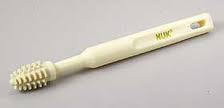
The technique used by the specialist was, “Beckman Oral Motor Intervention” http://www.beckmanoralmotor.comMake sure that you consult with a speech pathologist who specializes in oral motor therapy and has been trained in this area.  The essence of the program is to get the muscles firing both around the lips and inside the mouth. First, the muscles around the upper and lower lips were stretched.  This followed with gum massage to stimulate the mouth and stretches inside the cheeks.  All of this would wake up the mouth and move to the next step of resistive chewing.  Nick started with a Nuk Brush for this.

nuk brush

The specialist insisted on doing these techniques on me.  I was amazed at how alive and tingly my mouth felt afterwards.  She also taught me how to do them on Nick.  Consistency is the key to building strength when embarking on this program.

As I mentioned last week, Nick was very delayed in his gross motor development. Because his trunk was so weak, he sat slumped.  This affected his ability to chew and swallow.  A co-treatment plan of therapy helped to escalate Nick’s progress.  After Nick did the Beckman exercises, the occupational therapist would work  alongside placing a nubby rubber cushion under Nick to help build up his abdominal and back strength.

nubby therapy cushion

She placed her hands on his trunk manipulating his shoulders to maintain integrity while biting exercises were performed.  The feeding specialist pulled out all sorts of foods like Cheerios, goldfish, graham crackers, and sour gummy worms and wrapped them in gauze.  Then she placed them one at a time in his mouth, and he would bite down.  The gauze acted like a safety net to keep him from gagging or choking.  In less than a year, Nick was able to chew and swallow textured foods safely and his trunk became strong enough for him to be able to walk at age 3 ½.

I never thought I’d see the day when Nick could eat crunchy foods 🙂

Scan0014

Nick has come a long way since those days of sitting slump, gagging on food.  I am forever grateful to all of the therapists who have made him strong over the years and continue to help him grow.  He is a force to contend with in the world.  Last week he managed to pull yet another fire alarm at school.

Oh no, not again….. Tally now 30 alarm pulls…..

firelite-pull-station

October and Down Syndrome Awareness Month is almost over.  I hope you have gained some knowledge about Down syndrome in this month’s blogs.  It’s been one heck of a journey raising Nick, but all four burners are going now.  That’s what is in my noggin this week. 🙂

~Teresa

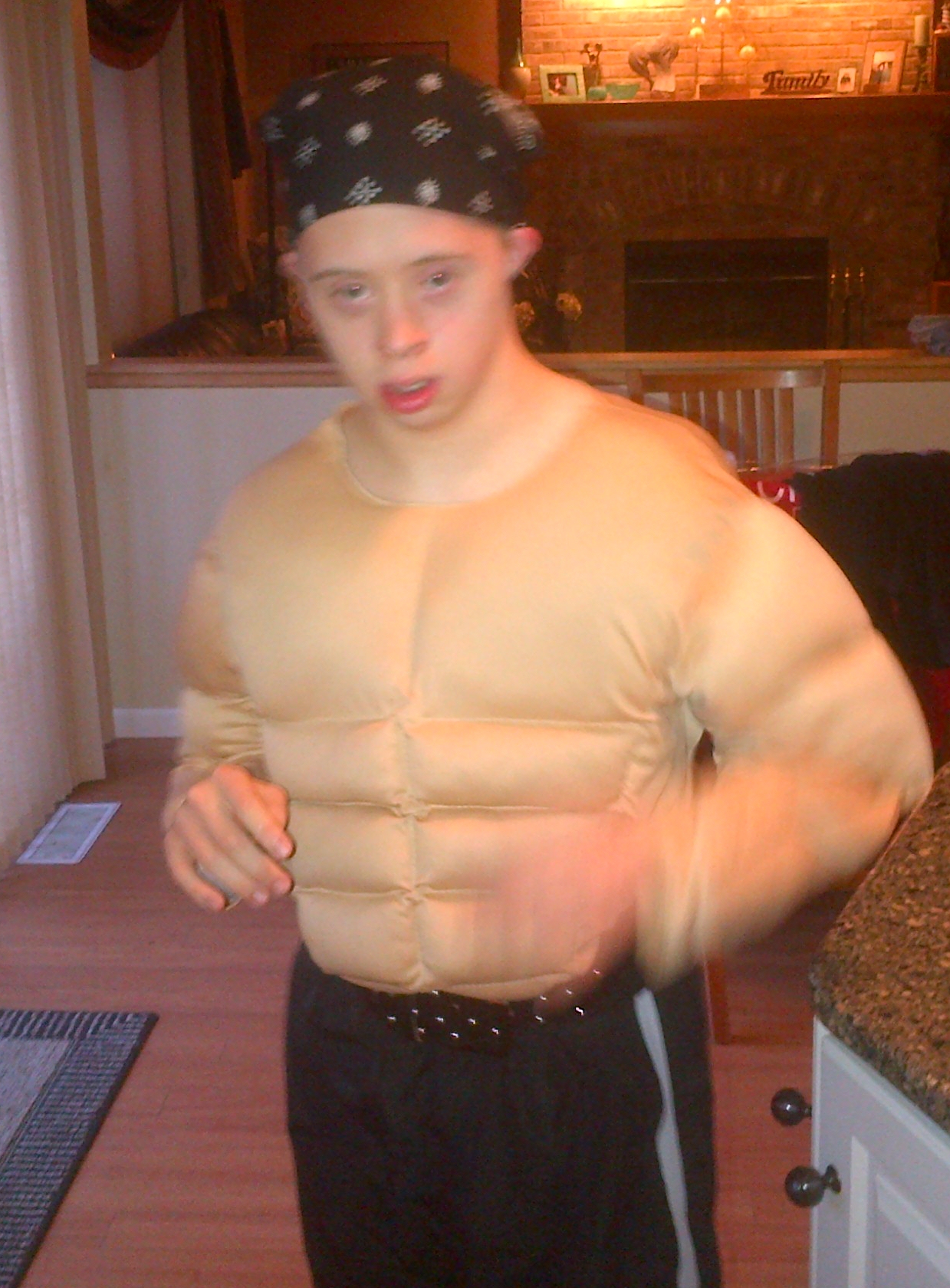
Big guy overcame low muscle tone!  More Halloween costume pictures over the years are located in the October 2012 archives. 🙂

IMG-20121027-00112

Posted in Down syndrome, Physical Therapy and Special Needs

Blog #72~Down Syndrome and Low Muscle Tone

Blog #72~Down Syndrome and Low Muscle Tone

October is Down Syndrome Awareness Month.  In Blog #26, located in the October 2012 archives, there is a complete overview about Down syndrome.

DSAwarenessMagnet

This week I want to put a lens on one of the physical traits of having Down syndrome.  Hypotonia, or low muscle tone is common in almost all babies with Down syndrome.  The appearance is floppy and the muscles are flaccid. As soon as I touched my son Nick after he was born, I could feel this.  He felt like a rag doll.

The good news is that hypotonia generally improves over time with early intervention and physical therapy.   Within eight weeks, we met with the early infant intervention team and began the work to confront his low muscle tone.  Right away, we were instructed to roll up blankets and stuff them on either side of Nick when he was sitting in his carrier.  Since the muscles are so floppy, there is a tendency for the limbs to dangle open.  We then started from the top and worked down.  The first step was to get the neck strong.  We incorporated a lot of tummy time providing lots of bright, colorful, and contrasting toys that would be stimulating.  His brother Hank helped out by pushing the buttons on musical toys so that Nick would lift his head up.  This would help develop more alertness as under arousal is typical for babies having Down syndrome.

Everything is ready for tummy time, look at that scrawny baby 🙂 …….

Scan0011

Once he was able to support his head, the early infant team began to work on building strength in his trunk.  At first he had to be held at the shoulders while sitting on a play ball.  The facilitator would lead the group with songs and blowing bubbles.  The babies would both track the bubbles and try to pop them with their fingers.  Gradually, the therapist was able to hold Nick at the chest, and after several months hold his waist while he worked on the ball. The physical therapist told us that Nick would not be able to pull up to stand or walk until his core was strong.  This meant when he could sit on the ball supported with her hands down on his hips. This took a very long time for Nick.

We propped up pillows in his high chair so he would flop over to the side. His brother Hank, keeping him entertained…….

Scan0010

A special chair was provided by the early infant intervention program.  Nick’s trunk was still weak and he had a lot of trouble sitting upright…….

Scan0008

Take a look at the average gross motor milestones:

Sitting alone-

Typical age 5-9 months

Down syndrome 6-30 months

Nick 22 months

Crawling-

Typical age 6-12 months

Down syndrome 8-22 months

Nick 28 months

Walking-

Typical age 9-18 months

Down syndrome 1-4 years old

Nick 3 ½ years old

As you can see, Nick’s low muscle tone affected his development in all of these gross motor areas.  After his first birthday, the physical therapist suggested we try doing horseback riding therapy with Nick. He was the youngest person they had ever tried at this facility.   We made the trek out to Tomball, Texas for these sessions for over a year.  Nick gained a lot of trunk strength during this time.  Keep in mind, not only were the muscles weak but also had less endurance.  Doing the sessions on the horse helped with increasing his endurance and the sensory input was very stimulating.

Giddy up Nick……

Scan0009

After a year of hard work, he finally sat on his own!  Nick with his cousin, Austin

Scan0012

Once Nick was able to sit up and crawl we began to find creative ways to get him up on his feet.  Hank would often dangle his favorite musical toy at the top of the bean bag chair.  As the music blared and lights flashed, Nick would climb up the makeshift mountain to reach the toy.  Around this time, I also began redecorating the living room.  I mounted several musical toys above the fire place so if he wanted to get to them, he had to pull up to stand.  His brother also enticed him, bouncing ping pong balls on the coffee table.  He would crawl over, pull up, play and laugh with Hank.

It was a long, slow rode to get him up and walking.  Nick had to work a lot harder to build his strength, endurance, alertness to defy the effects of low muscle tone and under arousal.  Hard work always pays off, and gets you to the top of the podium!

Nick in Middle School, brings home the gold 🙂

scan0011

That’s what is in my noggin this week!

~Teresa

Posted in Down syndrome

Blog #71~Down Syndrome Diagnosis…Have No Fear

Blog #71~ Down Syndrome Diagnosis….Have No Fear

October as everyone knows is Breast Cancer Awareness month.  It is also Down Syndrome Awareness Month.  Last year in Blog #26, located in the October 2012 archives, I did a full piece on Down syndrome awareness. Click here to check it out:  https://nickspecialneeds.wordpress.com/2012/10/15/blog-26-down-s…wareness-

This year I am taking a different route.  What happens to a parent when they find out that their child may have Down syndrome?  One feeling that evokes the mind immediately is fear.  The unknown tends arouse worry and anxiety.  Nineteen years ago when my son Nick was born the doctor told us he had several markers that suggested he might have Down syndrome.  Three days later, the chromosome test came back to confirm he did.  In 1994, there were no laptops or smart phones to quickly Google “Down syndrome” and great websites like http://noahsdad.com to ease my worries.   I was handed two brochures by the hospital administrator, that’s it.  There were so many questions in my mind.  How was my life going to change?  What would my son’s life look like?  I wonder what that crystal ball would have revealed?

crystal ball

Here are 5 things that I wish that crystal ball could have illuminated about having a child who has Down syndrome……….

1.  Don’t worry about giving up your life.  You will still be able to work, go out with your friends and take your son with you everywhere, even overseas vacations.

Nick Kiss

2.  You will meet many people who will show you how to navigate this new path and teach you about courage along the way. They will be educators, therapists, specialists, advocates and other parents who will light the lanterns and guide you and help your son learn and grow.

3.  Trust that all those milestones you are worried about like eating, talking, sitting up, crawling, walking and toileting will be met. Yes, eventually he will make it out of Pull-ups and Depends though this may test your limits. 🙂 Hitting these milestones may take a lot more time but when he does it will be glorious and sweetly savored.

extra chromosome extra cute

4.  Your son will teach you what pure, unconditional love is.  He will wake you up with a light in his eyes each morning. He will share a great sense of humor that will warm your heart and the hearts of many.

006

5.  One day your son will make you proud because he will be eager to work hard.  He will take great pride in the jobs he does both around the house and in the community. Unlike most of us he will enjoy vacuuming, laundry and unloading the dishwasher. 🙂  Yes, there will be some things he may not be able to do. But other times he will surprise you.  Just be patient and let God take him down the path that fits him.

Nick vacumming_Tabor Hills (3)

Those are the 5 things I wish that I’d known when faced with the diagnosis of my child having Down syndrome.   So, I tap all the moms on the shoulder that might be dealing with the birth of a child who has Down syndrome and say this…. “It’s going to be okay, relax and have no fear.”

keep calm extra chromosome

That’s what is in my noggin this week. 🙂

~Teresa

Posted in Fun Side of Nick

Nick Updates

Nick Updates…….

Nick got a bad stomach bug last weekend which made it’s way through the family.  We are all feeling much better now and look forward to sharing more with you on Monday!

Last week Nick finally got the staff at the new post-secondary transition program he is in (STEPS).  Quite frankly I am surprised they made it a whole month before he beat them to it!

firelite-pull-station

TALLY COUNT=29 Fire alarm pulls since 3rd grade

Thank you to everyone who hits the like and share buttons on Facebook and the book drawing winner is……

drum roll

Michelle Villa, congrats!

down syndrome and autism intersect

Have a great weekend and see you all on Monday!

~Teresa 🙂

Posted in Autism, Behavior/ ABA, Down syndrome

Blog #70~When Down Syndrome and Autism Intersect

Blog #70~When Down Syndrome and Autism Intersect

 
I just finished reading the Woodbine House book, When Down Syndrome and Autism Intersect, A Guide to DS-ASD for Parents and Professionals. As always, Woodbine House delivers the goods. I only wish this book had been available fifteen years ago when I began to suspect that Nick had something more going on than just Down syndrome.

down syndrome and autism intersect

I started to notice little things at first. Around the age of five Nick started to bang objects and exhibit other odd behaviors. After doing some internet research I stumbled upon a sensory processing disorder checklist. Nick met many of the criteria which led me to believe this was the reason for those behaviors. When we attended the local Down syndrome support group functions I also felt that he didn’t speak as well as his peers.

Nick is more interested in his hand flapping than Santa 🙂
scan0032
So, I went to have an evaluation done to see if he might have autism. The results of this indicated that Nick did not have autism as he was highly social and his language deficits were a result of having verbal apraxia of speech. For more information on verbal apraxia of speech I would suggest reading this Woodbine House book, Speaking of Apraxia A Parent’s Guide to Childhood Apraxia of Speech:

SOA_mock (2)

Six years passed and as puberty was full on, Nick’s behavior and meltdowns became more violent and dangerous. The staff at his school struggled along as well. It was nagging at me. I brought up my concerns and the need for an evaluation for autism. The staff informed me that this was not necessary as there was already a primary evaluation of Down syndrome. We decided to have an independent evaluation done at Little Friends Center for Autism, http://www.littlefriendsinc.org. Getting the official diagnosis of autism confirmed my suspicions and gave me a sense of relief and validation. Most importantly, the formal diagnosis allowed for getting the services of the school district’s autism specialist. This specialist helped to identify what triggers set off meltdowns and was able to put a behavior plan in place along with a better picture communication system with proper training for the staff and myself.

Nick age 12, proudly stands on the podium winning the state gold medal in the softball throw at the Special Olympics…

scan0011

 
According to the Kennedy Krieger Institute, http:// www.kennedykrieger.org,  around 10-15 percent of children with Down syndrome also have autism.

For an autism diagnosis there are three areas of development that a person must show significant difficulties:

1. Social Functioning
2. Non-verbal or difficulties with communication
3. Restricted interests and activities

Some of the symptoms and behavior shown with children having Down syndrome and autism are:

 
*Significant lack of social response
*Difficulties with communication and reported loss of verbal and expressive language.
*Repetitive behaviors like hand flapping, spinning or rocking, fixation on inanimate objects (strings, fans, mirrors, water, etc..)
*Sensory issues including the intensified sensitivity or need for more sensory input
*Behavioral challenges including frequent tantrums and physical violence

 
The book, When Down Syndrome and Autism Intersect contains a great deal of information on health issues and gives practical information on tackling the complex world of raising a child with Down syndrome and autism. My best advice is this, if you suspect that a child with Down syndrome has something else going on then run; don’t walk to get a firm diagnosis. There are more services that become available to help with challenging behaviors, communication and learning for our kids. That’s what is in my noggin this week! 🙂
~Teresa

Posted in Augmentative and Alternative Communication (AAC), Autism, Down syndrome, Speech and Occupational Therapy

Blog #69~Down Syndrome, Autism and Speech

Blog #69~Down Syndrome, Autism and Speech

I am often asked about Nick’s ability to produce words given the fact that he has Down syndrome and autism.  He does have a vocabulary including a few expletives that he picked up from us somewhere along the way. I find it interesting how he can say those words pitch perfectly.  This week I have a very special guest blogger.  Brian Sabella is Nick’s speech therapist and shares his perspective on working with Nick at Suburban Pediatric Therapies:  

Speech-Language Therapy and Nick

By Brian Sabella, CCC-SLP

I have been providing clinic-based speech-language therapy for Nick for over four years now. I feel fortunate for the experience for a couple reasons. First and foremost, he absolutely cracks me up—every week. There’s something about his brand of adolescent, slapstick humor that just resonates with me as a fellow male. Additionally, Nick’s family and support system are a pleasure to work with. They hold very high expectations of his communication abilities and understand communication takes other forms besides the spoken word. Nick uses a multifaceted system that includes spoken words, printed pictures, and electronic devices to communicate throughout his day. And as a speech therapist, I love it. For Nick, progress in “speech” means being able to communicate more effectively; it isn’t just about talking!

For those curious about the speech Nick does work on, here is a sample of some words we have practiced and continue to practice: help, Sprite, plate, shower, taco, pasta. With many of these words, Nick is not expected to articulate them exactly as you or I would, but rather, to produce them in a way that a listener would be more likely to understand. The idea is that Nick will probably be handing his conversational partner a picture of a taco anyway, so the spoken word is meant to enhance the communicative exchange. With this specific word, Nick will often produce aco, omitting the t. During our drill practice, I will call attention to my mouth and ask Nick to say it like I do, annunciating that missing t  sound and providing a visual cue (such as pointing near the area of my mouth where the sound is produced). After a correct production is established, Nick is encouraged to say it again a total of five times. Performing a high number of repetitions is always the best way to learn a new movement pattern, whether that movement is a golf swing, a pencil stroke, or a spoken word. Admittedly, speech drill is not one of Nick’s favorite things to do, so his good efforts are always rewarded with a bit of praise or even a small morsel of food.  You know, just to stay on his good side.

Most of my time spent with Nick in therapy hasn’t actually been focused on improving his speech. Some of it has. But I’m actually more concerned with improving Nick’s ability to communicate through other means. The reason for this is because, like many other individuals on the autism spectrum, Nick shows a strong preference for pictures.  He also presents with apraxia of speech, which further complicates matters. This is why at home and at school, Nick’s uses a picture exchange system that helps him communicate during everyday activities.

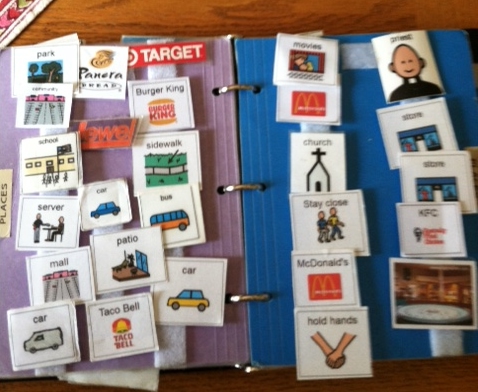
Teresa carries around with her a set of pictures of Nick’s favorite fast food restaurants.  When they are out running errands and it’s time for lunch, she shows Nick the pictures and he points to the logo of the restaurant he’s in the mood for. If he requests Taco Bell (which he usually does) he can then flip to a page that shows pictures of their menu items and he can indicate which ones he wants to order. Much of our time in speech therapy has been spent working on expanding his comprehension and use of these pictures.

photo (123)

Then there’s the Bored Board. As readers of this blog, you know that when Nick is bored, he finds ways of wreaking havoc in extremely creative ways. Picking up on these signs of boredom before Nick decides to dump fajita seasoning on the cat or spill an entire bottle of cooking oil on the floor will allow his parents to redirect these behaviors to something less destructive. The Board Bored shows Nick pictures of more appropriate objects and activities to request: DVDs, computer games, an iPod, a whoopee cushion, Flarp noise putty, a (fake) bloody Halloween hand, a sound effects toy that makes burping and glass-breaking sounds, etc.  Nick and I have spent hours working on requesting with the Bored Board so that he can more effectively use it in a time of need.

0916091611

Recently, our sessions have been focusing on having Nick formulate requests using “I want.”  We set up a board using an alternative-augmentative communication (AAC) iPad app called Proloquo2Go. It transforms the iPad, iPhone, or iPod Touch into a high-tech voice output device that helps a person communicate by typing or touching pictures. Nick’s screen displays a variety of preferred snacks and some phrases, including “I want.” Our goal was to have Nick indicate which snack he wanted by pressing “I want” then the snack item.  When he does this, the device speaks the sentence “I want popcorn;” I then reward him with some popcorn.  If Nick only touches the snack item without “I want” first, then I prompt him to press both.
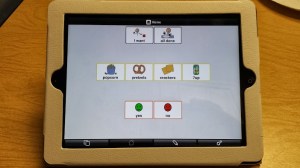
Proloquo2Go

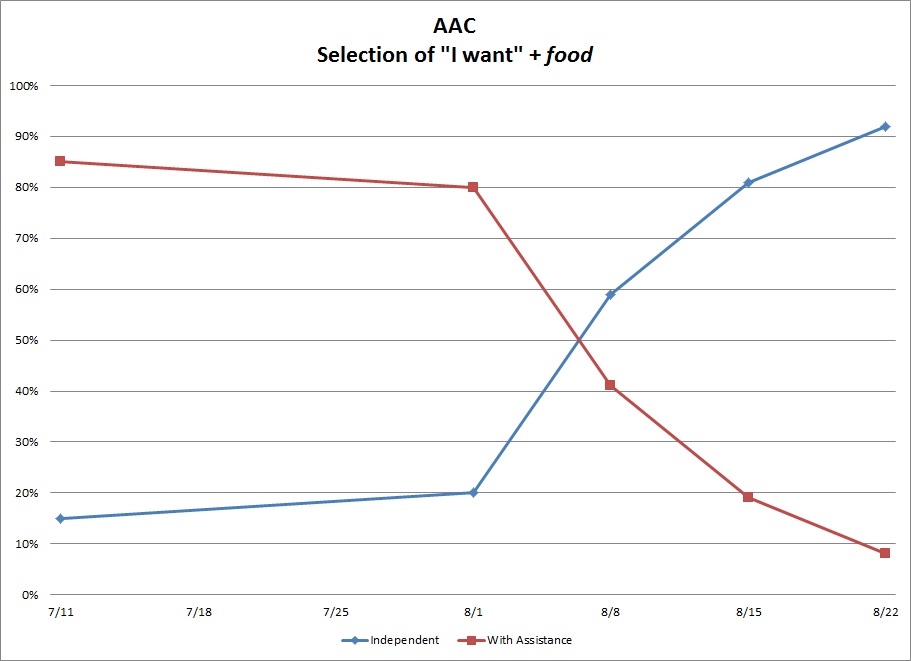
As you might imagine, producing these sentences was initially difficult for Nick.  But over time, he became very good at producing them.  This graph tracks his progress and shows that Nick went from almost always needing support to produce these “I want” requests to, after five sessions, almost always producing them independently.

Graph

As you can see, speech therapy is not always about speech.  For Nick, speech therapy is about helping him communicate effectively, even if it means doing so with pictures or electronic devices. With an alternative system of communication in place, Nick’s life is a little easier.  And his pets are a little safer, too.

Brian Sabella and Nick working at Suburban Pediatric Therapies 🙂 ……
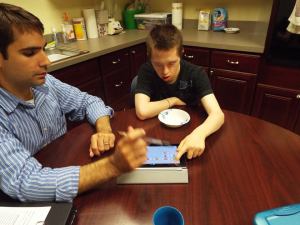
Brian and Nick

Special thanks to Brian Sabella, CCC-SLP for sharing his insights this week.  For more about Suburban Pediatric Therapies check out their website at http://www.sptherapies.com.  As you can see there is much more to communication then just speaking words.  That’s what is in my noggin this week. 🙂

~Teresa

Follow Nick on Social Media:

Facebook and Pinterest @Down Syndrome With A Slice Of Autism

Instagram @nickdsautism

Twitter @tjunnerstall