Wandering and Autism: 7 Prevention Strategies
April is National Autism Awareness Month. According to the National Autism Association, “Nearly half of children with autism engage in wandering behavior. Wandering occurs across all settings, under every type of adult supervision”.

There are safety precautions and prevention strategies families can put in place to secure a child that may run, bolt or wander. I’ve had a few scares with my son over the years. My son Nick is 25 years old and has a dual diagnosis of Down syndrome and autism (DS-ASD). Nick has no concept of the danger, and he can be fast; so we are always on high alert both at home and in the community.
A few years back, I wrote a blog addressing elopement which includes 7 prevention strategies. Here is our story of a scary day when Nick went missing, and what we’ve put in place to avoid wandering since then.
Click to read 7 Prevention Strategies for Wandering and Autism: https://nickspecialneeds.com/2013/07/01/blog-60wandering-and-autism/
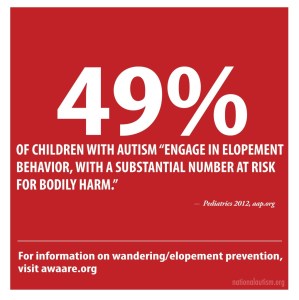
Wandering is a real risk for individuals with autism and other special needs. Putting a plan with prevention strategies in place at home, school and in the community can reduce the risk of your child to elope and provide security for you as a family. That’s what is in my noggin this week.
~Teresa 🙂
Follow Nick:
Facebook and Pinterest @Down Syndrome With a Slice Of Autism
Instagram #nickdsautism
Twitter @tjunnerstall



 “Based on personal experience, Grandin advocates early intervention to address autism and supportive teachers, who can direct fixations of the child with autism in fruitful directions. She has described her hypersensitivity to noise and other sensory stimuli. She claims she is a primarily visual thinker, and has said that words are her second language. Temple attributes her success as a humane livestock facility designer to her ability to recall detail, which is a characteristic of her visual memory. Grandin compares her memory to full-length movies in her head, that may be replayed at will, allowing her to notice small details. She also is able to view her memories using slightly different contexts by changing the positions of the lighting and shadows. Her insight into the minds of cattle has taught her to value the changes in details to which animals are particularly sensitive and to use her visualization skills to design thoughtful and humane animal-handling equipment.” (Wikipedia)
 Down Syndrome with a Slice of Autism