Posted in Augmentative and Alternative Communication (AAC), Autism, Down syndrome, Speech and Occupational Therapy

Blog #69~Down Syndrome, Autism and Speech

Blog #69~Down Syndrome, Autism and Speech

I am often asked about Nick’s ability to produce words given the fact that he has Down syndrome and autism.  He does have a vocabulary including a few expletives that he picked up from us somewhere along the way. I find it interesting how he can say those words pitch perfectly.  This week I have a very special guest blogger.  Brian Sabella is Nick’s speech therapist and shares his perspective on working with Nick at Suburban Pediatric Therapies:  

Speech-Language Therapy and Nick

By Brian Sabella, CCC-SLP

I have been providing clinic-based speech-language therapy for Nick for over four years now. I feel fortunate for the experience for a couple reasons. First and foremost, he absolutely cracks me up—every week. There’s something about his brand of adolescent, slapstick humor that just resonates with me as a fellow male. Additionally, Nick’s family and support system are a pleasure to work with. They hold very high expectations of his communication abilities and understand communication takes other forms besides the spoken word. Nick uses a multifaceted system that includes spoken words, printed pictures, and electronic devices to communicate throughout his day. And as a speech therapist, I love it. For Nick, progress in “speech” means being able to communicate more effectively; it isn’t just about talking!

For those curious about the speech Nick does work on, here is a sample of some words we have practiced and continue to practice: help, Sprite, plate, shower, taco, pasta. With many of these words, Nick is not expected to articulate them exactly as you or I would, but rather, to produce them in a way that a listener would be more likely to understand. The idea is that Nick will probably be handing his conversational partner a picture of a taco anyway, so the spoken word is meant to enhance the communicative exchange. With this specific word, Nick will often produce aco, omitting the t. During our drill practice, I will call attention to my mouth and ask Nick to say it like I do, annunciating that missing t  sound and providing a visual cue (such as pointing near the area of my mouth where the sound is produced). After a correct production is established, Nick is encouraged to say it again a total of five times. Performing a high number of repetitions is always the best way to learn a new movement pattern, whether that movement is a golf swing, a pencil stroke, or a spoken word. Admittedly, speech drill is not one of Nick’s favorite things to do, so his good efforts are always rewarded with a bit of praise or even a small morsel of food.  You know, just to stay on his good side.

Most of my time spent with Nick in therapy hasn’t actually been focused on improving his speech. Some of it has. But I’m actually more concerned with improving Nick’s ability to communicate through other means. The reason for this is because, like many other individuals on the autism spectrum, Nick shows a strong preference for pictures.  He also presents with apraxia of speech, which further complicates matters. This is why at home and at school, Nick’s uses a picture exchange system that helps him communicate during everyday activities.

Teresa carries around with her a set of pictures of Nick’s favorite fast food restaurants.  When they are out running errands and it’s time for lunch, she shows Nick the pictures and he points to the logo of the restaurant he’s in the mood for. If he requests Taco Bell (which he usually does) he can then flip to a page that shows pictures of their menu items and he can indicate which ones he wants to order. Much of our time in speech therapy has been spent working on expanding his comprehension and use of these pictures.
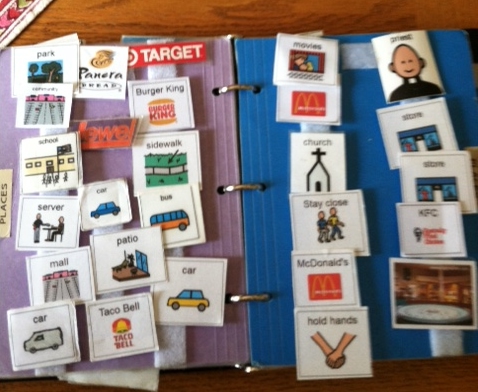
photo (123)

Then there’s the Bored Board. As readers of this blog, you know that when Nick is bored, he finds ways of wreaking havoc in extremely creative ways. Picking up on these signs of boredom before Nick decides to dump fajita seasoning on the cat or spill an entire bottle of cooking oil on the floor will allow his parents to redirect these behaviors to something less destructive. The Board Bored shows Nick pictures of more appropriate objects and activities to request: DVDs, computer games, an iPod, a whoopee cushion, Flarp noise putty, a (fake) bloody Halloween hand, a sound effects toy that makes burping and glass-breaking sounds, etc.  Nick and I have spent hours working on requesting with the Bored Board so that he can more effectively use it in a time of need.

0916091611

Recently, our sessions have been focusing on having Nick formulate requests using “I want.”  We set up a board using an alternative-augmentative communication (AAC) iPad app called Proloquo2Go. It transforms the iPad, iPhone, or iPod Touch into a high-tech voice output device that helps a person communicate by typing or touching pictures. Nick’s screen displays a variety of preferred snacks and some phrases, including “I want.” Our goal was to have Nick indicate which snack he wanted by pressing “I want” then the snack item.  When he does this, the device speaks the sentence “I want popcorn;” I then reward him with some popcorn.  If Nick only touches the snack item without “I want” first, then I prompt him to press both.

Proloquo2Go

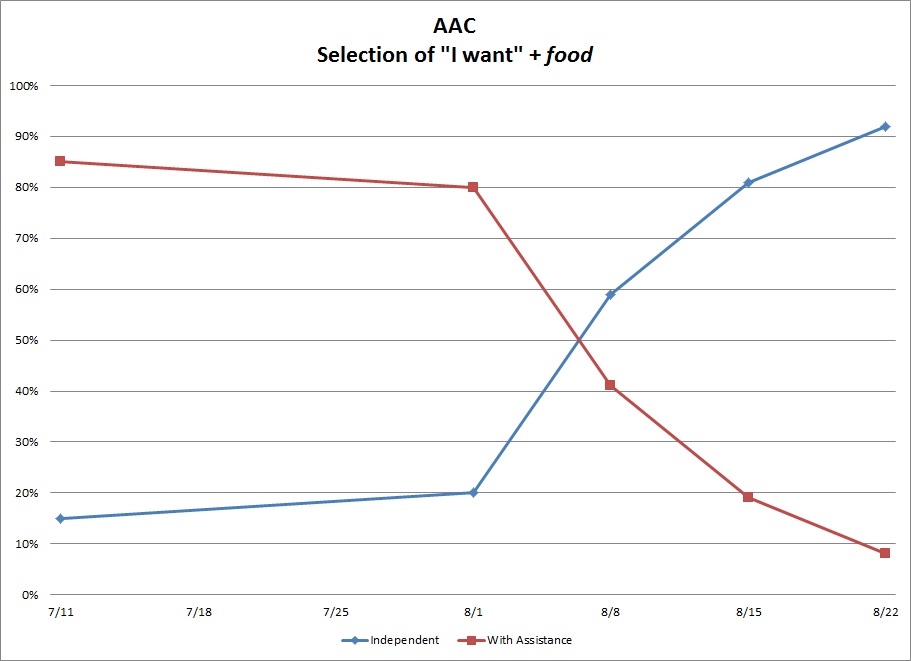
As you might imagine, producing these sentences was initially difficult for Nick.  But over time, he became very good at producing them.  This graph tracks his progress and shows that Nick went from almost always needing support to produce these “I want” requests to, after five sessions, almost always producing them independently.
Graph

As you can see, speech therapy is not always about speech.  For Nick, speech therapy is about helping him communicate effectively, even if it means doing so with pictures or electronic devices. With an alternative system of communication in place, Nick’s life is a little easier.  And his pets are a little safer, too.

Brian Sabella and Nick working at Suburban Pediatric Therapies 🙂 ……

Brian and Nick

Special thanks to Brian Sabella, CCC-SLP for sharing his insights this week.  For more about Suburban Pediatric Therapies check out their website at http://www.sptherapies.com.  As you can see there is much more to communication then just speaking words.  That’s what is in my noggin this week. 🙂

~Teresa

Follow Nick on Social Media:

Facebook and Pinterest @Down Syndrome With A Slice Of Autism

Instagram @nickdsautism

Twitter @tjunnerstall


Posted in Autism, Behavior/ ABA, Down syndrome, Education and Special Needs

Blog #3~DS-ASD, Getting Your Goat

Blog #3~DS-ASD, Getting Your Goat

  • Eggs
  • Celery
  • Balsamic vinegar
  • Olive Oil
  • Parsley
  • Fajita seasoning
  • Merlot
  • Penne pasta noodles
  • Laundry detergent
  • Acne wash
  • Fluoride rinse
  • Shaving cream
  • Whey protein powder
  • Shower gel
  • Hand lotion
  • Baby powder

That’s the short list and I don’t mean grocery list.  It is just some of the stuff that Nick has gotten his hands on and dumped out on the kitchen floor. I wish I could say that I am rewinding to back when Nick was age six.  But this is the here and now; the flavor of the week (or in this case for the last year or so.) Nick is 18 years old with a dual diagnosis of Down syndrome and autism.  This makes for an interesting mix of behaviors.

I have consulted teachers, therapists and behavior specialists in autism.  After they have a good laugh at the list, the conclusion is the same. First, it could be a sensory issue.  Nick seeks out many odd things to look through, tap and stim on and perhaps the act of dribbling out a tube of Mederma skin lotion from the second floor banister is satisfying some sensory need.   The second theory is that Nick is seeking attention and looking for a reaction. All I know that it is very hard to keep your cool when you see a full 64 ounce, Costco size container of olive oil emptied all over the floor. Fortunately I get my paper towels at Costco too. 🙂 I will say that the floor and my knees have a nice sheen to them.  Then there is our  poor cat, Miss Mellie sleeping innocently while Nick sprinkles a half bottle of fajita seasoning all over her gray fur.  Okay, I had to run into the other room and laugh on that one.

Freshly seasoned and washed cat…..

photo (113)

The dumping is just one facet.  Nick is like a toddler putting all kinds of things in the toilet.  A package of pens, my reader glasses, his iPod nano and his Dad’s watch are just a few of the things he’s submersed.  The newest trick is putting your shoes in the sink and running the water faucet full blast.  Here’s the thing.  He commits the crime, runs downstairs pointing up with a grin on his face and says “Uh oh.”  He is always looking to get a response.  It is not easy to keep a poker face during these episodes.  However I look at it like this, Nick is just trying to *”get my goat”.  The goat is a metaphor for a state of calm and peacefulness.  I grit my teeth, make absolutely no eye contact. On a shelf near the kitchen now stands a stack of permanently borrowed, white gym towels.   I point to the pile and he grabs a towel and cleans up.  No reinforcement is given to him.

Better put Mederma on the list…….

Not all the things he does are this messy.  Sometimes they are just plain funny, like a baby doll in the Pierogis….

So how can these inappropriate, attention seeking behaviors be managed?  First, the incidences are documented on what is called a Functional Behavior Assessment (FBA). On the form I record the date and time of the incident. Then follow the ABC’s:

Antecedent= What happened before the behavior

Behavior= The actual behavior and incident that occurred

Consequences= What happened after the incident

After looking at ABC ‘s, one can see if there is a common thread and determine why they might be doing the behavior.  As I mentioned in my very first blog entry, every behavior (even the bad ones) are trying to communicate something.  In some cases, it’s a sensory seeking reason.  Think about it- the sound of an object breaking or sight of a mess spilling or shattering all over the floor is exciting.  In the case of dumping, often it is when a parent is busy around the house, on the phone or trying to get ready to go to work.  It is clear that Nick is bored and seeking our attention while we are busy.  But mostly, I think it is a “control thing” for him.  It is something that HE has power over in his own life.

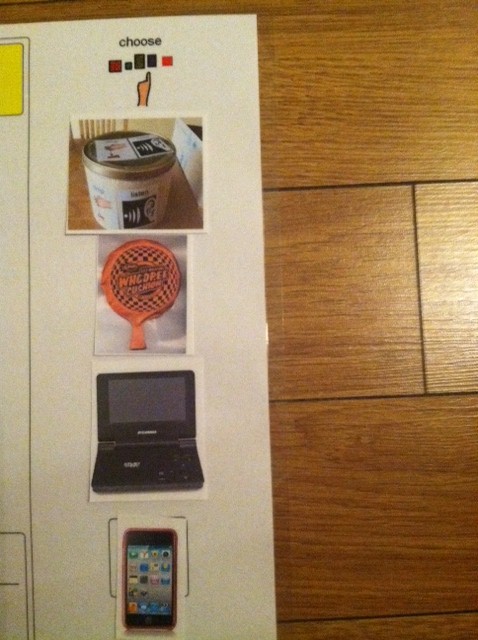
With this information a positive Behavior Support Plan (BSP) can be developed targeting undesirable behaviors.  Look at what possible replacement behaviors could be put in place instead.  This is where the “choice board” comes in.  This board has appropriate choices in the form of icons which he can pick from to better occupy his time. These choices should be highly preferred and stored away, so they are not accessible.  Below is a sample choice board.  The drop box is filled with fun things to throw and dump, followed by the woopie cushion, DVD player and iPod touch:

The final piece will be to add an icon to indicate that the behavior he did was wrong.  If he can see it in visual form, he will understand it.  This is to be done again without eye contact so as not to reinforce the attention he is craving.

Icon to show for inappropriate behaviors:

angry face

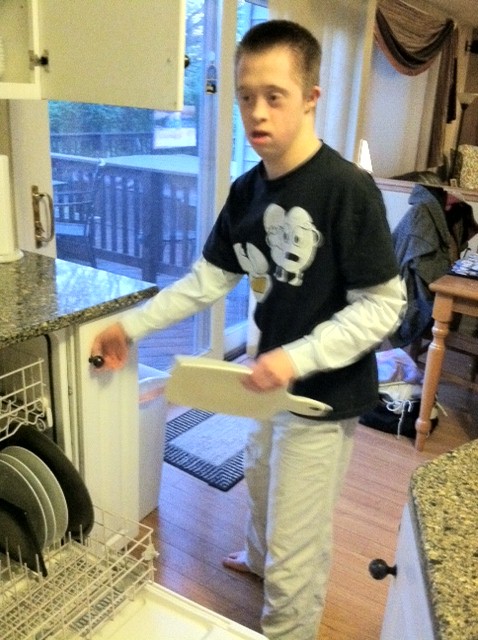
In the meantime, as I put the final touches on this piece, I turn around to see Nick unloading the dishwasher by himself.  This is a something he has complete control over (and is really adept at doing by himself).  I smother him with praise, “Good job big guy, I am so proud of you”.  Catch your child being good and reward them with the positive reinforcement.

Way to go Nick! 🙂

Show the icon for appropriate behavior:

happy face

All of these visual supports need to be done consistently across the board in every venue (home, school and community.) Hopefully with this plan in action, we can cut down on the dumping.  At this point in our lives we shouldn’t be dealing with this type of behavior or having to reinstall safety locks back on all the cabinet doors.  What can I say- It’s Nick’s world, the rest of us are just trying to keep up.  That’s what is in my noggin this week.

Here’s to not letting anyone get your goat*!

~Teresa 🙂

*The expression ‘to get your goat’ has its origins in horse racing. Race horses are very high-strung animals. Goats are often used as companion animals, to keep a horse calm. Someone wanting to fix a race would slip into the barn the night before the race, steal the goat, and then an upset, distracted horse would run a bad race. Hence, if you are upset and not at your best, it is said that ‘someone has gotten your goat.’

Nick age 5 with our next door neighbor goats in Northern California.

Follow Nick on Social Media:

Facebook and Pinterest @Down Syndrome With A Slice Of Autism

Instagram #nickdsautism

Twitter @tjunnerstall