Posted in Adult Day Programs for Special Needs, Autism, Down syndrome, Dual Diagnosis Down syndrome and autism, Recreation/Leisure and Special Needs

Fall Update: Nick DS-ASD

Fall Update: Nick DS-ASD

Time flies when you are having fun, and Nick is having a blast this fall.  My son, Nick is 23 years old and has a dual diagnosis of Down syndrome and autism.  He attends an adult day program which provides a wide variety of activities.  Community outings this fall included volunteer jobs, bowling, visits to local parks, fire station, grocery shopping and going out to eat.  His group also works in-house doing gardening, cooking, skill along with communication building using their Augmentative Alternative Communication (AAC) devices.  Nick uses a program called Touch Chat on an iPad for communication.

Nick cooking at his day program…..

Nick cooking meatballs

Nick was very excited to visit the fire station 🙂  He wasted no time buckling up right away….

Nick fire truck

Outside his adult day program, Nick enjoys community visits to the library, mall, parks, shopping, the movies and eating out.  He continues to have “date nights” meeting up with his buddy, Christopher.  We are very grateful to have such caring respite workers, to take him out several times each week.

Fun at the Halloween Store…..

Nick crown

Buddy Up Tennis, see Blog #190 to read all about it @https://nickspecialneeds.com/?s=buddy+up

Nick buddy tennis 2

Nick relaxing at the library.  Make yourself at home there, Big Guy….. 🙂

Nick library

That’s Nick’s world and update for this fall.  I would like to take a moment to thank our respite workers, Lara, Jodi and Kelsey for all they do for Nick and our family.  My son has a full and rich life, and we are grateful to have these supports in place to make this possible.

That’s what is in my noggin this week. 🙂

~Teresa 🙂

Want to see more pictures of Nick?  We have a lot more on social media:

Facebook and Pinterest @Down Syndrome With A Slice Of Autism

Instagram #nickdsautism

Twitter @tjunnerstall


Posted in Autism, Autism Spectrum Disorder (ASD), Dual Diagnosis Down syndrome and autism

Blog #169~ I’m Very Aware of Autism and More

Blog #169~ I’m Very Aware of Autism and More

autism ribbon

April is “Autism Awareness Month” – a time to promote awareness, acceptance and attention to those people who are diagnosed as being on the autism spectrum.

Yes, I’m very aware of autism, and more.  So is anyone, who has been around my son.  Nick is 23 years old, and has dual diagnosis of Down syndrome and autism, (DS-ASD).  He does a good job spreading awareness wherever he goes. 🙂  Honestly, it’s hard for me to get on board with the “Light it Up Blue” campaign.  Why is that?  Because my son doesn’t fit in with any of the support groups for autism, due to his is lack of speech, cognitive and developmental delays.

“Autism or Autism Spectrum Disorder (ASD), is a serious neurodevelopmental disorder that impairs a child’s ability to communicate and interact with others. It also includes restricted repetitive behaviors, interests and activities. These issues cause significant impairment in social, occupational and other areas of functioning.”

autism awareness 2016

Since my son has a dual diagnosis of DS-ASD, I’m going to put my focus on this area.  According to The National Down Syndrome Society (NDSS) http://www.ndss.org:

“Children who have ASD may or may not exhibit all of these characteristics at any one time nor will they consistently demonstrate their abilities across similar circumstances. Some of the variable characteristics of ASD we have commonly observed in children with DS-ASD include:

  • Unusual response to sensations (especially sounds, lights, touch or pain)
  • Food refusal (preferred textures or tastes)
  • Unusual play with toys and other objects
  • Difficulty with changes in routine or familiar surroundings
  • Little or no meaningful communication
  • Disruptive behaviors (aggression, throwing tantrums, or extreme non-compliance)
  • Hyperactivity, short attention, and impulsivity
  • Self-injurious behavior (skin picking, head hitting or banging, eye-poking, or biting)
  • Sleep disturbances
  • History of developmental regression (esp. language and social skills)”

NDSS_logo

My son Nick, certainly hits most of the bullet points listed above.  It’s a unique mix having a child with a dual diagnosis of DS-ASD.  For many years, I felt isolated from the local DS support group because my child had many of those characteristics.  Eventually, I was put in contact with a small group of parents that also had children with DS-ASD.  This was a group within The National Association for Down Syndrome (NADS), here is Chicago.  Finding this group, made all the difference.  These parents were in the same boat, sharing similar experiences, struggles, and yes funny stories, that I could relate to.  In addition to local support groups, there are many online groups for DS-ASD on Facebook.

photo (26)

During Autism Awareness Month, I would like to see the government and media focus   on more educational, behavioral supports and other treatment options.  What is going to happen to our kids when they age out of the school system?  There aren’t near enough employment opportunities, day programs or group homes for this rapidly growing population.  In addition, I’d like there to be an easier path to obtain funding through the government.

understanding

For the month of April, parents of a child with autism, or a dual diagnosis of DS-ASD, need understanding and support. Do you know a parent with a child who has autism?  Consider lending someone a hand, so they can run an errand.   We also need more compassion, and less judgment when we are out in public with our child.   And many of us, could use a good night’s sleep.

autism and sleep cartoon

You can also help by sharing information and stories, to raise awareness on social media. A better informed public will be more empathetic and supportive towards people with autism and a dual diagnosis of Down syndrome and autism.

That’s what is in my noggin this week. 🙂

~Teresa

Follow Nick:

Facebook and Pinterest- Down Syndrome With A Slice Of Autism

Instagram- #nickdsautism

Twitter- @tjunnerstall

Posted in Autism, Autism Safety and Wandering, Dual Diagnosis Down syndrome and autism

Blog #60~Wandering and Autism: 7 Prevention Strategies

Blog #60~ Wandering and Autism: 7 Prevention Strategies
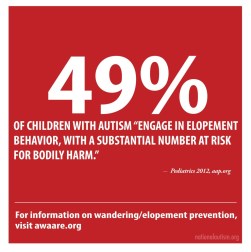
Wandering and autism

HEADLINES…… 

“Car hits, kills 11-year-old autistic boy on the Katy Freeway” 

“Body found in pond is missing autistic child” 

“Autistic boy found dead, face down in a lake”

A lost child is a parent’s worst nightmare. Sadly, the headlines above are just a sample of instances involving wandering/elopement and autism all over the country.

Much like the wandering behaviors in seniors with dementia or Alzheimer’s, children and adults with an Autism Spectrum Disorder (ASD) are prone to wandering away from a safe environment.  A study done by The Interactive Autism Network through the Kennedy Krieger Institute found this: “49% of children with autism attempt to elope from a safe environment, a rate nearly four times higher than their unaffected siblings. Two in three parents of elopers reported their missing children had a “close call” with a traffic injury. Thirty-two percent of parents reported a “close call” with a possible drowning.”

I understand this fear all too well.  There have been a several occasions where Nick has wandered, taken off at the pool and bolted down the street.  Nick is 19 years old and has a dual diagnosis of Down syndrome and autism (DS-ASD).  He has deficits in the areas of language and cognitive function which limits his understanding of safety.  He has no concept of danger.

One day when Nick 11 years old he was on the swing set in the backyard.  His Dad stepped inside to grab a baseball hat for a second.  Something made me stop and put down the garden shovel next to the flat of flowers. I walked around to the backyard.   He was gone.

Al came out the patio door.  I shouted to him, “Did Nick go inside?”

“No, I just came in for a second to grab a baseball hat.”

I felt a hot wave run through my body as I climbed up the burm, the slow crested hill that separated the backyard from the busy street.

downsized_0511010726 (2)

Al had recently ruptured his Achilles tendon and was wearing a therapy boot.  He hobbled up slowly behind me.  There was nothing but a stream of fast-moving cars pacing the road behind our house.

 I called out to his older brother, “Hank, go to the front and check with the neighbors and see if anyone saw him okay. Do it now!”

My neighbor came over, “I saw him a few minutes ago.  He got off the swing and started chasing a bunny.”  He pointed his finger left, “He ran that way.”

In the Midwest, the yards blend from one to the next in a seamless row like football fields connected one after the other. I squinted hoping to see some movement.  There was nothing,  just eerie silence. I took off running.  A dozen houses down, nothing.  Over ten minutes had passed since he had gone missing. I was in panic mode, my body was shaking and legs began to fatigue.  I kept sprinting but there were only five houses left before the subdivision entrance.   Suddenly, I saw a small figure running. “Nick stop now!”

He just kept going.  My strides turned into leaps.  I caught up with him 2 houses before he reached the subdivision entrance.  He looked at me as if nothing was wrong.  We walked in silence back home.  I gripped his hand tightly and counted how many houses he had run passed.  Final count=20 houses!

It makes me sick to my stomach recalling that horrible day. We have since put some things in place as a precaution to keep Nick safe. What can families do to insure the safety of their child?  In my research, I found an excellent website called AWAARE which stands for Autism Wandering Awareness Alerts Response Educationwww.awaare.org.  This site has a comprehensive list of tips, materials and tools.

7 TIPS FOR WANDERING AND AUTISM RISK MANAGEMENT:

1. Secure your home

Install secure door locks, home security systems, install inexpensive battery operated alarms on door and window to alert when opened. Place hook and eye locks on all doors above your childs reach.  Fence in the yard and put visuals like stop signs to doors.

Here is what we have on our doors…….
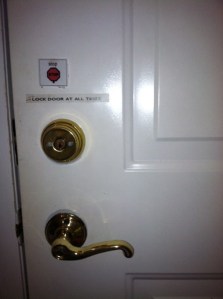
photo (115)

2. Get an ID Bracelet

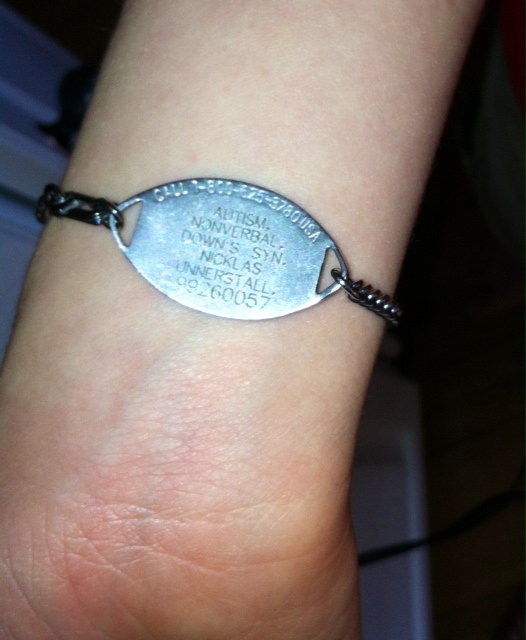
Medic Alert, www.medicalert.org  is what Nick wears and it stays on him firm.
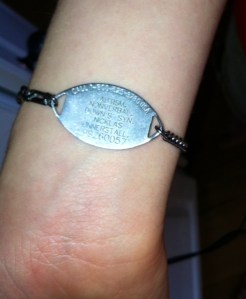
photo (116)

Another popular bracelet is called Project Lifesaver, www.projectlifesaver.org.

3. Consider a mobile tracking device

Project Lifesaver (https://projectlifesaver.org), Angel Sense https://www.angelsense.com) and LoJack SafetyNet (www.safetynetbylojack.com) services have wrist and ankle tracking devices.  There are many other mobile GPS tracking systems you can purchase at Best Buy and other big box stores along with phone apps as well.  See the resource page on the AWAARE website above for more information.

4. Teach your child to swim

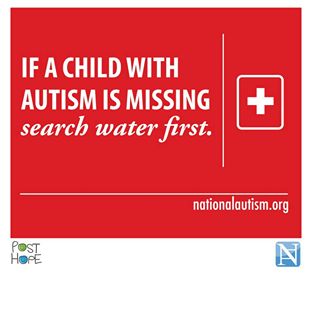
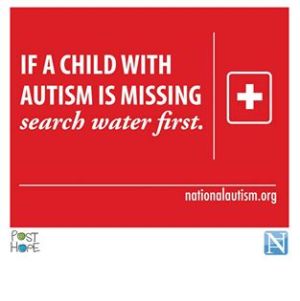
A large percentage of the headlines for wandering and autism end tragically because of drowning deaths.  Children are often drawn to water.  Check your local YMCA or special recreation association for swim lessons.
autism missing pic

5. Alert your neighbors

Make a simple handout with your name, address, phone number, information about your child (autism, non-verbal etc….) and include a photograph of your child.   Ask them to call you immediately if they see your child outside of your home.

6. Alert First Responders

Provide the local police and fire stations with key information before an incident occurs. Ask your local police department if they have a data base and registration program for individuals with special needs. See the AWAARE website given above for printable handouts.  There is also a free Big Red Safety Toolkit with free downloads on wandering and prevention.

7. Work with an ABA Therapist on a Behavior Plan

A BCBA certified behavior therapist can help with understanding the child’s goal and triggers that cause them to wander. The child may be trying to get to something they prefer, or avoid something they don’t want to do. When you can determine the function of this behavior, you can put supports and strategies in place to decrease wandering or bolting. If the behavior is occuring in school, address this with the IEP team and put measures in place to insure safety for your child.

Nick still requires 24/7 supervision and the house is sealed up like Fort Knox.  As a family we have to make sure there is always a designated watchman.  After doing this research on autism and wandering, I understand the necessity to be proactive and more responsible. Next stop: Make a call into the local police and fire stations to see what they have in place for wandering and persons with autism and other special needs in our community.   Discussion of this topic needs to continue.  I will be researching more tracking and monitoring devices.  Look for this on Part Two of  Autism and Wandering within the next two weeks.

That’s what is in my noggin this week!

~Teresa 🙂

Follow Nick:

Facebook and Pinterest @Down Syndrome With A Slice Of Autism

Instagram #nickdsautism

Twitter @tjunnerstall

Posted in Autism, Behavior/ ABA, Down syndrome, Education and Special Needs

Blog #3~DS-ASD, Getting Your Goat

Blog #3~DS-ASD, Getting Your Goat

  • Eggs
  • Celery
  • Balsamic vinegar
  • Olive Oil
  • Parsley
  • Fajita seasoning
  • Merlot
  • Penne pasta noodles
  • Laundry detergent
  • Acne wash
  • Fluoride rinse
  • Shaving cream
  • Whey protein powder
  • Shower gel
  • Hand lotion
  • Baby powder

That’s the short list and I don’t mean grocery list.  It is just some of the stuff that Nick has gotten his hands on and dumped out on the kitchen floor. I wish I could say that I am rewinding to back when Nick was age six.  But this is the here and now; the flavor of the week (or in this case for the last year or so.) Nick is 18 years old with a dual diagnosis of Down syndrome and autism.  This makes for an interesting mix of behaviors.

I have consulted teachers, therapists and behavior specialists in autism.  After they have a good laugh at the list, the conclusion is the same. First, it could be a sensory issue.  Nick seeks out many odd things to look through, tap and stim on and perhaps the act of dribbling out a tube of Mederma skin lotion from the second floor banister is satisfying some sensory need.   The second theory is that Nick is seeking attention and looking for a reaction. All I know that it is very hard to keep your cool when you see a full 64 ounce, Costco size container of olive oil emptied all over the floor. Fortunately I get my paper towels at Costco too. 🙂 I will say that the floor and my knees have a nice sheen to them.  Then there is our  poor cat, Miss Mellie sleeping innocently while Nick sprinkles a half bottle of fajita seasoning all over her gray fur.  Okay, I had to run into the other room and laugh on that one.

Freshly seasoned and washed cat…..

photo (113)

The dumping is just one facet.  Nick is like a toddler putting all kinds of things in the toilet.  A package of pens, my reader glasses, his iPod nano and his Dad’s watch are just a few of the things he’s submersed.  The newest trick is putting your shoes in the sink and running the water faucet full blast.  Here’s the thing.  He commits the crime, runs downstairs pointing up with a grin on his face and says “Uh oh.”  He is always looking to get a response.  It is not easy to keep a poker face during these episodes.  However I look at it like this, Nick is just trying to *”get my goat”.  The goat is a metaphor for a state of calm and peacefulness.  I grit my teeth, make absolutely no eye contact. On a shelf near the kitchen now stands a stack of permanently borrowed, white gym towels.   I point to the pile and he grabs a towel and cleans up.  No reinforcement is given to him.

Better put Mederma on the list…….

Not all the things he does are this messy.  Sometimes they are just plain funny, like a baby doll in the Pierogis….

So how can these inappropriate, attention seeking behaviors be managed?  First, the incidences are documented on what is called a Functional Behavior Assessment (FBA). On the form I record the date and time of the incident. Then follow the ABC’s:

Antecedent= What happened before the behavior

Behavior= The actual behavior and incident that occurred

Consequences= What happened after the incident

After looking at ABC ‘s, one can see if there is a common thread and determine why they might be doing the behavior.  As I mentioned in my very first blog entry, every behavior (even the bad ones) are trying to communicate something.  In some cases, it’s a sensory seeking reason.  Think about it- the sound of an object breaking or sight of a mess spilling or shattering all over the floor is exciting.  In the case of dumping, often it is when a parent is busy around the house, on the phone or trying to get ready to go to work.  It is clear that Nick is bored and seeking our attention while we are busy.  But mostly, I think it is a “control thing” for him.  It is something that HE has power over in his own life.

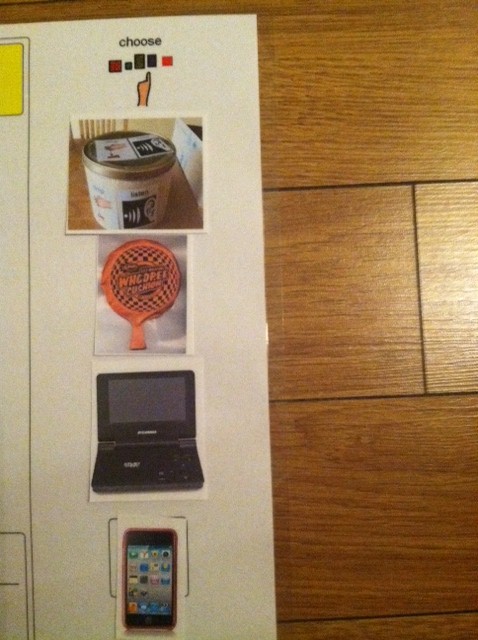
With this information a positive Behavior Support Plan (BSP) can be developed targeting undesirable behaviors.  Look at what possible replacement behaviors could be put in place instead.  This is where the “choice board” comes in.  This board has appropriate choices in the form of icons which he can pick from to better occupy his time. These choices should be highly preferred and stored away, so they are not accessible.  Below is a sample choice board.  The drop box is filled with fun things to throw and dump, followed by the woopie cushion, DVD player and iPod touch:

The final piece will be to add an icon to indicate that the behavior he did was wrong.  If he can see it in visual form, he will understand it.  This is to be done again without eye contact so as not to reinforce the attention he is craving.

Icon to show for inappropriate behaviors:

angry face

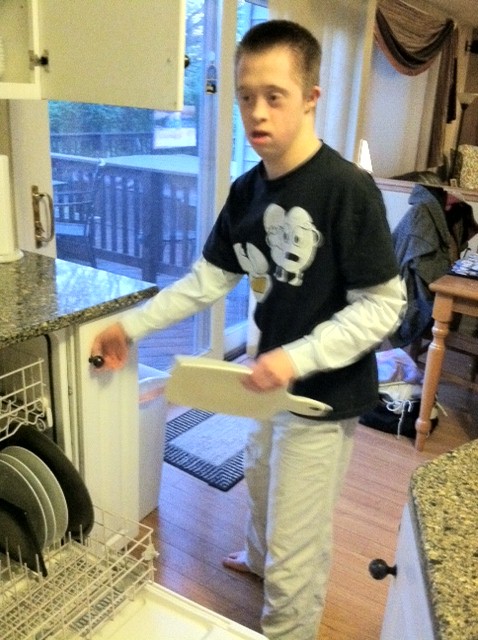
In the meantime, as I put the final touches on this piece, I turn around to see Nick unloading the dishwasher by himself.  This is a something he has complete control over (and is really adept at doing by himself).  I smother him with praise, “Good job big guy, I am so proud of you”.  Catch your child being good and reward them with the positive reinforcement.

Way to go Nick! 🙂

Show the icon for appropriate behavior:

happy face

All of these visual supports need to be done consistently across the board in every venue (home, school and community.) Hopefully with this plan in action, we can cut down on the dumping.  At this point in our lives we shouldn’t be dealing with this type of behavior or having to reinstall safety locks back on all the cabinet doors.  What can I say- It’s Nick’s world, the rest of us are just trying to keep up.  That’s what is in my noggin this week.

Here’s to not letting anyone get your goat*!

~Teresa 🙂

*The expression ‘to get your goat’ has its origins in horse racing. Race horses are very high-strung animals. Goats are often used as companion animals, to keep a horse calm. Someone wanting to fix a race would slip into the barn the night before the race, steal the goat, and then an upset, distracted horse would run a bad race. Hence, if you are upset and not at your best, it is said that ‘someone has gotten your goat.’

Nick age 5 with our next door neighbor goats in Northern California.

Follow Nick on Social Media:

Facebook and Pinterest @Down Syndrome With A Slice Of Autism

Instagram #nickdsautism

Twitter @tjunnerstall