Posted in Autism, Down syndrome, Fun Side of Nick

Blog # 9~ Brotherly Love

Nick’s final exam schedule came home in the back pack last week.  I showed it to his brother, Hank who had just finished with his finals at NIU.  We both had a good laugh.

“Mom, remember my junior year of high school and those finals I had? They were a bitch!”

“How can I forget?  That one day you had a final in Trig and English.  Nick had the Blueberry Hill breakfast final.”

“Yea then the next day, it was Genetics and History and Nick’s was like Naperville River walk and shopping.  That was so pathetic!”

Each day that week, Nick got off so easy compared to Hank.  The rivalry of brothers extends past the boundaries of normally developed children.  So this week is all about brotherly love.  One question I am often asked is what the relationship is like between the two.  Rather than try to answer this I decided to go to the source, Hank.  Here is his perspective on the relationship with his younger brother.  Hank is going to be a sophomore at Northern Illinois University (NIU) and will be turning 20 next month.  The boys are 19 months apart in age.

My Brother Nick, By Hank Unnerstall:

“My brother Nick is not like any ordinary brother. There is an extra chromosome in the 21st pair which is the result of Nick having Down syndrome and later, an autism diagnosis that separates him from normal people. Having Nick as a brother has made me open my eyes to life in general and the traits that make me the man I am today.

Some of the earliest memories with Nick start from when I was around 5 years old. Being that young I did not fully understand why my brother was different but I accepted it because he is my brother.  I remember when I began getting older and going to elementary school when my mom and brother would pick me up and drop me off at school. Nick would be doing his normal sound making and hand clapping in public that would sometimes embarrass me in front of my peers. I also recall the times at the old California house we had where Nick and I would start messing around and wrestling with each other but then Nick would take it seriously and start pinching me. His ways of fighting back around that time were much less harmful than it is now when he has one of his meltdowns or I like to call them “monkey boy” episodes. These memories are some examples of tough things in which I have had to deal with in which growing up with my brother.

Hank and Nick at San Francisco Bay….

It would be remiss of me if I didn’t mention a horribly embarrassing time.   Back around my freshman year of high school, Nick and his respite worker and I all went to Arby’s for a late lunch. Once we got our food we sat down, Nick started to make loud and disgruntled sounds when we put his food in front of him. I told him to be quiet in a not so nice tone. Next thing you know he became furious and proceeded to throw his food and random objects like trays, sugar packets and salt shakers all over the place.  We tried to calm him down but he was at the point of no return (aka monkey boy.)   I went on to restrain him and he was pinching, kicking and biting, anything to hurt me.  Somehow we ended wrestling around on the ground and to the other people in the restaurant it must have looked like we were fighting.  This was awkward and embarrassing for me because I was much bigger than him.  I knew it didn’t look right. I just wanted to leave and never show my face again.

That was the worst, or well at least one of them!

 But, there are many traits to Nick.   For example, he is usually a very happy and silly kid who always has a grin on his face. That’s why people love him at school and of course our family despite what we deal with when relating to Nick. Also, even though Nick has autism it does not stop him from being a socially engaging little dude even though he can’t speak. He loves to get attention whether it is him trying to act cute or to negatively do something to get ours. For example if we do not pay Nick any attention for a while he might spray shaving cream over the stairs.

Some of the best memories I can recall having with my brother can be the times where he will just sit next to me on the couch and watch TV with me and just chill out. Also I love to see him dance intensely while listening to the music that I provide him which is usually hip-hop/rap. Basically whenever Nick is in a good mood and happy he always knows how to put a smile on myself and many others faces. Having Nick as a brother has taught me to be a very patient person. I think I got this trait from the numerous times I have had to babysit Nick throughout the years. Also I feel that I have a certain outlook on life after growing up with Nick. For instance, Nick is always happy about the smallest things and he’s the one who is mentally disabled. So how I’ve been trying to live my life is to the fullest and I’m always trying to be as positive as possible no matter what life throws at me.”

Hank and Nick at the Sox game this past weekend……

Oh how they have grown up since the days of past when they use to play sweetly on the living room floor.
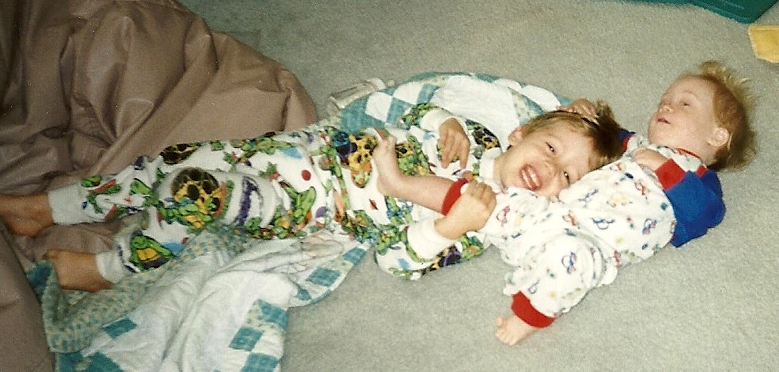
My Dad always said they looked like innocent cubs wrestling on the ground…..one more…. 😉

.
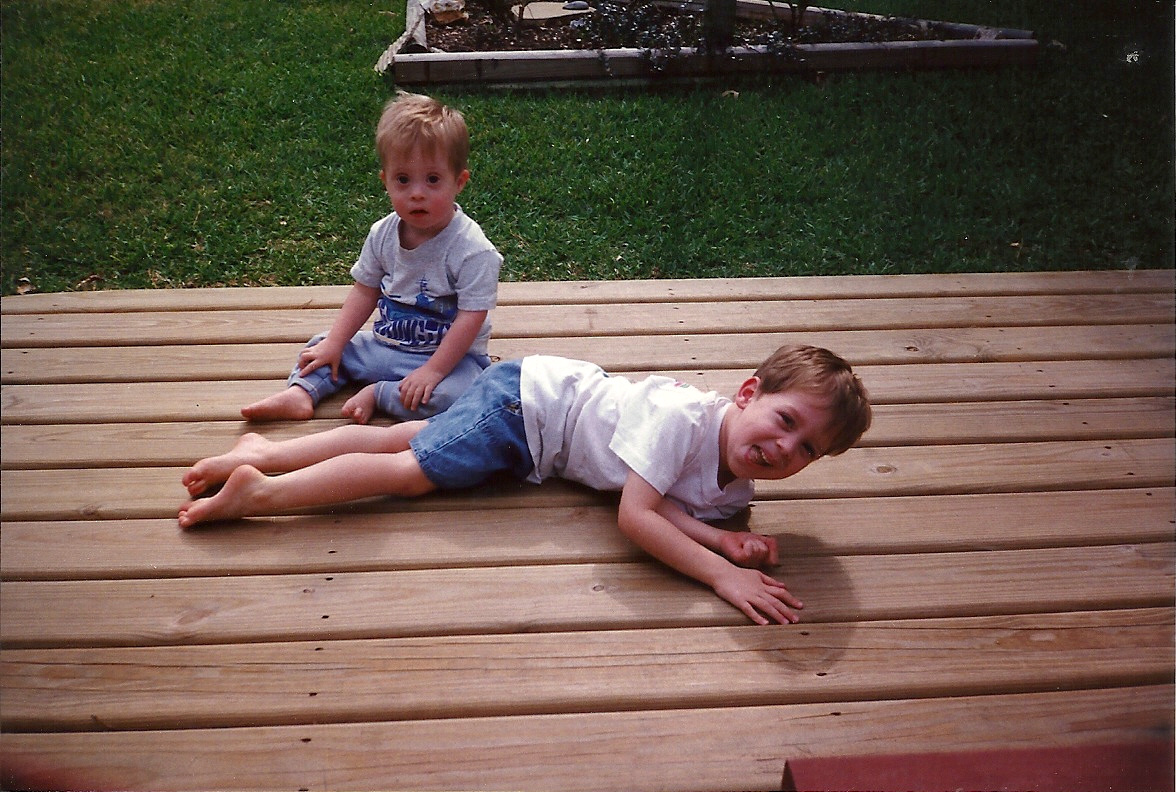
Those peaceful days long faded as Nick became more frustrated…..giving way to huge meltdowns as he became older.  I applaud Hank putting up with the challenging behaviors of having a brother with not only Down syndrome but also autism.   We did our best to provide support by taking him to sibling workshops along with having him read “The Sibling Slam Book” by Don Meyer.  This is an excellent resource of what it is REALLY like to have a brother or sister with special needs.  We carved out time to just spend with Hank (buddy days) so he wouldn’t feel like Nick, Down syndrome and later autism didn’t consume our family.  I am very proud of Hank and his relationship with his brother.
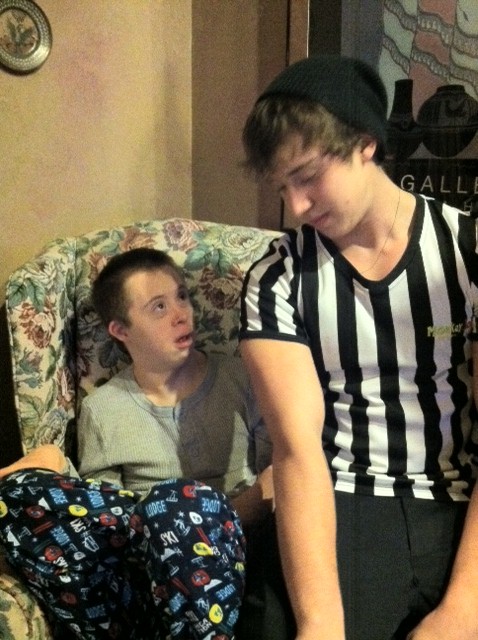
It has been a crazy, twisted road we have been on but let me just say this….While the sibling relationship takes on a different form with a special needs child, there is no doubt that the bond is there.  I wish that Hank and Nick could have conversations, play video games and throw a baseball like most brothers do.  But that was not meant to be. One thing for certain is that there is a connectedness and love between them.  Last fall Hank took off for NIU. How did I know that Nick missed him?  He walked around with this picture in his hands, never letting it go even as he used the bathroom 🙂
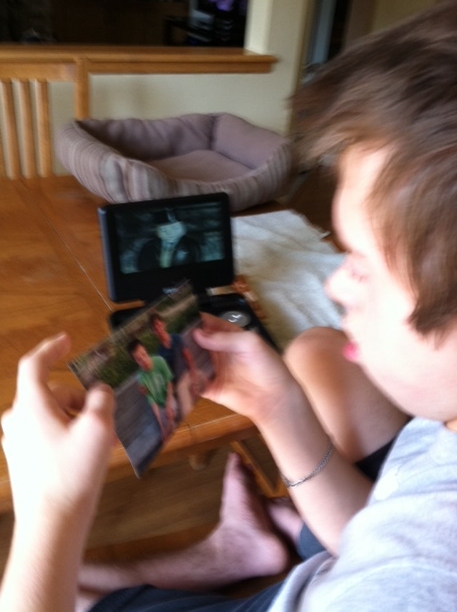
Brotherly love is evident.  That is what is in my noggin this week.  Until next Monday, may your short week be full of love and connections spoken or unspoken.

~Teresa

***Special thanks to my son, Hank my guest blogger extraordinaire 🙂


Posted in Autism, Down syndrome, Education and Special Needs, Speech and Occupational Therapy

Blog #8~ Three Scary Letters: IEP

Blog #8~ Three Scary Letters: IEP

Who would think that the 3 letters IEP could evoke anxiety and trepidation in the hearts of many parents of children with special needs?  IEP stands for Individualized Education Plan.  I used to be one of those scared and frail kittens shaking as I walked into the doorway.  My son, Nick has Down syndrome and autism.  I’ve been through my share of IEP meetings and learned a great deal on how to handle them.  I heard my share of war stories:

“Watch out they will try and get away with cutting your service hours!”

“Why would they do that?”

“Oh the budget constraints and pressure from the school district, that’s why. They are going to say the teacher can address the issues and you don’t need the additional speech therapy hours.”

So enter the neophyte parents into the doorway to face the army of personnel from the school.  The IEP team usually consists of the classroom teacher, case manager, occupational therapist, speech therapist, adapted PE teacher, school counselor, social worker, school nurse and a student services representative. Oh and yes, the parents too. 🙂  I can recall many in the early days crammed in tightly around a table and feeling very clueless in the early days.   The IEP meeting is intended to be a team effort, but sometimes we couldn’t help but feel like it was them against us.

What an IEP exactly?  Here is some information from Wikipedia:

An IEP is designed to meet the unique educational needs of one child, who may have a disability, as defined by federal regulations. The IEP is intended to help children reach educational goals more easily than they otherwise would.  In all cases the IEP must be tailored to the individual student’s needs as identified by the IEP evaluation process, and must especially help teachers and related service providers (such as paraprofessional educators) understand the student’s disability and how the disability affects the learning process. 

The IDEA 2002 requires that an IEP must be written according to the needs of each student who meets eligibility guidelines under the IDEA and state regulations, and it must include the following:

  • The child’s present levels of academic and functional performance
  • Measurable annual goals, including academic and functional goals
  • How the child’s progress toward meeting the annual goals are to be measured and reported to the parents
  • Special education services, related services, and supplementary aids to be provided to the child
  • Schedule of services to be provided, including when the services are to begin, the frequency, duration and location for the provision of services
  • Program modifications or supports provided to school personnel on behalf of the child
  • Least Restrictive Environment data which includes calculations of the amount of time student will spend in regular education settings verses time spent in special education settings each day
  • Explanation of any time the child will not participate along with nondisabled children
  • Accommodations to be provided during state and district assessments that are necessary to the measuring child’s academic and functional performance
  • The student should attend when appropriate. If the student is over 14 they should be invited to be part of the IEP team.
  • Additionally, when the student is 16 years old, a statement of post-secondary goals and a plan for providing what the student needs to make a successful transition is required. This transition plan can be created at an earlier age if desired, but must be in place by the age of 16.

IEPs also include other pertinent information found necessary by the team, such as a health plan or a behavior plan for some students.

The IEP can be daunting on paper, or shall I say more like a ream of paper averaging for Nick around 50 pages total.  The biggest tip I can share is to request all of the reports and intended goals prior to the meeting for your review.  In addition, I suggest meeting with the case manager at least a month before the meeting to discuss proposed goals that will be in the education plan.  That way there are no surprises at the IEP meeting.  If the parent and teacher have a good communication system back and forth there shouldn’t be any.  (For additional support, go to the links and resource pages on this website and look under Wrightslaw, Bridges for Kids-IEP goals and Barb Bateman’s book, Better IEP’s.)

Over the years we have utilized outside advocacy when we felt like the needs of our son might be compromised.  Rewind to 1998 in Houston, when Nick was attending a public pre-school program twice a week and a private special needs pre-school three days a week.  (This was before we could get him in the private school full time). We brought an entourage of very strong women from the private school to advocate for Nick.  Our advocates dissected that IEP and insured that all supports were in place down to the last detail.  That being a nubby rubber cushion for Nick to sit on to keep his core activated and him alerted.  I was floored at the way they spoke up for our son.  I would have never known to boldly ask for these things.

Nick at The Arbor School in Houston, Texas……

The presence of an outside advocate walking in with you at an IEP meeting can certainly make the team members sit up and be on point.  Memorable meeting number two was in 2001 when lived in the east bay area of Northern California. Nick’s language was minimal and he was getting frustrated not being able to communicate verbally.   On this particular occasion we were being met with resistance with regards to the school providing a proper picture communication system and training of staff and parents.  Enter the Executive Director of The Down syndrome Connection by our side.  (DSC is the local Down syndrome support group)  The school’s Physical Therapist asked if she could report first as she had another meeting to attend.  The Social Worker raised her hand and asked if she could go second and then excuse herself.

Without blinking an eye,  the DSC Director calmly said, “Wait a minute, we are all here to discuss Nick’s future, right?  We only have this meeting once a year. The least you can do is stay and be a contributing member to this team.”

No one dared to leave that meeting.  Oh, and yes the communication specialist was immediately put in place to help with the picture communication system for Nick.

Nick in California

There is only one word for these advocates and the others that followed…..Rock Stars!

I have learned from the best.  The frail kitten morphed into a lion that can roar.  Why, because I have to fight for him because he has no voice. I know Nick the best and what works for him.  I don’t have to agree with the team.  In my matter of fact approach I simply state my parent concerns and have them put in writing in the IEP.  So parents, if you don’t agree, then push your chair back, state that you don’t agree and do not sign it. You may have to take it to the next level if you get a push back.  That’s when you use the two words that can evoke the most fear…Due Process!  (Thank you Kendra, Nick’s Private Occupational Therapist for giving me the courage to do these things.)

Nick at private occupational therapy with Kendra

More fun with Kendra

And please, do not call me “The Mom”, or “Nick’s Mom.”  The name is Mrs. Unnerstall.  Yes, IEP meetings can be scary.  But parents, don’t be fraidy cats.  Just get prepared!   Request those reports and goals ahead of time.  Schedule a meeting with the case manager before hand to make sure you are on the same page.  Communicate with the teacher so there are no surprises.  And finally if you don’t feel supported, then bring an advocate to the meeting.   That’s what is in my noggin this week.  Until next Monday, may you find the inner lion within you and fight the good fight!

~Teresa


Posted in Autism, Down syndrome, Speech and Occupational Therapy

Blog #6 The Nick Connection

Once upon a time, Nick only had Down syndrome.  I am unable to say with any certainty when the light switch flipped.  The symptoms of autism didn’t appear after any round of immunizations or before the age of 3.  In fact there were many symptoms that Nick didn’t have.

Autism is defined by the Mayo Clinic as, One of a group of serious developmental problems called autism spectrum disorders (ASD) that appear in early childhood — usually before age 3. Though symptoms and severity vary, all autism disorders affect a child’s ability to communicate and interact with others. Children with autism generally have problems in three crucial areas of development — social interaction, language and behavior. But because autism symptoms vary greatly, two children with the same diagnosis may act quite differently and have strikingly different skills. In most cases, though, severe autism is marked by a complete inability to communicate or interact with other people. Some children show signs of autism in early infancy. Other children may develop normally for the first few months or years of life but then suddenly become withdrawn, become aggressive or lose language skills they’ve already acquired.”

Nick has always found a way to connect with people.  Years ago, when he was around 2 years old, a woman approached me in the local Kroger supermarket.  She went out of her way to tell me how good Nick’s eye contact was and how engaging his personality was.  Countless doctors, therapists and teachers have made the same recognition over the years since then. He thrives around people and having fun with them.

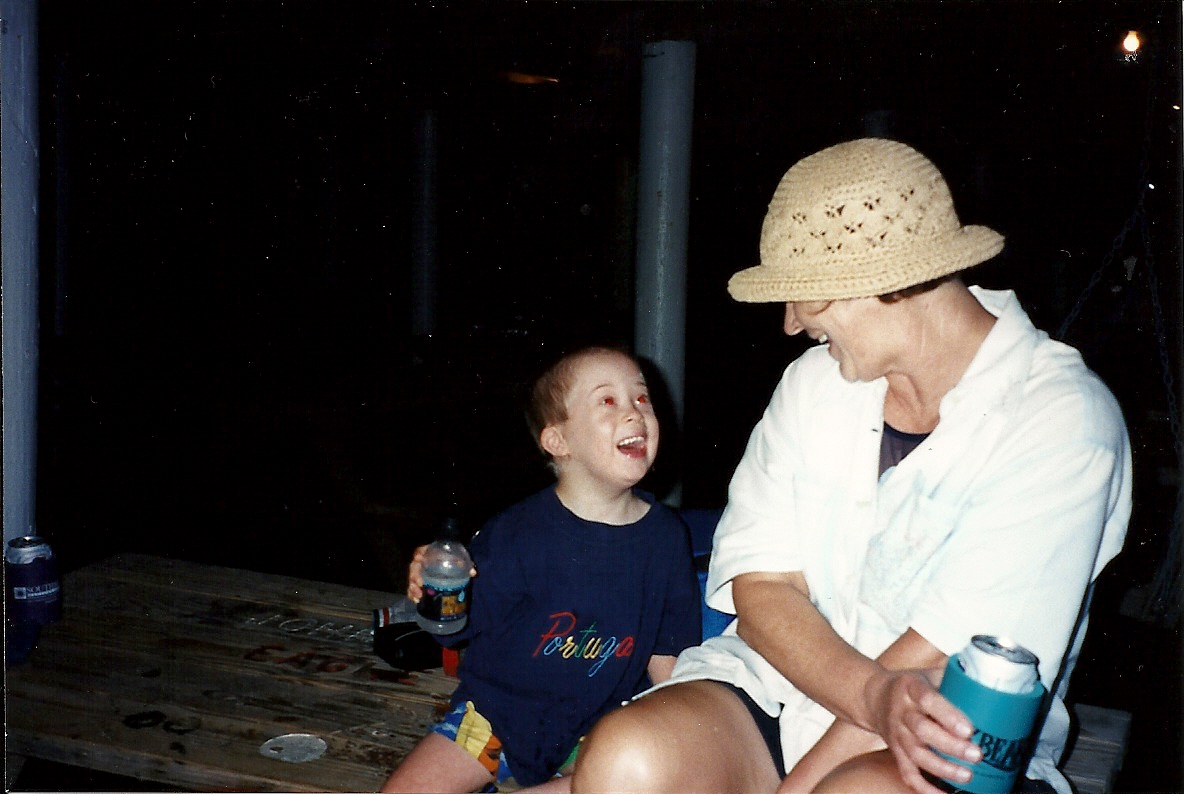
Being silly pouring water on Grandma Babs

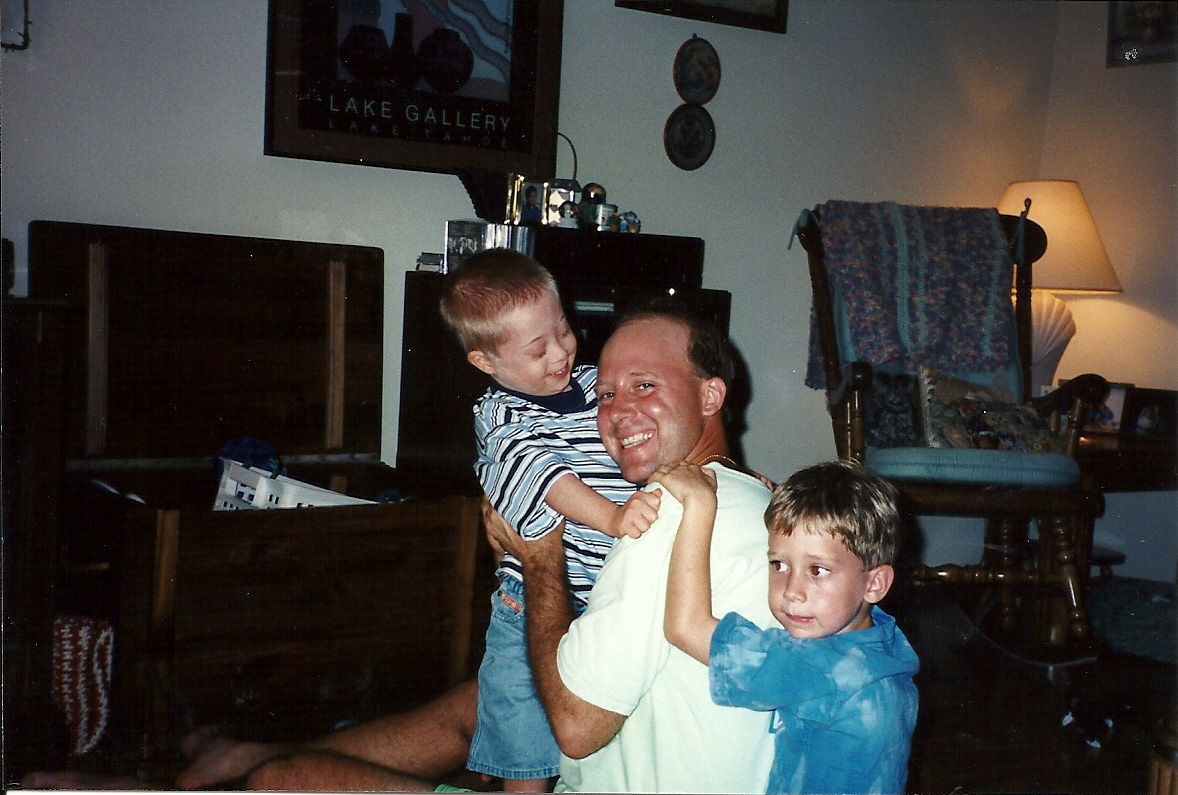
Fun with his Dad and brother, Hank

As I mentioned earlier, there was no flip of the switch.   A few things stood out around the age of 4. At the time, we lived in northern California. He started rocking more back and forth and became increasingly intolerant of having his hair cut.  Then there was the trip to Half Moon Bay where he began to pinch his cheeks hard as we walked across the coarse grain sandy beach. I suspected these behaviors were sensory related.  To make sure all the bases were covered I took him in to be evaluated for autism at age 5.  The Mayo clinic states that, “Though each child with autism is likely to have a unique pattern of behavior, these are some common autism symptoms:  

Social skills

  • Fails to respond to his or her name
  • Has poor eye contact
  • Appears not to hear you at times
  • Resists cuddling and holding
  • Appears unaware of others’ feelings
  • Seems to prefer playing alone — retreats into his or her “own world”

Language

  • Starts talking later than age 2, and has other developmental delays by 30 months
  • Loses previously acquired ability to say words or sentences
  • Doesn’t make eye contact when making requests
  • Speaks with an abnormal tone or rhythm — may use a singsong voice or robot-like speech
  • Can’t start a conversation or keep one going
  • May repeat words or phrases verbatim, but doesn’t understand how to use them

Behavior

  • Performs repetitive movements, such as rocking, spinning or hand-flapping
  • Develops specific routines or rituals
  • Becomes disturbed at the slightest change in routines or rituals
  • Moves constantly
  • May be fascinated by parts of an object, such as the spinning wheels of a toy car
  • May be unusually sensitive to light, sound and touch and yet oblivious to pain

Of the symptoms listed above, Nick displayed none in the social skills category.  The physician noted that his slow speech development was probably due to having Down syndrome and Verbal Apraxia (a neurologically based condition that is characterized by difficulties planning and producing the complex set of oral movements necessary for intelligible speech. For more information on Apraxia click on my favorites section, a new book, Speaking of Apraxia- A Parent’s Guide to Apraxia of Speech by Leslie Lindsay has just been published.  Regarding behavior, Nick did exhibit a few of the symptoms but never was fascinated with spinning any objects or sensitive to light or pain.  So cut to the chase, after the screening the conclusion was he did not have autism.

Fast forward 6 years later, his speech hadn’t improved and the behaviors were growing more severe.  Nick’s speech was limited.  Imagine someone putting duct tape across your mouth and trying to navigate the world.  With no voice he would get frustrated and turn to throwing such things as a chair across the room or breaking a glass across the floor.  Worse yet, he would have meltdowns that drew blood and bruises when he would pinch, kick and bite. At Gi Gi’s Playhouse group time (a local Down syndrome support group,) I began to notice that he was playing more by himself and primarily with any musical toy he could get his hands on dancing side to side.

This was more than just Down syndrome.  Next stop Little Friends Center for Autism.  The second screening was much more comprehensive and included a team of therapists who individually assessed him.  Voila, diagnosis confirmed.  I can say first hand that the evaluation methods had improved tenfold.  I suspect that is one of the reasons why the incidences of autism cases have risen so significantly over the past five years.

So back to the Nick connection, because he has always been highly social it was hard to see that somewhere in the midst autism had crept in.  The tapping, rocking, hand flapping, humming and the sounds of musical toys had become white noise to us like the dryer running in the background. We had become immune to them all. To us he was the guy who won over the hearts of everyone he touched.  He was the fun guy who can click with everyone. When he was much younger he had a belly flash club.  He wouldn’t see his Aunt Laura or my friend Sally for months and yet when he would reunite he greeted them by lifting his shirt up and flashing his belly.

Nick getting ready to belly flash!

He likes to give a high five, rub elbows, noses and he loves to get raspberries. Oh and let me not forget the burps, fake sneezes and what we like to call “force farting” to get your attention. For that I am grateful, well maybe not the force farting (Al’s term given for when Nick pushes out one to get a rise out of us) 😉 but I am glad he is so engaging.  And I have to say those who know Nick can attest to the fact that he can replicate exact sneezes after you do yours. Even Aunt Ali’s tiny, high pitched achoo!

Elbows… with his teacher, Rob

Noses…

The fact that he can make those connections warms my heart as his mother.  That’s what is in my noggin this week, until next Monday….May you find those special ways to connect with those around you!

~Teresa

Posted in Autism, Behavior/ ABA, Down syndrome, Education and Special Needs

Blog #3~DS-ASD, Getting Your Goat

Blog #3~DS-ASD, Getting Your Goat

  • Eggs
  • Celery
  • Balsamic vinegar
  • Olive Oil
  • Parsley
  • Fajita seasoning
  • Merlot
  • Penne pasta noodles
  • Laundry detergent
  • Acne wash
  • Fluoride rinse
  • Shaving cream
  • Whey protein powder
  • Shower gel
  • Hand lotion
  • Baby powder

That’s the short list and I don’t mean grocery list.  It is just some of the stuff that Nick has gotten his hands on and dumped out on the kitchen floor. I wish I could say that I am rewinding to back when Nick was age six.  But this is the here and now; the flavor of the week (or in this case for the last year or so.) Nick is 18 years old with a dual diagnosis of Down syndrome and autism.  This makes for an interesting mix of behaviors.

I have consulted teachers, therapists and behavior specialists in autism.  After they have a good laugh at the list, the conclusion is the same. First, it could be a sensory issue.  Nick seeks out many odd things to look through, tap and stim on and perhaps the act of dribbling out a tube of Mederma skin lotion from the second floor banister is satisfying some sensory need.   The second theory is that Nick is seeking attention and looking for a reaction. All I know that it is very hard to keep your cool when you see a full 64 ounce, Costco size container of olive oil emptied all over the floor. Fortunately I get my paper towels at Costco too. 🙂 I will say that the floor and my knees have a nice sheen to them.  Then there is our  poor cat, Miss Mellie sleeping innocently while Nick sprinkles a half bottle of fajita seasoning all over her gray fur.  Okay, I had to run into the other room and laugh on that one.

Freshly seasoned and washed cat…..

photo (113)

The dumping is just one facet.  Nick is like a toddler putting all kinds of things in the toilet.  A package of pens, my reader glasses, his iPod nano and his Dad’s watch are just a few of the things he’s submersed.  The newest trick is putting your shoes in the sink and running the water faucet full blast.  Here’s the thing.  He commits the crime, runs downstairs pointing up with a grin on his face and says “Uh oh.”  He is always looking to get a response.  It is not easy to keep a poker face during these episodes.  However I look at it like this, Nick is just trying to *”get my goat”.  The goat is a metaphor for a state of calm and peacefulness.  I grit my teeth, make absolutely no eye contact. On a shelf near the kitchen now stands a stack of permanently borrowed, white gym towels.   I point to the pile and he grabs a towel and cleans up.  No reinforcement is given to him.

Better put Mederma on the list…….

Not all the things he does are this messy.  Sometimes they are just plain funny, like a baby doll in the Pierogis….

So how can these inappropriate, attention seeking behaviors be managed?  First, the incidences are documented on what is called a Functional Behavior Assessment (FBA). On the form I record the date and time of the incident. Then follow the ABC’s:

Antecedent= What happened before the behavior

Behavior= The actual behavior and incident that occurred

Consequences= What happened after the incident

After looking at ABC ‘s, one can see if there is a common thread and determine why they might be doing the behavior.  As I mentioned in my very first blog entry, every behavior (even the bad ones) are trying to communicate something.  In some cases, it’s a sensory seeking reason.  Think about it- the sound of an object breaking or sight of a mess spilling or shattering all over the floor is exciting.  In the case of dumping, often it is when a parent is busy around the house, on the phone or trying to get ready to go to work.  It is clear that Nick is bored and seeking our attention while we are busy.  But mostly, I think it is a “control thing” for him.  It is something that HE has power over in his own life.

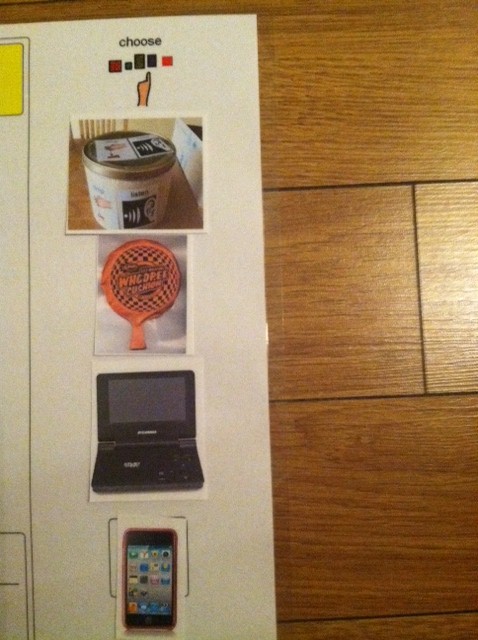
With this information a positive Behavior Support Plan (BSP) can be developed targeting undesirable behaviors.  Look at what possible replacement behaviors could be put in place instead.  This is where the “choice board” comes in.  This board has appropriate choices in the form of icons which he can pick from to better occupy his time. These choices should be highly preferred and stored away, so they are not accessible.  Below is a sample choice board.  The drop box is filled with fun things to throw and dump, followed by the woopie cushion, DVD player and iPod touch:

The final piece will be to add an icon to indicate that the behavior he did was wrong.  If he can see it in visual form, he will understand it.  This is to be done again without eye contact so as not to reinforce the attention he is craving.

Icon to show for inappropriate behaviors:

angry face

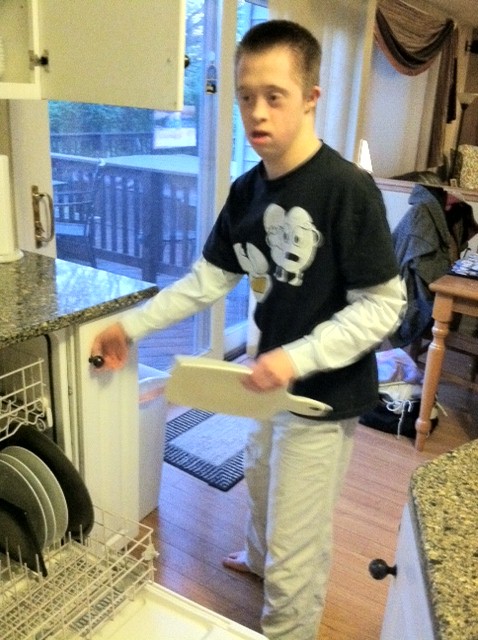
In the meantime, as I put the final touches on this piece, I turn around to see Nick unloading the dishwasher by himself.  This is a something he has complete control over (and is really adept at doing by himself).  I smother him with praise, “Good job big guy, I am so proud of you”.  Catch your child being good and reward them with the positive reinforcement.

Way to go Nick! 🙂

Show the icon for appropriate behavior:

happy face

All of these visual supports need to be done consistently across the board in every venue (home, school and community.) Hopefully with this plan in action, we can cut down on the dumping.  At this point in our lives we shouldn’t be dealing with this type of behavior or having to reinstall safety locks back on all the cabinet doors.  What can I say- It’s Nick’s world, the rest of us are just trying to keep up.  That’s what is in my noggin this week.

Here’s to not letting anyone get your goat*!

~Teresa 🙂

*The expression ‘to get your goat’ has its origins in horse racing. Race horses are very high-strung animals. Goats are often used as companion animals, to keep a horse calm. Someone wanting to fix a race would slip into the barn the night before the race, steal the goat, and then an upset, distracted horse would run a bad race. Hence, if you are upset and not at your best, it is said that ‘someone has gotten your goat.’

Nick age 5 with our next door neighbor goats in Northern California.

Follow Nick on Social Media:

Facebook and Pinterest @Down Syndrome With A Slice Of Autism

Instagram #nickdsautism

Twitter @tjunnerstall