Posted in Augmentative and Alternative Communication (AAC), Autism, Behavior/ ABA, Dual Diagnosis Down syndrome and autism

Blog #155~More Than Down Syndrome,DS-ASD

Blog #155~More Than Down Syndrome, DS-ASD

My son, Nick has Down syndrome. There came a point when I felt like we didn’t fit in with the Down syndrome support groups. We stopped going to the local support group holiday parties, play groups and other fundraising events. My son, Nick lacked speech and displayed unusual and repetitive behaviors. These stimming behaviors included tapping, shaking and throwing objects. Vocal stimming and yelling was another behavior that he exhibited. His speech delays and inability to communicate, resulted in frustration on his part, which led to behavior problems and meltdowns. It became apparent that this was more than just Down syndrome, when he hit puberty.

photo-26

We approached the elementary school IEP team about these outbursts, where he would throw things, trash the classroom along with pinching and scratching staff. It didn’t seem like any of us, could get a handle these problems both in school or at home. The school IEP team was reluctant about getting an autism evaluation done, as they stated; “We have a primary diagnosis of Down syndrome we can work from”. Rather than push the matter with the school, we chose to have an independent evaluation done and paid for it (with some help from our private insurance), out-of-pocket.

It was money well spent. Nick got the new diagnosis of Down syndrome and autism (DS-ASD). If you suspect that your child’s behaviors might be related to more than just Down syndrome, I would strongly suggest that you get a referral from your primary care physician to get an evaluation for autism.

The diagnosis of autism, was like getting the magic key, that unlocked the door to more services for our son...….

magic key

Here are the additional services we received with the secondary diagnosis of autism for our son Nick who also has Down syndrome. Obtaining these services took some time, but the effort to get them, has been well worth it. These services were provided in part, by the school district and outside agencies:

*Behavior Support was requested from the school district, A BCBA certified autism specialist did a Functional Behavior Assessment (FBA). This lead to the development of a Behavior Support Plan (BSP), specifically targeting all triggers, and how to prevent & handle crisis situations during meltdowns. BSP’s can also target skill development in a variety of areas like toilet training which is very challenging. After the BSP was put into the IEP, we collaborated as a team. We built in specific visual supports and sensory breaks into his day, which helped him to stay focused and regulated.

*Speech Support and training on how to properly implement a Picture Exchange System (PECS), along with an Alternative Augmentative Communication (AAC) device.

ipad touch chat.JPG         photo (123)

*Toilet Training and workshops for home support  This included coaching on how to develop and implement a timed toileting schedule and use visual supports to promote independent living skills inside the home.

*Additional State Funding (In-Home Family Support Child Based Waiver)  This is funding for respite care, behavior support and safety/ health equipment to support the child at home.

*Federal Funding (Supplemental Security Income-SSI)  A federal  income supplement program funded by general tax revenues (not Social Security taxes). It is designed to help aged, blind, and disabled people, who have little or no income; and it provides cash to meet basic needs for food, clothing, and shelter.

Getting the secondary diagnosis label of Down syndrome and autism (DS/ASD), helped the school staff, therapists, medical professionals, family and friends get a better understanding of Nick’s behaviors and additional needs. By getting access to these additional supports, we’ve been able to change the strategies needed to help Nick. It’s important to note that with co-occurring DS-ASD, the autism symptoms often supersede over those related to Down syndrome. Behaviors and additional needs associated with DS-ASD are complex.

DS-ASD Ribbon

As a result of obtaining these supports, Nick’s communication improved, allowing him to feel understood, respected and less frustrated. As a family, we felt better assisted with the training provided from the BCBA and our local autism center. Applying for the state waiver and securing the funding for respite staff took some of the burden off us.

If you suspect your child with Down syndrome may have autism, read this link by the National Down Syndrome Society for the signs and symptoms: https://www.ndss.org/resources/dual-diagnosis-syndrome-autism/

Additional resources for navigating a dual diagnosis of Down syndrome and autism:

*When Down Syndrome and Autism Intersect-A Guide to DS/ASD for Parents and Professionals and Supporting Positive Behavior in Children and Teens with Down Syndrome books:
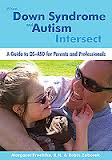
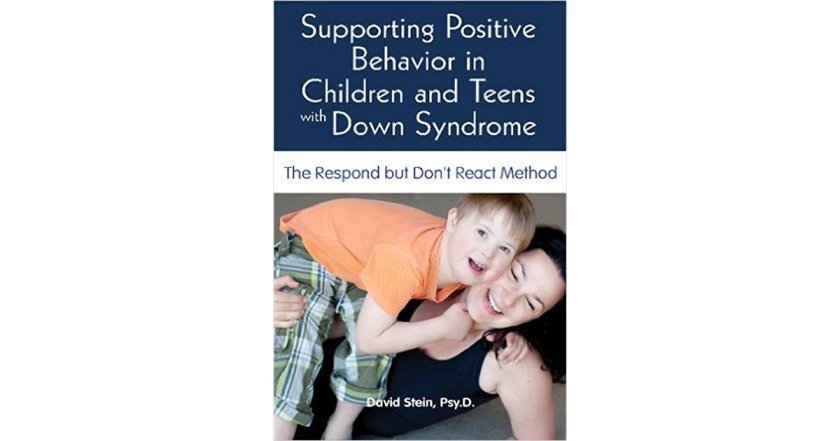
down-syndrome-and-autism-intersect

Book Supporting Positive Behavior DS

*The Kennedy Krieger Institute- https://www.kennedykrieger.org

*Down Syndrome Association (UK)- http://www.downs-syndrome.org.uk/for-families-and-careres/dual-diagnosis/

*National Association for Down Syndrome (NADS)http://www.nads.org/resources/down-syndrome-and-autism/

*Facebook Support Groups:

-Down Syndrome With A Slice Of Autism

-Autism Discussion Page (Bill Nason)

-The Down Syndrome-Autism Connection http://www.ds-asd-connection.org

The challenges of having a child with co-occurring Down syndrome and autism (DS-ASD) are unique. So many parents say that they no longer fit in with the Down syndrome support groups and can’t relate to the autism groups either; they feel isolated. You as the parent, know your child best.  If you suspect that your child with Down syndrome may have symptoms associated with autism, I strongly suggest that you take action to get a clinical, medical evaluation. The autism label doesn’t change who your child is as a person, it gives you a better understanding how to meet the child at their own level.

That’s what is in my noggin this week 🙂

~Teresa

Follow Nick:

Facebook, Instagram and Pinterest @Down Syndrome With A Slice Of Autism 

Twitter @tjunnerstall

Posted in Adult Day Programs for Special Needs, Augmentative and Alternative Communication (AAC), Autism, Down syndrome, Dual Diagnosis Down syndrome and autism, Recreation/Leisure and Special Needs

Blog #154~Adult Day Program 6 Month Update

Blog #154~Adult Day Program 6 Month Update

On my son’s 22nd birthday this past February, the little yellow bus stopped coming to the door.  My son, Nick has Down syndrome and autism and has aged out of school.  For the past 6 months,  Nick has been going to an adult day program.  This week I want to share some of the activities he’s been doing in this excellent program at the Keeler Center.

Nick’s adult day program is filled with many fulfilling activities each day.  Mondays are dedicated field trip days.

Here are some of the places Nick has visited in the community:

Shedd Aquarium

Library

Brookfield Zoo

Fabyan Park Japanese Garden

Fox Valley Park District Greenhouse

Phillips Park

Red Oak Nature Center

Art Studios

Fermi Lab

Local restaurants (Noodles & Company, Dunkin Doughnuts, Culvers, Colonial Café, etc..)

In the facility, Nick participates in a variety of activities:

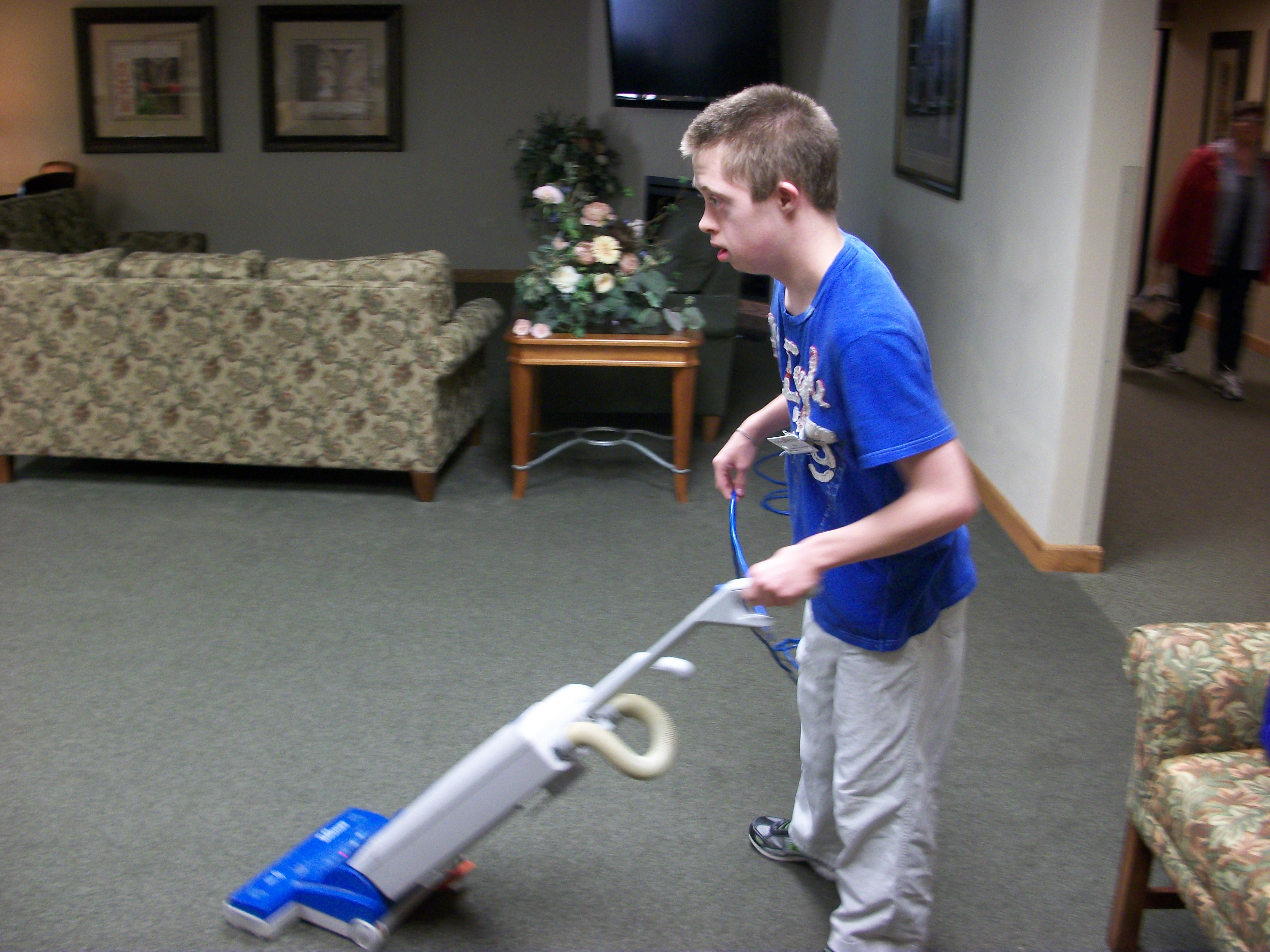
Vocational jobs (cleaning and vacuuming sensory room, recycling, shredding, work  bins, gardening, menu planning, cooking, etc..)

nick vacumming aid

Social circle (News to You, greeting and using AAC devices)

Science projects

Table and bin work

Nick work aid

Arts and Crafts (for art fairs, mothers/father’s day, making cards, painting, etc..)

Recreational (gym activities, yoga, etc..)

Nick yoga AID

Fun Fridays (Holiday theme parties, dancing, karaoke, games, concerts, cookouts, movies, etc..)

Speech therapy (insurance private pay), to work on articulation and using his AAC device

Outside the facility, his group does community recycling, shopping for cooking day as well as volunteer jobs.  One of the sites is at a local church, (stuffing bulletins and cleaning the nursery).  The other workplace is at a food pantry, where they organize and stock inventory, like dried beans, cereal and peanut butter.

Nick recycling

Nick has a full life and rewarding activities in his adult day program. The staff is very dedicated, caring, welcoming and patient.  Yes, patient! Nick’s pulled several fire alarms the last few months.  The behaviorist on staff  has put a plan in  place, and met with the staff to curtail this ongoing problem. Hey, it’s Nick’s world, the rest of us are just trying to keep up. The current fire alarm pull count is now 40 pulls since 3rd grade.

While his speech is limited due to having a dual diagnosis of Down syndrome and autism, I can tell that he is very happy in this program.  How do I know?  When I wake him up in the morning he is excited to get dressed and out the door.  The other day I was driving him and his buddy Josh to the site.  Just before we crossed over the Fox River, Nick started saying “Keeler” with a big thumbs up.  It warms my heart knowing that Nick is happy and contributing to society. That’s what is in my noggin this week.

~Teresa

Follow Nick:

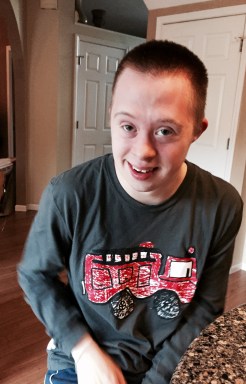
nick fire truck shirt

@Down Syndrome With A Slice Of Autism on:

Facebook  pintrest

#nickdsautism on:

instagram-logo

@tjunnerstall on:

twitter logo


Posted in Autism, Education and Special Needs, IEP (Indivdualized Education Plan)

Blog #153~Special Needs Back to School Tips

Blog #153~Special Needs Back to School Tips

For the first time in 22 years, I don’t have to buy school supplies for my son.  Nick is 22 years old and has Down syndrome and autism.  He aged out of school on his birthday last February.   He attends an adult day program, which he enjoys immensely.  After 22 years I’ve learned a few tricks for getting back to school smoothly with your child that has special needs:

Back to school helpful tips

 5 Special Needs Back to School Tips

1.Look over your child’s IEP (Individualized Education Plan) before school begins.  The IEP outlines academic and functional goals, supports needed, accommodations and services.  Reach out to your child’s case manager/IEP coordinator or Support Teacher, and ask specifically how these will be implemented, and how data will be tracked.

2. Arrange a visit to the classroom before school begins.  Request that a social story (pictures or video); be made of the settings that your child will be in at school, (classroom, lunch room, gym, sensory area, etc.).  If possible have the social story include pictures of support staff and classroom peers. If a child with autism can see it in picture and/or written form, they will better understand it.  This in turn, becomes their blueprint which; will lesson anxiety levels for your child.

Social Story for Back to School:

back to school Nick

3.During the classroom meet and greet, arrange a mode of communication with your child’s teacher.  In the past I have used both email and a communication notebook which goes back and forth.  Since my son is for the most part non-verbal, so this allowed me to share if Nick had a restless night or was maybe he was fixated on fire alarms. (By the way,  he’s been at it again. He pulled a few more alarms this summer, while staff was on vacation. Check the “About” Page for the current pull count).

Communication Book and Daily Activity Chart:

photo (117)

4.Start Early! Get school supplies, clothes and shoes shopping done and haircut at least a week before the start of school.  Having a child with special needs often means a lot of angst over haircuts.  For Nick the stress of getting one can affect him for several days after.  If you would like more tips on haircuts, hit the search box on the top right of this page.  Type in: Blog #18, A Cut Above. The night before school starts, have your child help lay out the clothes, organize the school supplies and pick out lunch/snack choices.  It’s all about having a smooth start to the day and this helps especially at six o’clock in the morning.  One thing that was NEVER EARLY; the school bus.  Make sure you have carved out your schedule accordingly and have something for your child to do while you wait.  On average, we’ve waited 30-45 minutes for the bus to get to our house the first few days of school.

photo (113)

5.Consider doing volunteer work at your child’s school.  It is fun and you can see firsthand how your child is doing in the classroom.

Here are a few school volunteer ideas:

*Holiday Parties

*Art Awareness Presenter

*Chaperone Field Trips

*Field Days

*Picture Day

*Work book fairs

*Library aid

*Special Olympics Practices

*Assist Case Manager/ Support Teacher- Making copies, laminating, helping to create classroom supports.

Nick and I wish you all the best as you start the new school year with your child that has special needs.  Be cognizant of what is in the IEP, follow-up with communication, layout the blueprint for your child and get organized.  That’s the recipe for a smooth start to the new school year.  Oh, and don’t forget to take that cute first day of school picture and post it on Facebook.  That’s what is in my noggin this week!

~Teresa

Nick’s First Day of Kindergarten, 1999……

scan0003

Follow Nick:

@Down Syndrome With A Slice of Autism on Facebook and Pinterest

#nickdsautism on Instagram 

@tjunnerstall on Twitter


Posted in Autism, Down syndrome, Dual Diagnosis Down syndrome and autism, IEP (Indivdualized Education Plan), Physical Therapy and Special Needs, Speech and Occupational Therapy

Blog #152~Lessons From Olympian Simone Biles

Blog #152~Lessons From Olympian Simone Biles

After winning individual gold in the women’s gymnastics all-around on Thursday, Simone Bile’s, in an interview, made a declaration. “I’m not the next Usain Bolt or Michael Phelps,” she said. “I’m the first Simone Biles.”

Simone Biles

Before going to teach spinning class last week, I was rushing around the house getting ready.  Out of the corner of my eye, I caught a glimpse of the Good Morning America interview featuring gold medalist, Simone Biles at the Rio 2016 Summer Olympics.  It struck me that this pint-sized, power house had 4 training tips that packed a lot of punch. I grabbed my coffee, pen and pad to jot down a few bullet points.

Having a child with special needs presents many obstacles in life.  I’ve had my share of them with my son Nick, for the past 22 years.  Nick has Down syndrome and autism.  The low muscle tone (a trait of having Down syndrome) delayed him from reaching gross motor milestones until much later than most babies.  He didn’t sit up until a year old, and he didn’t walk until he was 3 ½ years old.  Nick had to work a lot harder to hit those targets with years of physical therapy.  We’ve also spent 22 years going to speech and occupational therapy to help feeding, communication along with fine motor, sensory issues.

It has been quite a journey, which brings me back to those bullet points I scribbled down.  In the Good Morning America interview, Simone offered up some advice on her training regimen.  They are 4 simple lessons, and my take on they apply to raising a child with special needs:

  1. Enjoy the Ride

The journey isn’t always going to be easy.  It’s going to take a lot of hard work and shedding tears.  And that’s to be expected.  But, find a way to embrace the journey.  Have some fun as you go, and surround yourself with people who make you laugh.

  1. Never Give Up

There will be days, weeks and months where you see no progress.  Sometimes mistakes will be made.  That’s when you pick yourself up and trust that you can do it no matter what.

  1. Trust Your Squad

The fierce five huddled, cheered each other on, and believed in other.  When you have a child with special needs, you have to get a good squad together to help push them to succeed.  This includes the IEP team along with outside therapists.  Huddle in from time to time, and always keep the lines of communication open.  Make sure all the goals and dreams for your child are in sync.  Parents should have their own squad of friends and support groups you feel comfortable with.  Your squad understands the insurmountable pressure faced when raising a child with special needs.

Fab 5 Rio

4. Treat Yourself

After a competition, Simone (whether she wins or not) enjoys pepperoni pizza.  Parents of special needs kids spend a lot more time and energy helping their child reach goals.  It is beyond exhausting. Get a respite worker to watch your child.  Find the things that you enjoy and indulge.  Go out to lunch with girlfriends, get a manicure, go workout, take a trip to Target (alone), enjoy a nap, have a glass of wine.  Treat yourself, you deserve it.

That’s great advice from the 19-year-old Olympian champion.   Life will always have it ups and downs, twists and turns.  But if you can find a way to embrace the journey, you can hit the top of that podium and be the champion of your own life and your child’s.

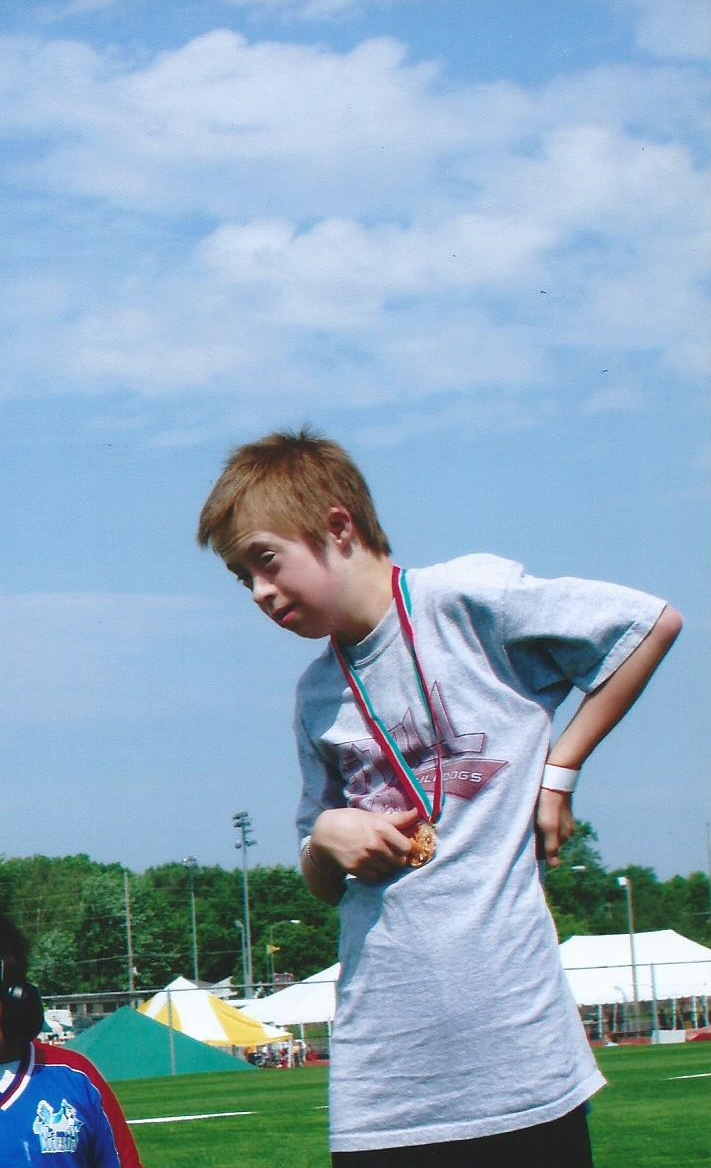
Nick wins the gold for the softball throw at the State Special Olympics~2003

Nick Special Olympics


That’s what is in my noggin this week.

~Teresa

Follow Nick:

Facebook @Down Syndrome With A Slice Of Autism

instagram-logo#nickdsautism

pintrest@Down Syndrome With A Slice Of Autism

twitter logo@tjunnerstall


Posted in Down syndrome, Dual Diagnosis Down syndrome and autism, Parenting Special Needs

Blog #150~A&E’s Born This Way, an Exclusive Interview

Blog #150~A&E’s Born This Way, an Exclusive Interview

A&E’s Emmy nominated series, Born This Way premieres its second season next Tuesday, 7/26/16 at 10pm/9pm (Central).  Born This Way features a cast of seven young adults with Down syndrome.  The show follows each cast member pursuing their real lives with passions, wants and needs the same as any other person their age. It will warm your heart, make you laugh and smile. They shine a wonderful light showing how awesome their lives are. And they’ve got serious swag…..

A&E’s Born This Way premieres, Tuesday July 26th at 10pm/ 9pm (Central)

Trump_Key_Art_Premiere_FIN.indd

Recently, I was approached by the marketing department to partnership with A&E to help bring awareness and promote this show.  My son, Nick is 22 years old and has Down syndrome as well as autism.  So, I was happy to jump at the chance to do so.  Today’s blog post is an exclusive interview with the mother of Sean, a featured cast member on the show.

Sean McElwee is 22 years old.  He’s a dashing young man, an excellent golfer and gifted athlete. Sean thrived in inclusion in primary school and survived exclusion in secondary school.  He attends community college and works at Home Depot. He is a self-professed ladies man, and has dance moves that own the floor.

Sean with his parents Rick and Sandra……

Sean family pic

Let’s get to the interview with Sean’s Mom, Sandra Assimotos McElwee ….

Sandra Assimotos McElwee is an advocate for unborn babies with Down syndrome and created one of the first websites for parents with a prenatal diagnosis. She’s the author of three books,Who’s the Slow Learner? A Chronicle of Inclusion and Exclusion”. McElwee contributed to the books, Gifts: Mothers Reflect on How Children with Down Syndrome Enrich Our Lives“,  and “You Will Dream New Dreams, Inspiring Personal Stories by Parents of Children with Disabilities.” Married over twenty-two years to Sean’s father, Rick, they enjoy traveling and participating in Sean’s sports activities.  A medical sales professional, McElwee’s most important job is being Sean’s mother.

Interview with Sandra McElwee, Sean’s mom:

1.     What advice do you have for parents with younger children and newborns that have Down syndrome?

—Enjoy your baby, don’t get caught up in the ‘what could be’ although I know it’s hard to not think about a future wedding when you have a baby. The dreams you may have, the dreams that you had that may have been dashed by the diagnosis –they will become new dreams and in my case dreams I could never have imagined in my wildest imagination! 

2.  During the age that Sean was in the public school system, what was the most difficult part of the IEP process for you?  Where you happy with the end result of schooling and his IEP.

—I’ve written a book about this—‘Who’s the Slow Learner? A Chronicle of Inclusion and Exclusion.’

Who's The Slow Learner

Sean was an inclusion pioneer, the first student included with a disability in his elementary school. His inclusion was such a success by the 4th grade the school became an inclusive school and there were no segregated classes and around 40 students with a variety of special needs fully included. The wheels fell off in secondary school. So no, I was not happy with the end result, but the first 7 years were text-book perfect.

The most difficult part of the IEP process was in high school when educators and administrators outright lied to me.  

3.  What advice would you give for new teachers and special education teachers who will be working with students that have Down syndrome?

–Please give your students opportunities. Allow them to express their interests and support them in pursuing their interests. Don’t assume just because someone can’t speak clearly that they don’t have something to say—listen to them. And do not expect a person with Down syndrome to have BETTER BEHAVIOR than the typical students.  

4.  What has been your biggest joy and accomplishment raising Sean?  What has been the toughest time and struggle?

–Seeing Sean grow into a confident, independent adult. The toughest struggles have been dealing with the prejudices of educators who limited his opportunities when he was in high school. 

5.  What would you like to share with the world about Sean, Down syndrome and being on Born This Way?

—I want the world to see that Sean and people with DS are more alike than different, they simply needs support and opportunities to show the world their capabilities. 

6.  As a mom of my son Nick, who is 22 years old and has Down syndrome; what are your biggest fears for your son now that he is an adult? 

—My biggest fears are that he will get his heart broken to the point of not wanting to try again…although he really has a lot of tenacity so like most fears, mine is probably unfounded.

I hope that Born This Way and this interview will enlighten and inspire parents, family, friends and educators who have been lucky enough to be touched by a child who has Down syndrome.  Be sure to set your DVR’s for A&E’s Born This Way.  Please share this blog and the additional social media links below.  That’s what is in my noggin this week!

~Teresa

Follow Nick:

scan0016

Facebook @Down Syndrome With A Slice Of Autism

instagram-logo#nickdsautism

pintrest@Down Syndrome With A Slice Of Autism

twitter logo@tjunnerstall


Posted in Autism, Down syndrome, Dual Diagnosis Down syndrome and autism

April is Autism Awareness Month

April is Autism Awareness Month

autism awareness 2016

April is “Autism Awareness Month“.  I am quite aware of autism every day of the year.  My son Nick, is 22.  He has Down syndrome and autism.  He requires constant supervision 24/7, 365 days of the year.  There is some funding through the state which helps pay for his adult day program and respite care.  In addition, he receives Supplemental Security Income monthly.  But this doesn’t come close to covering the costs. Autism is the fastest growing developmental disorder, yet most under funded.

Putting a ribbon on the car bumper is not going to do enough to help families living with autism.

autism ribbon

My hope is for more acceptance, compassion, research, funding and programs to support families living with autism.  And, we need more “family” bathrooms to be accessible in public facilities.  Nick can’t go into the men’s rest room by himself.  It would not be safe for him to go alone.  Not to mention that he would flush the toilet repeatedly, then run every single faucet full blast.

Autism statistics in 2000 were 1 in 150.  By 2010 it was 1 in 68.  Autism is not going anywhere.  In fact, people with autism are growing up and aging out of the school system like my son, Nick.  Families with autism need more support.  We can’t do it alone.  That’s what is in my noggin this week.

~Teresa

Follow Nick on Social Media:

Facebook and Pinterest  @Down Syndrome With A Slice Of Autism

Instagram  @nickdsautism

Twitter @tjunnerstall


Posted in Autism, Down syndrome, Physical Therapy and Special Needs, Speech and Occupational Therapy

Blog #100~20 Tidbits about Nick

Blog #100~ 20 Tidbits about Nick

To celebrate the 100 milestone of this blog “Down Syndrome with a Slice of Autism,” I made a list of 20 things about my son Nick.

Nick 20 years ago, what a little kewpie doll…..

Nick baby

1. Nick was born the day after his Dad’s birthday.

2. Nick was in NICU and on oxygen for one week due to an AV valve in his heart not closing.  Fortunately, this closed up within a week.  He was released from the hospital on Valentine’s Day which was also Ash Wednesday.

Aqua heart

3. Nick started early intervention with speech, occupational and physical therapy at 8 weeks old. They taught him sign language. He worked on a stability ball to build core strength long before it became trendy.

4. Nick was the youngest child to start horseback riding therapy in the early intervention program at age one.

5. We use to prop up pillows on the sides of his high chair to keep him from flopping over to the side, until his core became stronger.

Nick high chair

6. Due to his low muscle tone (a trait of Down syndrome) he didn’t walk or eat solid foods until he was 3 ½ years old.  We did a co-treatment with extensive OT and speech therapy with a feeding specialist using the Debra Beckman feeding technique

7. Nick doesn’t like yogurt or applesauce because I’d mix this awful smelling and tasting Nutrivene Vitamin Supplement into them.

8. To get Nick to pull up to stand, his brother would bounce ping pong balls on the coffee table to catch his attention. I also hung several music toys over the fireplace so he had to pull up to his feet to hear the music. (Hmmmm, maybe that’s why he’s obsessed with pushing buttons.) 🙂

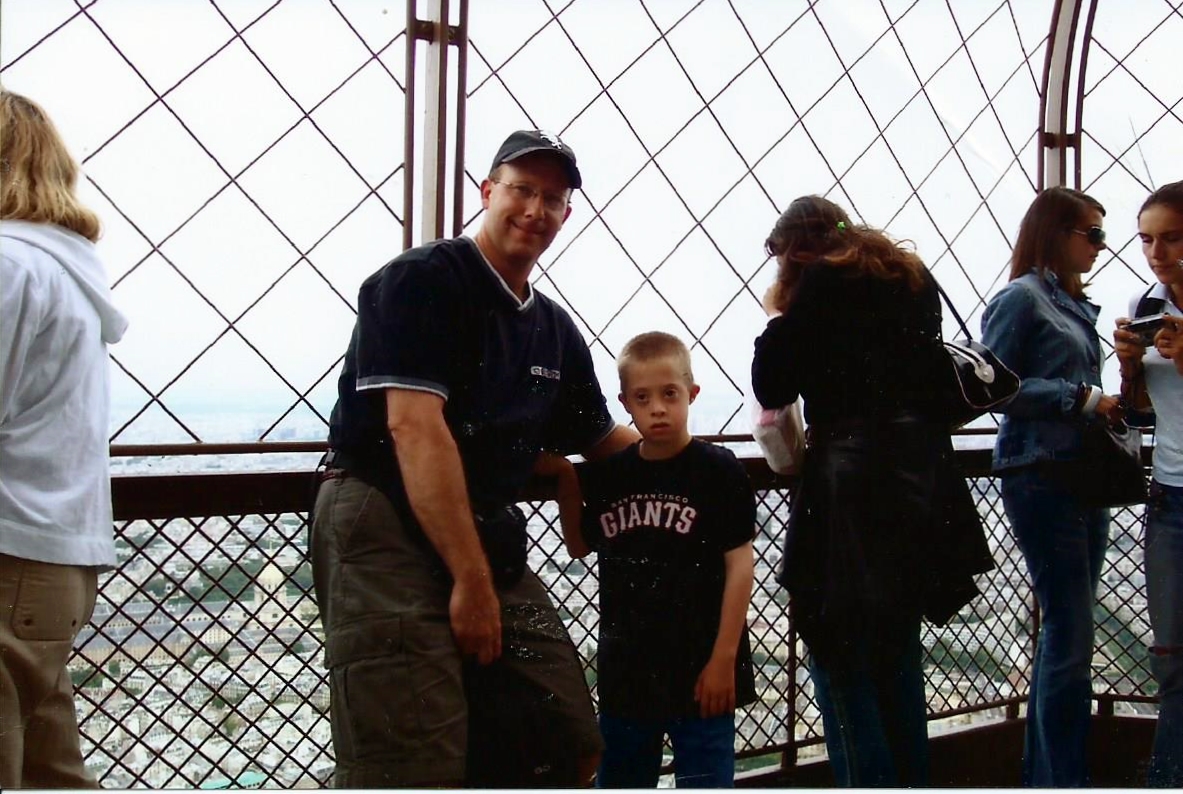
9. Nick has been to the top of the Eiffel Tower and Notre Dame Cathedral.

Nick Eiffel Tower

10. He has been overseas three times including London, France and Spain.

11. Nick can replicate exact sneezes, high and low pitch, big and small ones.

12. He is so flexible that he can sleep with his legs crossed and folded all the way forward.

13. Nick’s a thrill seeker and will sign “more” as soon as a roller coaster ride is over.

14. He hates to wear hat and gloves no matter how cold it is.

Nick sled

Unless he’s indoors :)……….

Nick Winter Ninja

15. Nick’s favorite actor is Eddie Murphy, in the movies The Nutty Professor, Doctor Doolittle, and Norbit.

16. He doesn’t like any fruit at all (except raspberries, that is giving and getting them). He does LOVE salads.

raspberry

17. He won a gold medal in the softball throw event at the Illinois State Special Olympics.

Nick Special Olympics

18. Nick was evaluated for autism at age 5, but didn’t get a formal diagnosis until he was 11 years old.

19. Nick has a thing for dolphins and beluga whales.

Nick Kiss

20. Before the 30 fire alarm pulls, Nick would grab car remote keys and set the alarms off.

Hope you enjoyed the 20 snippets about Nick.  Thank you so much for reading and sharing Nick’s world for the last 100 blogs.   That’s what is in my noggin this week. 🙂

~Teresa

20 Year Old Nick…..

photo (120)

Follow Nick:

Facebook and Pinterest @Down Syndrome With A Slice Of Autism

Instagram #nickdsautism

Twitter @tjunnerstall


Posted in Autism, Down syndrome, Dual Diagnosis Down syndrome and autism

Blog #74~ Teaching to 21

Blog #73~ Teaching to 21
Last week, I was a guest lecturer at Northern Illinois University. The graduate level class topic was “Functional Communication and Social Skills” as it relates to autism. I presented a parent’s perspective.

NIU logo

One of the greatest gifts we can give our kids is teaching personal independence. It’s never too early to start working on these skills. One concept brought to my attention by Nick’s support teacher from elementary school is called, “Teaching to 21.” What skills will an individual with special needs require to lead a successful life after school is finished? Here is a list of skills that should be addressed both in school and at home for students with special needs:

 Assessment of Functional Living Skills (AFLS)

Source: http://autismbeacon.com/topics/article/functional_skills_for_people_on_the_autism_spectrum

“Functional skills” are those skills that if learners cannot do for themselves, someone will have to do for them. Functional skills are immediately useful and important. They increase self-help and independence and are present in every setting and throughout every stage of life:

Basic skills:
Self-management
Basic Communication
Dressing
Toileting
Grooming
Bathing
Health, safety, first aid
Night time routines

Home Skills Module:
Meals at home
Dishes
Clothing
Laundry
Housekeeping
Chores
Household mechanics
Leisure
Kitchen
Cooking

Community Participation:
Basic mobility
Community knowledge
Shopping
Meals in public
Money handling
Phone
Time
Social awareness
Manners

School Skills:
School waiting and transitions
Classroom routines
Meals at school
Classroom people, places and objects
Classroom mechanics
Outside school
Functional academics
Classroom leisure and independence

The IEP team should address these skills in goal planning and daily schedules of the student. In addition, supports should be put in place that will assist the student in reaching these goals. Here are some of the supports that Nick has used in school. Since Nick has a dual diagnosis of Down syndrome and autism, these tangible provisions give him clarity and focus in doing his tasks.

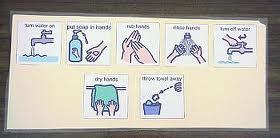
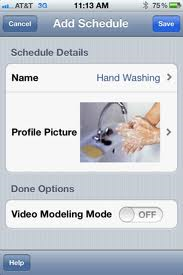
*Visual supports such as task strips, social stories, picture schedules and video modeling:
task strip
*First-then visual or app to remind student what they are working for:
first then

first then app
*Timed Timer clock or app and Picture Scheduler app:

timed timer

picture schedule app
*Physical prompting-teacher may do hand over hand to teach a school and fade back to just pointing to direct student.

*Guiding student with visual cues (putting stickers on washcloths to teach folding sequence, sprinkle hole punch paper dots on floor to teach vacuuming, using counting templates, etc…)

Nick packaging door knobs_Habitat_4 (2)

For students with autism, if they can see it…. they can understand it. In Blog #5~Ready, Set, Action (located in April 2012 Archives) I wrote about how successful video modeling was in teaching Nick skills around the house. He responds to and is motivated by seeing the footage in a video format. It also landed him a community job at a local elder residence care facility.

Nick hard at work 🙂
Nick vacumming_Tabor Hills (3).

Nick takes great pride in his jobs both in the community, school and at home. We continue to work on the skills needed for him to be as independent in all areas of his life so he is ready to manage things when he is finished with school. It’s all about starting early and teaching to 21! That’s what is in my noggin this week. 🙂

~Teresa

Follow Nick on Social Media:

Facebook and Pinterest @Down Syndrome With A Slice Of Autism

Instagram @nickdsautism

Twitter @tjunnerstall

Posted in Augmentative and Alternative Communication (AAC), Autism, Down syndrome, Speech and Occupational Therapy

Blog #69~Down Syndrome, Autism and Speech

Blog #69~Down Syndrome, Autism and Speech

I am often asked about Nick’s ability to produce words given the fact that he has Down syndrome and autism.  He does have a vocabulary including a few expletives that he picked up from us somewhere along the way. I find it interesting how he can say those words pitch perfectly.  This week I have a very special guest blogger.  Brian Sabella is Nick’s speech therapist and shares his perspective on working with Nick at Suburban Pediatric Therapies:  

Speech-Language Therapy and Nick

By Brian Sabella, CCC-SLP

I have been providing clinic-based speech-language therapy for Nick for over four years now. I feel fortunate for the experience for a couple reasons. First and foremost, he absolutely cracks me up—every week. There’s something about his brand of adolescent, slapstick humor that just resonates with me as a fellow male. Additionally, Nick’s family and support system are a pleasure to work with. They hold very high expectations of his communication abilities and understand communication takes other forms besides the spoken word. Nick uses a multifaceted system that includes spoken words, printed pictures, and electronic devices to communicate throughout his day. And as a speech therapist, I love it. For Nick, progress in “speech” means being able to communicate more effectively; it isn’t just about talking!

For those curious about the speech Nick does work on, here is a sample of some words we have practiced and continue to practice: help, Sprite, plate, shower, taco, pasta. With many of these words, Nick is not expected to articulate them exactly as you or I would, but rather, to produce them in a way that a listener would be more likely to understand. The idea is that Nick will probably be handing his conversational partner a picture of a taco anyway, so the spoken word is meant to enhance the communicative exchange. With this specific word, Nick will often produce aco, omitting the t. During our drill practice, I will call attention to my mouth and ask Nick to say it like I do, annunciating that missing t  sound and providing a visual cue (such as pointing near the area of my mouth where the sound is produced). After a correct production is established, Nick is encouraged to say it again a total of five times. Performing a high number of repetitions is always the best way to learn a new movement pattern, whether that movement is a golf swing, a pencil stroke, or a spoken word. Admittedly, speech drill is not one of Nick’s favorite things to do, so his good efforts are always rewarded with a bit of praise or even a small morsel of food.  You know, just to stay on his good side.

Most of my time spent with Nick in therapy hasn’t actually been focused on improving his speech. Some of it has. But I’m actually more concerned with improving Nick’s ability to communicate through other means. The reason for this is because, like many other individuals on the autism spectrum, Nick shows a strong preference for pictures.  He also presents with apraxia of speech, which further complicates matters. This is why at home and at school, Nick’s uses a picture exchange system that helps him communicate during everyday activities.

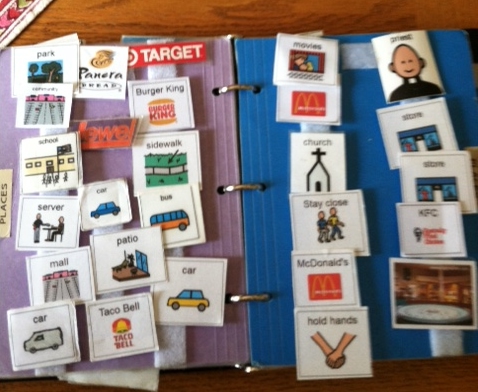
Teresa carries around with her a set of pictures of Nick’s favorite fast food restaurants.  When they are out running errands and it’s time for lunch, she shows Nick the pictures and he points to the logo of the restaurant he’s in the mood for. If he requests Taco Bell (which he usually does) he can then flip to a page that shows pictures of their menu items and he can indicate which ones he wants to order. Much of our time in speech therapy has been spent working on expanding his comprehension and use of these pictures.

photo (123)

Then there’s the Bored Board. As readers of this blog, you know that when Nick is bored, he finds ways of wreaking havoc in extremely creative ways. Picking up on these signs of boredom before Nick decides to dump fajita seasoning on the cat or spill an entire bottle of cooking oil on the floor will allow his parents to redirect these behaviors to something less destructive. The Board Bored shows Nick pictures of more appropriate objects and activities to request: DVDs, computer games, an iPod, a whoopee cushion, Flarp noise putty, a (fake) bloody Halloween hand, a sound effects toy that makes burping and glass-breaking sounds, etc.  Nick and I have spent hours working on requesting with the Bored Board so that he can more effectively use it in a time of need.

0916091611

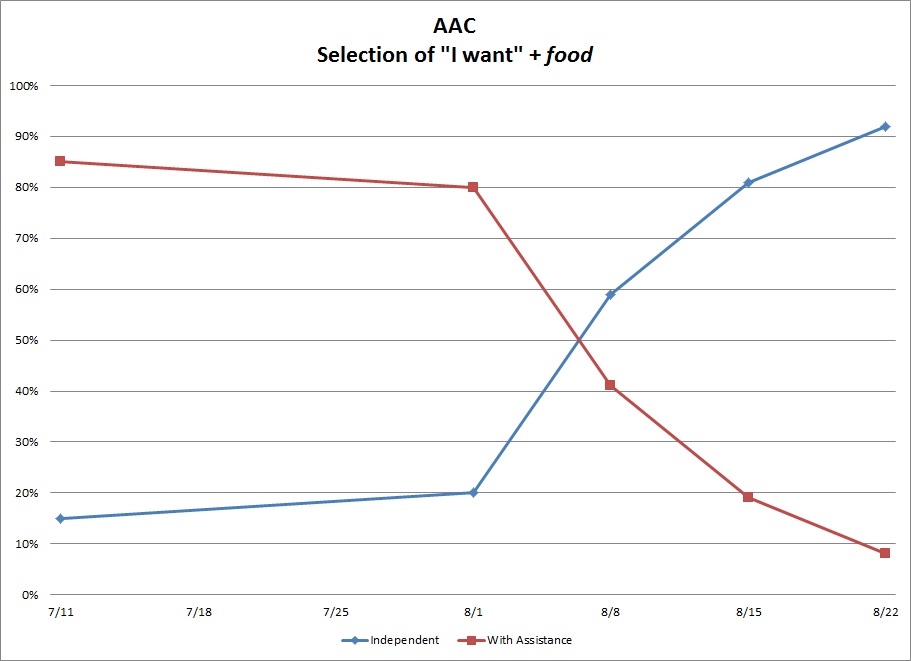
Recently, our sessions have been focusing on having Nick formulate requests using “I want.”  We set up a board using an alternative-augmentative communication (AAC) iPad app called Proloquo2Go. It transforms the iPad, iPhone, or iPod Touch into a high-tech voice output device that helps a person communicate by typing or touching pictures. Nick’s screen displays a variety of preferred snacks and some phrases, including “I want.” Our goal was to have Nick indicate which snack he wanted by pressing “I want” then the snack item.  When he does this, the device speaks the sentence “I want popcorn;” I then reward him with some popcorn.  If Nick only touches the snack item without “I want” first, then I prompt him to press both.

Proloquo2Go

As you might imagine, producing these sentences was initially difficult for Nick.  But over time, he became very good at producing them.  This graph tracks his progress and shows that Nick went from almost always needing support to produce these “I want” requests to, after five sessions, almost always producing them independently.

Graph

As you can see, speech therapy is not always about speech.  For Nick, speech therapy is about helping him communicate effectively, even if it means doing so with pictures or electronic devices. With an alternative system of communication in place, Nick’s life is a little easier.  And his pets are a little safer, too.

Brian Sabella and Nick working at Suburban Pediatric Therapies 🙂 ……

Brian and Nick

Special thanks to Brian Sabella, CCC-SLP for sharing his insights this week.  For more about Suburban Pediatric Therapies check out their website at http://www.sptherapies.com.  As you can see there is much more to communication then just speaking words.  That’s what is in my noggin this week. 🙂

~Teresa

Follow Nick on Social Media:

Facebook and Pinterest @Down Syndrome With A Slice Of Autism

Instagram @nickdsautism

Twitter @tjunnerstall


Posted in Autism, Autism Safety and Wandering, Dual Diagnosis Down syndrome and autism

Blog #60~Wandering and Autism: 7 Prevention Strategies

Blog #60~ Wandering and Autism: 7 Prevention Strategies

Wandering and autism

HEADLINES…… 

“Car hits, kills 11-year-old autistic boy on the Katy Freeway” 

“Body found in pond is missing autistic child” 

“Autistic boy found dead, face down in a lake”

A lost child is a parent’s worst nightmare. Sadly, the headlines above are just a sample of instances involving wandering/elopement and autism all over the country.

Much like the wandering behaviors in seniors with dementia or Alzheimer’s, children and adults with an Autism Spectrum Disorder (ASD) are prone to wandering away from a safe environment.  A study done by The Interactive Autism Network through the Kennedy Krieger Institute found this: “49% of children with autism attempt to elope from a safe environment, a rate nearly four times higher than their unaffected siblings. Two in three parents of elopers reported their missing children had a “close call” with a traffic injury. Thirty-two percent of parents reported a “close call” with a possible drowning.”

I understand this fear all too well.  There have been a several occasions where Nick has wandered, taken off at the pool and bolted down the street.  Nick is 19 years old and has a dual diagnosis of Down syndrome and autism (DS-ASD).  He has deficits in the areas of language and cognitive function which limits his understanding of safety.  He has no concept of danger.

One day when Nick 11 years old he was on the swing set in the backyard.  His Dad stepped inside to grab a baseball hat for a second.  Something made me stop and put down the garden shovel next to the flat of flowers. I walked around to the backyard.   He was gone.

Al came out the patio door.  I shouted to him, “Did Nick go inside?”

“No, I just came in for a second to grab a baseball hat.”

I felt a hot wave run through my body as I climbed up the burm, the slow crested hill that separated the backyard from the busy street.

downsized_0511010726 (2)

Al had recently ruptured his Achilles tendon and was wearing a therapy boot.  He hobbled up slowly behind me.  There was nothing but a stream of fast-moving cars pacing the road behind our house.

 I called out to his older brother, “Hank, go to the front and check with the neighbors and see if anyone saw him okay. Do it now!”

My neighbor came over, “I saw him a few minutes ago.  He got off the swing and started chasing a bunny.”  He pointed his finger left, “He ran that way.”

In the Midwest, the yards blend from one to the next in a seamless row like football fields connected one after the other. I squinted hoping to see some movement.  There was nothing,  just eerie silence. I took off running.  A dozen houses down, nothing.  Over ten minutes had passed since he had gone missing. I was in panic mode, my body was shaking and legs began to fatigue.  I kept sprinting but there were only five houses left before the subdivision entrance.   Suddenly, I saw a small figure running. “Nick stop now!”

He just kept going.  My strides turned into leaps.  I caught up with him 2 houses before he reached the subdivision entrance.  He looked at me as if nothing was wrong.  We walked in silence back home.  I gripped his hand tightly and counted how many houses he had run passed.  Final count=20 houses!

It makes me sick to my stomach recalling that horrible day. We have since put some things in place as a precaution to keep Nick safe. What can families do to insure the safety of their child?  In my research, I found an excellent website called AWAARE which stands for Autism Wandering Awareness Alerts Response Educationwww.awaare.org.  This site has a comprehensive list of tips, materials and tools.

7 TIPS FOR WANDERING AND AUTISM RISK MANAGEMENT:

1. Secure your home

Install secure door locks, home security systems, install inexpensive battery operated alarms on door and window to alert when opened. Place hook and eye locks on all doors above your childs reach.  Fence in the yard and put visuals like stop signs to doors.

Here is what we have on our doors…….

photo (115)

2. Get an ID Bracelet

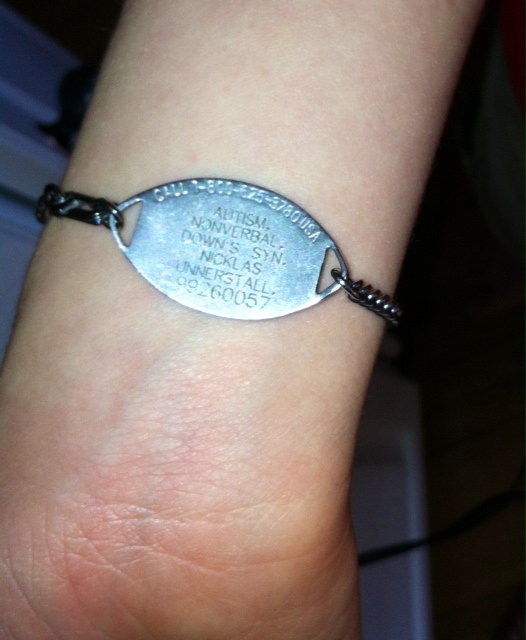
Medic Alert, www.medicalert.org  is what Nick wears and it stays on him firm.

photo (116)

Another popular bracelet is called Project Lifesaver, www.projectlifesaver.org.

3. Consider a mobile tracking device

Project Lifesaver (https://projectlifesaver.org), Angel Sense https://www.angelsense.com) and LoJack SafetyNet (www.safetynetbylojack.com) services have wrist and ankle tracking devices.  There are many other mobile GPS tracking systems you can purchase at Best Buy and other big box stores along with phone apps as well.  See the resource page on the AWAARE website above for more information.

4. Teach your child to swim

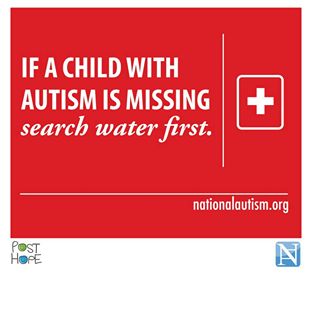
A large percentage of the headlines for wandering and autism end tragically because of drowning deaths.  Children are often drawn to water.  Check your local YMCA or special recreation association for swim lessons.

autism missing pic

5. Alert your neighbors

Make a simple handout with your name, address, phone number, information about your child (autism, non-verbal etc….) and include a photograph of your child.   Ask them to call you immediately if they see your child outside of your home.

6. Alert First Responders

Provide the local police and fire stations with key information before an incident occurs. Ask your local police department if they have a data base and registration program for individuals with special needs. See the AWAARE website given above for printable handouts.  There is also a free Big Red Safety Toolkit with free downloads on wandering and prevention.

7. Work with an ABA Therapist on a Behavior Plan

A BCBA certified behavior therapist can help with understanding the child’s goal and triggers that cause them to wander. The child may be trying to get to something they prefer, or avoid something they don’t want to do. When you can determine the function of this behavior, you can put supports and strategies in place to decrease wandering or bolting. If the behavior is occuring in school, address this with the IEP team and put measures in place to insure safety for your child.

Nick still requires 24/7 supervision and the house is sealed up like Fort Knox.  As a family we have to make sure there is always a designated watchman.  After doing this research on autism and wandering, I understand the necessity to be proactive and more responsible. Next stop: Make a call into the local police and fire stations to see what they have in place for wandering and persons with autism and other special needs in our community.   Discussion of this topic needs to continue.  I will be researching more tracking and monitoring devices.  Look for this on Part Two of  Autism and Wandering within the next two weeks.

That’s what is in my noggin this week!

~Teresa 🙂

Follow Nick:

Facebook and Pinterest @Down Syndrome With A Slice Of Autism

Instagram #nickdsautism

Twitter @tjunnerstall