Posted in Autism, Down syndrome, Dual Diagnosis Down syndrome and autism, Education and Special Needs, IEP (Indivdualized Education Plan)

Blog #239~ Back to School Tips for DS-ASD Families in 2021

Blog #239~Back to School Tips for DS-ASD Families in 2021

As the 2021-2022 School year approaches after a lengthy Covid-19 lockdown, many families feel anxiety about returning to school. Families who have a child with a dual diagnosis of Down syndrome and autism (DS-ASD) have additional challenges and needs to consider.

My name is Teresa Unnerstall, I am a DS-ASD parent, consultant and author of A New Course: A Mother’s Journey Navigating Down Syndrome and Autism. My son Nick is 27 years old and my passion is to help families, educators, therapists, medical professionals and anyone interested in supporting individuals with co-occurring DS-ASD.

Order your copy on Amazon at https://amzn.to/2W3Un6X

This week, I want to offer some practical tips to help families ease back to school. Whether you are in person or remote, the goal should be a smooth transition for students.

Here are my 10 Back to School Tips:

1. Prepare the student with a visual countdown calendar, and re-instate morning/evening routines before school starts.

2. Tour the school with your child. Then, create a social story or video social story of the school settings and staff that the student will be interacting with. Review this several times before school starts.

3. At the tour, whether it’s in person or virtual, ask the teacher to show you the Covid-19 safety precautions, accommodations and equipment that is listed in the IEP to make sure everything is in place.

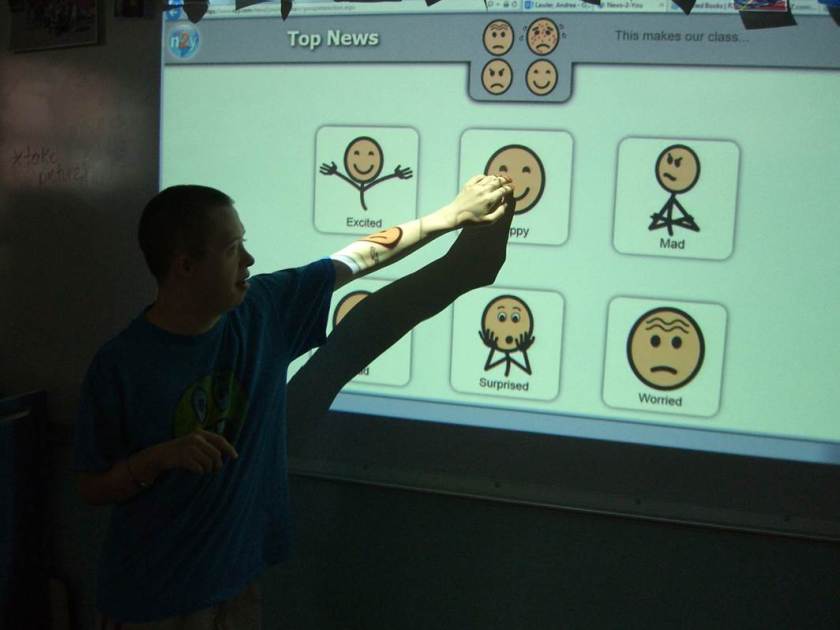
First Then Visuals

Nick using the Smart Board

4. Prepare a student “About Me” profile sheet. There are many templates available online. You can include different sections such as, Things I love, My Strengths, What Works Best for Me, How to best support me, What Doesn’t Work for Me, and Interests. Make several copies to share with the staff.

5. Determine the modes of communication back and forth with the teacher and school staff. Examples include texting, email, communication logs/notebooks and daily report sheets. This is very important as many students with DS-ASD who have language deficits or may be non-verbal.
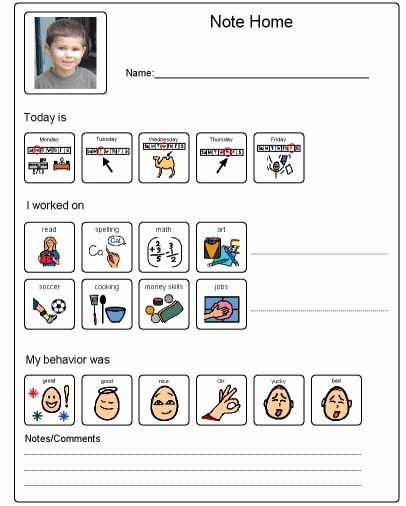
Daily Report Sheet

6. Review the child’s IEP to insure that all goals and accommodations are still relevant. Note any additional needs or concerns you have coming off of the summer break and remote learning. Share these with the staff at school.

7. If the student has a behavior support plan, check to see if this has been shared with all staff and is ready to put in place on day one. Make a list of any new target behaviors that may need to be addressed.

8. If the student uses AAC (Augmentative and Alternative Communication) make sure the teacher and aides are familiar with how to use the program, whether it’s high tech or low tech like a picture exchange system (PECS). You can request a training for staff and parents on how to program devices, navigate tabs and get trained on how to utilize PECS with the school speech and language therapist or school district AAC specialists.

AAC Touch Chat Program

9. Students may have lost skills or experienced regression due to summer break and remote learning due to the Covid-19 Pandemic. Evidenced-based practices help students regain lost skills and develop new ones. Some examples are using visuals, schedules, task strips, task analysis, first-then prompts, visual timers, choice boards and sensory breaks.

Sensory Break PECS Icon, Is there a sensory break area for students in your school?
Time Timer App
Choice Boards

10. Show your commitment by staying on top of your child’s progress. Ask for data within the first quarter. Data drives decision making for future conferences and IEP meetings. If possible, volunteer at school, (room parent, field trip chaperone, art awareness presenter, book fairs, picture day and assisting with making learning materials like laminating and making copies).

Being prepared, invested and aware of your child’s needs will help them reach their full potential for the new school year. As students re-enter school after a long break, let’s also remember to extend each other some grace, be flexible, and give time and space to establish the new normal, whether you are heading back into the classroom or working remotely.

That’s what is in my noggin this week.

~Teresa 🙂

Follow us on Social Media: Facebook, Instagram and Twitter

Posted in Down syndrome, Dual Diagnosis Down syndrome and autism, Recreation/Leisure and Special Needs

Blog #190~Nick & Buddy Up Tennis

Blog #190~ Nick & Buddy Up Tennis

I took my son Nick, to the Buddy Up Tennis program over the weekend.  Buddy Up Tennis is a high-energy, adaptive tennis and fitness program for children and young adults with Down syndrome.  They provide fun and rewarding 90-minute clinics on a weekly basis.  The program currently serves 550 individuals ages five to young adults with Down syndrome across the country.  Honestly, I wasn’t sure how cooperative Nick would be given that he has a dual diagnosis of Down syndrome and autism.  I am happy to report that he participated and followed directions fairly well, for his first time out.

Nick buddy tennis 2

This 90 minute Buddy Up Tennis-Naperville clinic, is held at Five Star Tennis Center.  Athletes are paired with a buddy and start off with a warm up.  Each participant gets to toss the dice and perform a variety of calisthenic exercises like toe touches, push-ups, jumping jacks and sit ups.  Nick needed some prompting on these.  I had to laugh when everyone got down to do push ups and Nick was still standing.  Then about the time he got down on all fours, the rest of the group was up doing jumping jacks. 🙂

fitness dice                Buddy Up Tennis Logo

After the warm-up, the participants break up into groups.  The younger kids use modified equipment and balls on a separate court.  The teens and young adults move to circuit training.  Stations are set up focus on balance, agility, hand-eye coordination and upper body movements that mimic tennis strokes and serves.

Nick navigated each station with prompts, praise and elbow bumps, from his buddies and coaches.  He moved at a slower pace than his peers, and there were a few stations he was less interested in.  But overall, did a good job!

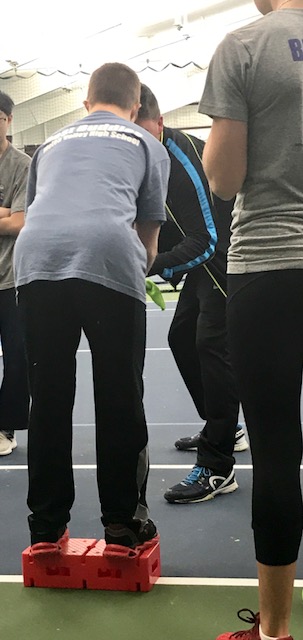
Nick Buddy Tennis balance

After circuit training, the athletes worked on volleys and ground strokes.  Nick needed more prompting and hand over hand assistance, to move through these drills.  But he remained patient and compliant.  It really helped to have a peer partner and the coaches cheering him on, as well as the other athletes modeling appropriate behavior.

Nick buddy tennis

Towards the end of the clinic, Nick did begin to lose interest in hitting tennis balls.  I grabbed a ball hopper, and he and his peer buddy collected balls.  Nick is good at putting things away, so this kept him perked him up and engaged.  For the last 10 minutes, all the groups come together, and play a few rounds of duck, duck, goose. Then, the coaches present certificates to the top awesome athletes for that week.  Nick was awarded one of these for working hard.  Yay Big Guy! 🙂

Overall, I feel the experience was a success for Nick.  I was a little nervous going in, because he can be loud and distracting with the stimming behaviors associated with autism.  However, these behaviors were quite diminished during the clinic.  It reminded me of when Nick was in a full inclusion classroom, when we first moved into the Chicago area, 15 years ago.  Positive peer role models is one of the benefits of placing your child in full inclusion classroom.  When Nick was in a full inclusion classroom, the loud noises, tapping and other stimming decreased.  That alone, makes it worthwhile to enroll him in the next session coming up in January.

I plan on making a few visuals of the calisthenic exercises, circuit stations and sequence of moving through the drills will help with transitioning.  For individuals with autism, it helps to have a picture schedule to assist them in understanding what is expected of them.  If they can see it, they can better understand it.

Buddy Up Tennis is a wonderful program, and I’d like to thank the coaches and volunteers for the opportunity to have Nick be a part of group.  For more information about Buddy Up Tennis, visit their website at http://buddyuptennis.com/

That’s what is in my noggin this week. 🙂

~Teresa

Follow Nick:

Facebook & Pinterest @Down Syndrome With A Slice Of Autism

Instagram #nickdsautism

Twitter @tjunnerstall