Posted in Autism, Fun Side of Nick

Blog #61~Stuff On My Cat Part II

Blog #61~ Stuff on my Cat Part II

Stuff + Cats= Awesome

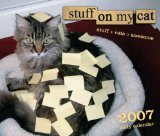
stuff on my cat book

That’s the motto for the internet phenomenon called “Stuff on my cat.”  Here’s what Amazon wrote about this book by Mario Garza:

“It began with a handful of digital photographs of office supplies, toys, and spare computer parts thoughtfully placed on Mario Garza’s snoozing cat, Love. Over time, the objects became bigger: remote controls, shoes, empty pizza boxes. And then cat owners everywhere were sucked into the Internet phenomenon that is defined by a simple motto: stuff + cats = awesome.  Culled from the thousands of outrageous photographs submitted by mischievous animal lovers, here are 200 of the most unbelievably entertaining images of cats with all manner of things on them: wigs, Easter eggs, dogs, cheeseburgers, cookware, gummi bears, action figures, tiaras, beer cans, pinecones, a statue of the Buddha, and much more. An introduction by the site’s creator explains the Stuff on My Cat philosophy, and playful illustrations and graphics are sprinkled throughout.”

In Blog #33~Stuff On My Cat (located in the December 2012 Archives), I wrote and shared numerous pictures of random objects we put on our cats over the years.  Why do we do this?  I have to embrace Mario Garza’s philosophy to answer this one.  Our cats rule the house.  Sleeping all day long wherever the sun radiates, claiming the fresh, warm laundry as their “personal paradise” and plopping on your lap even if you just want to sit down for a second.

God forbid you disturb them.  I have to contort my legs with bizarre yoga moves  slinking out of bed so as not to disturb her slumber. She wields her power at 5:00 a.m. letting out piercing cries and meows that sound as if you haven’t fed her in a week.  So, why put stuff on our cats?  Mario Garza is right on his philosophy:  “There is a very satisfying shift of power going on.  Now I’m in control when I sneak up behind her while she naps and put a pancake on top of her head-checkmate.” 🙂

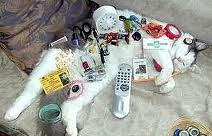
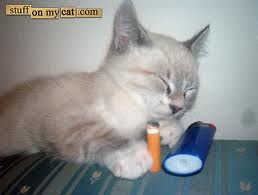
Check out a few from the website www.stuffonmycat.com……

stuff on my cat loaded

stuff on cat with cig

stuff on my cat glasses

stuff on my cat post its

Nick loves to do this too,  he is 19 and has Down syndrome and autism.  Here are some of the stunts he’s pulled on our 16+ year old  tabby……..

photo (121)

Mellie has some company, Nick’s plush animals and a Taco Bell dog….

photo (122)

Another deluge of toys along with a package of microwave popcorn…..

photo (128)

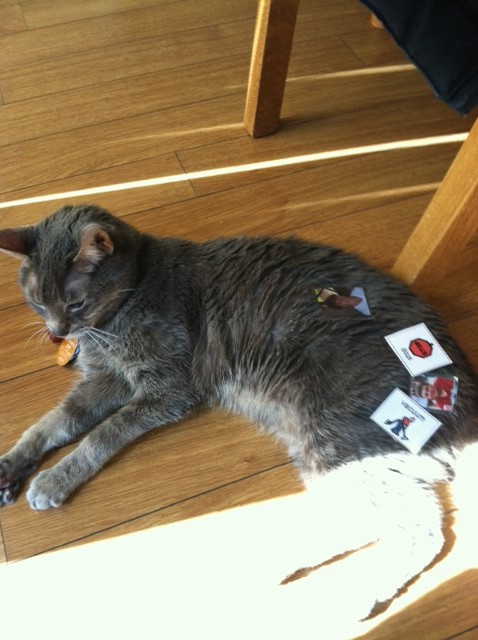
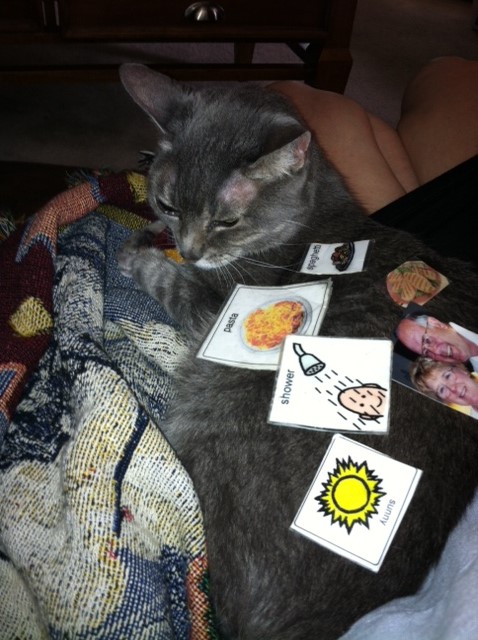
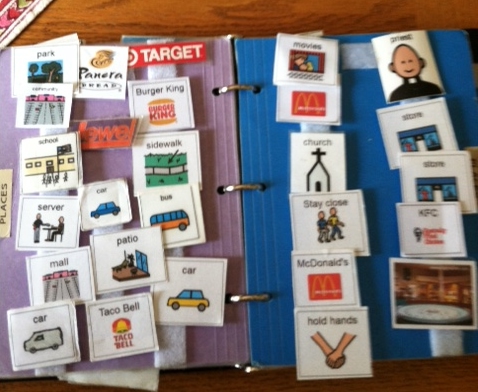
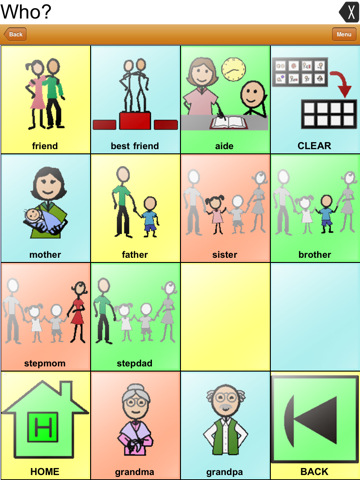
Mellie is trying to relax in her 1:00 p.m. sun spot.  Nick had other ideas his PECS icons, (Picture Exchange System.) I think he was communicating that he missed his brother, Hank and friend/respite worker, Bobby……

photo (123)

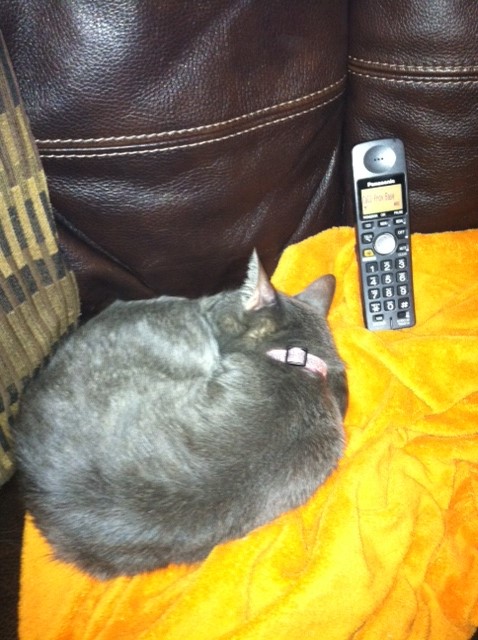
Apparently Nick thinks Mellie is expecting an important call…. 🙂

photo (119)

More fun with PECS icons….Nick mapped out his agenda last Friday…….

photo (124)

“Oh Kitty, go get me some Sprite please!”

photo (127)

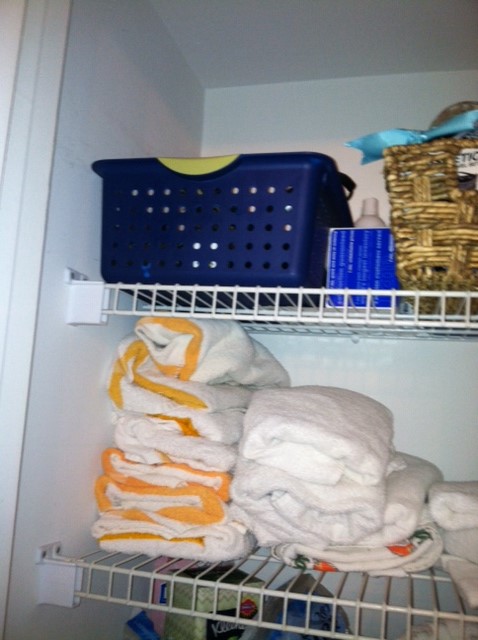
I get a kick out of how creative Nick is and appreciate his mischievous side.  Here is one of Nick who had been “stimming” (a trait of autism) with my makeup mirror. He fell asleep next to the cat who had melded herself to a warm towel out of  the dryer…… apparently the cat doesn’t hold a grudge….. 🙂

IMG-20121123-00001

Speaking of being mischievous, here are a couple I did.  Oh I just can’t resist every once in awhile…. hee, hee, hee…… 🙂

Cinco de Mayo Mellie….. Ole!

photo (130)

“The Graduate”

photo (129)

Hope you enjoyed the second installment of stuff on my cat.  Next week I will get back to part two of “Wandering and Autism”.  Sometimes its fun to be mischievous. That’s what is in my noggin this week, meow!

~Teresa 🙂


Posted in Autism, Autism Safety and Wandering, Dual Diagnosis Down syndrome and autism

Blog #60~Wandering and Autism: 7 Prevention Strategies

Blog #60~ Wandering and Autism: 7 Prevention Strategies

Wandering and autism

HEADLINES…… 

“Car hits, kills 11-year-old autistic boy on the Katy Freeway” 

“Body found in pond is missing autistic child” 

“Autistic boy found dead, face down in a lake”

A lost child is a parent’s worst nightmare. Sadly, the headlines above are just a sample of instances involving wandering/elopement and autism all over the country.

Much like the wandering behaviors in seniors with dementia or Alzheimer’s, children and adults with an Autism Spectrum Disorder (ASD) are prone to wandering away from a safe environment.  A study done by The Interactive Autism Network through the Kennedy Krieger Institute found this: “49% of children with autism attempt to elope from a safe environment, a rate nearly four times higher than their unaffected siblings. Two in three parents of elopers reported their missing children had a “close call” with a traffic injury. Thirty-two percent of parents reported a “close call” with a possible drowning.”

I understand this fear all too well.  There have been a several occasions where Nick has wandered, taken off at the pool and bolted down the street.  Nick is 19 years old and has a dual diagnosis of Down syndrome and autism (DS-ASD).  He has deficits in the areas of language and cognitive function which limits his understanding of safety.  He has no concept of danger.

One day when Nick 11 years old he was on the swing set in the backyard.  His Dad stepped inside to grab a baseball hat for a second.  Something made me stop and put down the garden shovel next to the flat of flowers. I walked around to the backyard.   He was gone.

Al came out the patio door.  I shouted to him, “Did Nick go inside?”

“No, I just came in for a second to grab a baseball hat.”

I felt a hot wave run through my body as I climbed up the burm, the slow crested hill that separated the backyard from the busy street.

downsized_0511010726 (2)

Al had recently ruptured his Achilles tendon and was wearing a therapy boot.  He hobbled up slowly behind me.  There was nothing but a stream of fast-moving cars pacing the road behind our house.

 I called out to his older brother, “Hank, go to the front and check with the neighbors and see if anyone saw him okay. Do it now!”

My neighbor came over, “I saw him a few minutes ago.  He got off the swing and started chasing a bunny.”  He pointed his finger left, “He ran that way.”

In the Midwest, the yards blend from one to the next in a seamless row like football fields connected one after the other. I squinted hoping to see some movement.  There was nothing,  just eerie silence. I took off running.  A dozen houses down, nothing.  Over ten minutes had passed since he had gone missing. I was in panic mode, my body was shaking and legs began to fatigue.  I kept sprinting but there were only five houses left before the subdivision entrance.   Suddenly, I saw a small figure running. “Nick stop now!”

He just kept going.  My strides turned into leaps.  I caught up with him 2 houses before he reached the subdivision entrance.  He looked at me as if nothing was wrong.  We walked in silence back home.  I gripped his hand tightly and counted how many houses he had run passed.  Final count=20 houses!

It makes me sick to my stomach recalling that horrible day. We have since put some things in place as a precaution to keep Nick safe. What can families do to insure the safety of their child?  In my research, I found an excellent website called AWAARE which stands for Autism Wandering Awareness Alerts Response Educationwww.awaare.org.  This site has a comprehensive list of tips, materials and tools.

7 TIPS FOR WANDERING AND AUTISM RISK MANAGEMENT:

1. Secure your home

Install secure door locks, home security systems, install inexpensive battery operated alarms on door and window to alert when opened. Place hook and eye locks on all doors above your childs reach.  Fence in the yard and put visuals like stop signs to doors.

Here is what we have on our doors…….

photo (115)

2. Get an ID Bracelet

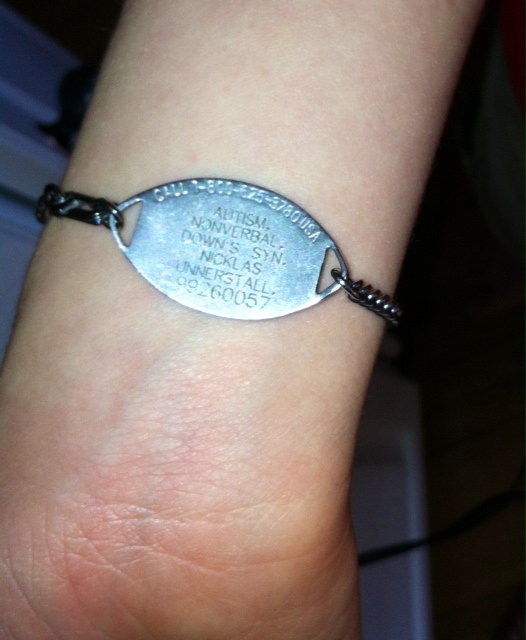
Medic Alert, www.medicalert.org  is what Nick wears and it stays on him firm.

photo (116)

Another popular bracelet is called Project Lifesaver, www.projectlifesaver.org.

3. Consider a mobile tracking device

Project Lifesaver (https://projectlifesaver.org), Angel Sense https://www.angelsense.com) and LoJack SafetyNet (www.safetynetbylojack.com) services have wrist and ankle tracking devices.  There are many other mobile GPS tracking systems you can purchase at Best Buy and other big box stores along with phone apps as well.  See the resource page on the AWAARE website above for more information.

4. Teach your child to swim

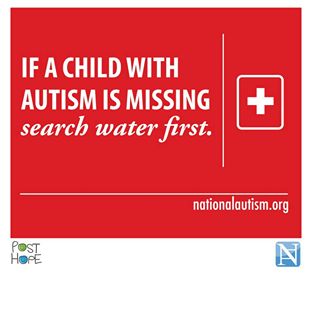
A large percentage of the headlines for wandering and autism end tragically because of drowning deaths.  Children are often drawn to water.  Check your local YMCA or special recreation association for swim lessons.

autism missing pic

5. Alert your neighbors

Make a simple handout with your name, address, phone number, information about your child (autism, non-verbal etc….) and include a photograph of your child.   Ask them to call you immediately if they see your child outside of your home.

6. Alert First Responders

Provide the local police and fire stations with key information before an incident occurs. Ask your local police department if they have a data base and registration program for individuals with special needs. See the AWAARE website given above for printable handouts.  There is also a free Big Red Safety Toolkit with free downloads on wandering and prevention.

7. Work with an ABA Therapist on a Behavior Plan

A BCBA certified behavior therapist can help with understanding the child’s goal and triggers that cause them to wander. The child may be trying to get to something they prefer, or avoid something they don’t want to do. When you can determine the function of this behavior, you can put supports and strategies in place to decrease wandering or bolting. If the behavior is occuring in school, address this with the IEP team and put measures in place to insure safety for your child.

Nick still requires 24/7 supervision and the house is sealed up like Fort Knox.  As a family we have to make sure there is always a designated watchman.  After doing this research on autism and wandering, I understand the necessity to be proactive and more responsible. Next stop: Make a call into the local police and fire stations to see what they have in place for wandering and persons with autism and other special needs in our community.   Discussion of this topic needs to continue.  I will be researching more tracking and monitoring devices.  Look for this on Part Two of  Autism and Wandering within the next two weeks.

That’s what is in my noggin this week!

~Teresa 🙂

Follow Nick:

Facebook and Pinterest @Down Syndrome With A Slice Of Autism

Instagram #nickdsautism

Twitter @tjunnerstall

Posted in Augmentative and Alternative Communication (AAC), Autism, Fun Side of Nick

Blog #59~ The Sleuth Detective

Blog #59~ The Sleuth Detective

The iPod has disappeared, here we go again…..geesh.  One of the many “gifts” that Nick has given me besides razor sharp reflexes is a keen eye as a sleuth detective.

inspector klouseau

Things have a way of vanishing into a *black hole around here.

black hole

Since Nick has Down syndrome and autism and limited verbal skills, I can’t exactly ask him to back track his steps to find his iPod.  I showed him the media bin where it’s should be kept as I signed the word, “help.”

photo (125)

Then, I pointed to the icon in his communication book asking him where is it?  I am met with a blank stare.  So, I take off to check the usual spots.  First stop, behind the couch….nada.  Next, a peer underneath my bed….nil. Now I have to do some back tracking.  When did he have his iPod last?  Over twenty minutes have past as I searched the house.  Then I remembered he was hanging out in Hank’s room.  I do a full room scan for a few minutes then zero in on the bed.  I pulled the comforter back…..bingo!

photo (121)

A few weeks ago I thought I was losing my mind.  I had a stack of letters sitting on the kitchen counter that I was going to mail the next day.  Poof, they were gone.  I sent a text to Al to see if he had mailed them…… nope.  I followed the trail again checking the usual spots….crickets……

“Oh great, now what?  Please don’t be in the trash.”

I dug my way down the garbage, picking through as coffee grounds and gunk stuck to my hands.  No luck.

detective

Finally I had one last thought.  I opened the door to the basement that is in a state of disarray after being flooded  from the spring rains in April………

photo (115)

There’s an hour of my life I will never get back. 

What is the worst thing that has vanished in the black hole?  The entire contents (10 pages) filled with icons out of Nick’s communication book.  I spent a day and a half a day sniffing out every trail I could think of that Nick might have taken.  I couldn’t imagine having to make all those icons, laminate and apply the Velcro again.

Noooooooooooooooooooooooooooo!

photo (116)

I went into the bathroom to see if he might have flushed them down the toilet. Well, it wouldn’t be the first time.  In Blog #21~ What is Normal?  (located in the September 2012 archives), I wrote about the time my leopard reader glasses went missing.  I always keep them next to the laptop in the same place.  The next day Sergio, our plumber was fixing a clogged toilet……

photo (113)

“I found out why your toilet was clogged. You can still wear theeeese glasses they were in clean water, not poopy water.”

Leopard readers back in it’s rightful place…..

photo (124)

The toilet flushed just fine, what a relief…..  The next day, I went to get Nick’s work bins that are stored on a high shelf in the laundry room.  I glanced inside one.  He had emptied his book one by one and put them all in here.  Whew……Thank goodness! 🙂

Communication Book restored, we dodged a bullet on that one…..

photo (123)

The phone went missing a few weeks ago. The phone is easy to find since you can hit the intercom button, but not this time.  Finally I discovered it tucked in the blue bin where I keep my blow dryer. Normally I just reach up and pull the dryer out, but last Thursday and I pulled the whole bin down.  Mystery solved, inside there it sat, the long, lost uncharged phone.

photo (122)

It seems as I write this piece there is a pattern emerging.   Nick definitely likes to drop things, but then other times he likes to put them up in those high bins. Note to self for the next thing that drops into the black hole. There are no lessons
to be learned this week.  It’s just a slice of life in Nick’s world…. The rest of us are just trying to keep up!  That’s what is in my noggin.

~Teresa

*According to Wikipedia:  “A black hole is a region of space-time from which gravity prevents anything, including light, from escaping.[1] The theory of general relativity predicts that a sufficiently compact mass will deform space-time to form a black hole. Around a black hole, there is a mathematically defined surface called an event horizon that marks the point of no return. The hole is called “black” because it absorbs all the light that hits the horizon, reflecting nothing, just like a perfect black body in thermodynamics.”

Posted in Autism, Down syndrome, Education and Special Needs

Blog #57~ Community Jobs and Nick

Blog #57~ Community Jobs and Nick

How does someone who has special needs of both Down syndrome and autism find work in the community?  This week I am excited to have a guest blogger.  I asked Sara Stoodley, the Vocational Coordinator at Nick’s high school to write a few thoughts on Nick’s jobs.   In Blog #46~ A Day in the Life of Nick (located in the March 2013 archives) I wrote about a typical day at school along with his community jobs. He has some in school jobs such as working in the cafeteria, washing PE clothes and shredding.  Out in the community he worked at three different sites.  He worked at Tabor Hills (elderly residence home) doing maintenance, Re-Store- Habitat for Humanity (packaging and maintenance) and Adopt Pet Shelter (sorting newspapers for the animal cages.)  I think it is interesting to get different perspectives on Nick. 🙂 Here’s what Sara had to share:

Community Jobs and Nick

By Sara Stoodley, Vocational Coordinator MVHS

Nick working cookies

It’s hard to believe it’s been two year since I began working with Nick-what a wild ride! In my 10 years of working in this field, Nick is one of the most unique individuals I have ever worked with!  When I began at Metea last year, I began developing work training sites for ALL of our students, and I never imagined Nick not being a part of that. Through his time in community work block, he has increased his endurance, time on task, initiative, and his willingness to try new experiences. Given who Nick is, you must always be on your toes! Overall, Nick has had more good days than bad, and when they’re good they’re GOOD, but when they’re bad, they’re BAD.

Two stories come to mind:

THE GOOD: In his last week at Tabor Hills, he had an amazing day!!!! Each week, his job is to vacuum an area within the facility. All year, at both sites in which he vacuums we have been working with him to independently get the vacuum, unravel the cord, plug it in, turn on the vacuum, and start working. Most times, Nick needs a prompt to complete each of the steps as he will lollygag, get distracted, sit on the floor, etc. However, on this day, he completed the whole process by himself!!! What a huge accomplishment for Nick! It was also very rewarding for the team of people that he works with to see that he does have it in him 🙂

Nick tabor hills

THE BAD: Two words-FIRE ALARM! Nick always has staff with him 1:1 while he works and everyone that works with him is aware of the thrill the sounds of a fire alarm have on him.  However, one day last year, he was a sneaky little fox at Tabor Hills, a supported living facility, and identified an alarm that he had not previously recognized and he got it!!! Can you imagine the panic that went through the staff that was with him, the residents, the facility staff, and the community? Staff immediately responded to alert the administrators that it was indeed Nick who pulled the fire alarm and that there was no immediate danger but in the moment, YOWZA! Great response by all and well Nick, he was pretty proud of himself  🙂

firelite-pull-station

The team is only as strong as its members. In my time working with Nick, it has always been a team. Given my role in the building, the opportunity for 1:1 time with students is limited so I rely on Nick’s team (Teachers, Support staff, Speech Pathologist, Social Worker, Occupational Therapist, etc) to assist me in finding the balance, learning his needs, and working to support the development of work skills while always striving for more for both him and our employers!

Nick has strengthened my belief that all students deserve and should be out working. He has increased my marketing repertoire as I have, at times, had to work to keep him at the job sites given who he is as an individual.  He has reminded me that there is never a dull moment and to always be on my toes as you never know what he is going to throw at you! What a pleasure and experience it has been, thank you Nick!

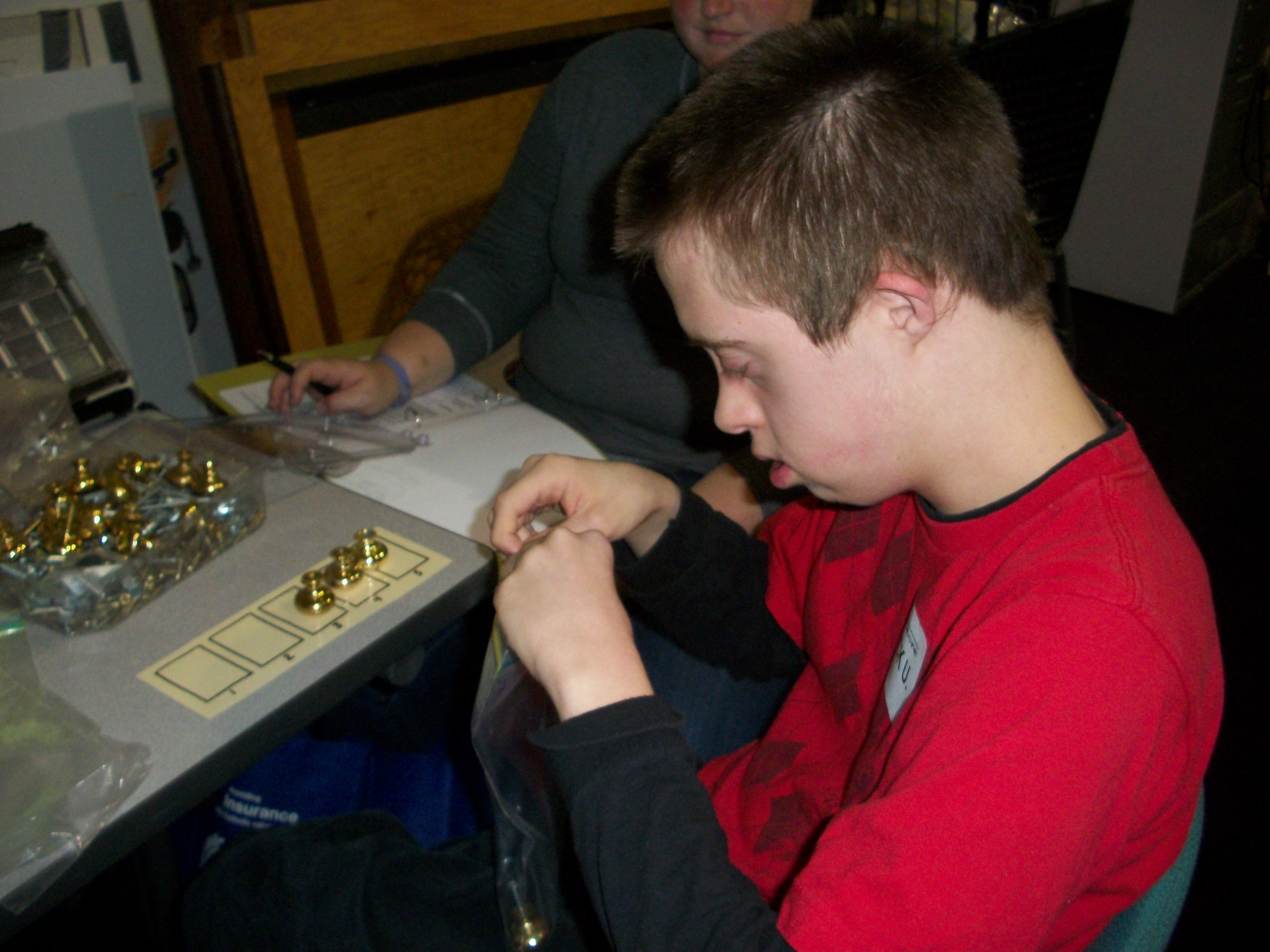
Nick doing packaging at Re-Store- Habitat for Humanity with Miss R…….

Nick packaging door knobs_Habitat_4 (2)

A special thank you to Sara Stoodley for sharing her perspective of how Nick operates in his community jobs.  That’s what is in my noggin this week. 🙂

~Teresa

Posted in Education and Special Needs, Fun Side of Nick

Blog #56~ Cap and Gown…. or just gown?

Blog #56~ Cap and Gown…. or just gown?

I unfurled the gown and hung it up so the crease marks would begin to loosen.  While the iron warm up I took a look at the cap and tassel and put it on my head.

“Hmmmmmm, ten bucks that’s not going to stay on Nick’s head.”

If you think about it the graduation cap is a silly looking thing.  You try to walk and the tassel is bouncing around, dangling in your face.  The hat never sits firmly on your head.  Who came up with such a dumb looking cap for such a scholarly milestone?  Here are a few facts I pulled off of Wikipedia about the cap and gown:

cap and gown

 Graduation portrait of Linus Pauling wearing a mortarboard, 1922

“The square academic cap, graduate cap, or mortarboard] (because of its similarity in appearance to the hawk used by bricklayers to hold mortar) or Oxford cap, is an item of academic head dress consisting of a horizontal square board fixed upon a skull-cap, with a tassel attached to the center. In the UK and the US, it is commonly referred to the mortarboard is generally believed by scholars to have developed from the biretta, a similar-looking hat worn by Roman Catholic clergy. The biretta itself may have been a development of the Roman pileus quadratus, a type of skullcap with superposed square and tump.”

I wasn’t sure what moment the tissues would be needed that day.  It happened when I got down the stairs holding the freshly pressed gown.  I saw the family gathered in the living room then it hit me. Gulp, eyes welled up with tears.  So much had happened in the last 19 years to get Nick to this day.

photo (116)

photo (119)

Armed with an icon strip I made early that morning, we dropped Nick off with Miss R, his teacher.

photo (115)

We waited anxiously for the moment when Nick would be walking in with his senior class.  The processional-*Pomp and Circumstance always gets to me. It’s a powerful song that never ceases to put a lump in my throat, symbolizing pride and valor and victory.  We waited as the classmates fill in the rows of chairs, knowing that with our last name it would be awhile.  Then he appeared…….Big guy Nick!

IMG-20130526-00100 (2)

The first thing I noticed was that he wasn’t wearing his cap….. shocker, right 🙂  He followed the line compliantly with his bare head and distinctive double cowlicks.  I couldn’t help but see how much shorter he stood next to his peers.  At least we could spot him easily amongst the 600+ students.

IMG-20130526-00101

I guess we didn’t need to waste that Google search on whether the tassel is worn on the left or right side. 🙂 

IMG-20130526-00105

The senior reflection address given by the Salutatorian made mention of one thing that caught our attention.  “Metea Valley Class of 2013, we have been pioneers for the last four years.  Together we have survived the ACT’s and the winter fire drills of 2009….”  Looks like Nick indirectly got a shout out. 🙂

scan0001

Considering the size of his class, the ceremony moved swiftly as the roll came from two sides in rapid fire. Nick made his way up to the podium to accept his diploma.  So far so good!  Wait, not so fast……plop there goes the diploma.  The person presenting the diploma picked it up and handed it back to Nick who proceeded to drop it a second time.  Then, as Nick reached the stairs at the end of the stage, he tossed it to the floor.  By now there was a log jam of students lining up behind him trying to get back to their row of seats.  Well, at least he sat quietly and was appropriate through the rest of the ceremony.  Plus, we dodged the DeKalb Fire Department getting called to the scene. All in all, it was a grand day full of family, love, laughter and wait for it…….

You guessed it, chocolate cake!

photo (121)

It was a blessing to have my family in from Texas.  Thanks to Babs, my mom, Laura, Scott, Jenna and Jake for making the trek up.  Al’s parents Jim and Theresa were also a part of the celebration.  Milestones such as graduations much like birthdays are benchmarks to pause and look back at the life we have lived.  If you haven’t read Blog #41~Back to the Future, located in the February 2013 archives I would highly recommend you doing so (don’t forget to grab the tissues.)  Having a child who has Down syndrome and autism has been full of challenges.  His obstacles have been enormous.  Hundreds of hours of physical, occupational and speech therapy, 17 IEP meetings along with blood sweat and tears have molded Nick into the young man that he was meant to be.

scan0016

It’s been one heck of a ride, and I couldn’t be more proud of Big Guy!  That’s what is in my noggin this week. 🙂

~Teresa

*”Pomp and Circumstance” was composed by Sir Edward Elgar (b. 6/2/1857 d. 2/26/1934). “Pomp and Circumstance” was first performed on October 19, 1901 in Liverpool, England. As the students commence onto the stage they are handed their diplomas and given a handshake. It is at that point the students flip the tassels on their hats.

Posted in Autism, Down syndrome

Blog #48~Joy and Sorrow

Blog #48~Joy and Sorrow

Yesterday during the homily at mass the message began with the feeling of true sadness for those who witnessed Jesus dying on the cross.   Then just imagine days later what it must have felt like to see the rock pushed way from the tomb and find it empty.  But then Jesus reveals himself as having risen and bringing the great message of eternal life. What an array of emotions.  The depth in which we experience a range of feelings can be overwhelming. The homily message was this…..  Life is like that with the ebb and flow of joy and sorrow.

Rewind 19 years ago to the moment Nick was born.  “It’s a boy!  Does he have all his fingers and toes?”  He did and he was beautiful.  He was smaller than his brother and his hair was lighter. He was perfect. 🙂 We were elated!  Within ten minutes, they whisked him out of the room for further examination.  He was having breathing difficulties.  The room became silent.

Like a light switch the emotions flipped from joy to fear.  Time ticked away as I sat there deserted waiting to find out if my baby was okay.  Cold and alone under a bare sheet and thin blanket, I braced myself.  It seemed like forever until the doctors came back with Al.  Fear was replaced by sorrow.  I saw it all over their faces.  I could tell the news was not going to be good.  Two words:  Down syndrome.  These two words would change our lives forever.

I never saw Down syndrome as the end of the world. After a week in ICU, the breathing tube and monitors were unplugged and we were able to bring him home.   It was more like entering a different world.  Emily Pearl Kingsley wrote this poem about her experience.  She has a son who has Down syndrome.

“Welcome to Holland”
I am often asked to describe the experience of raising a child with a disability – to try to help people who have not shared that unique experience to understand it, to imagine how it would feel. It’s like this: When you’re going to have a baby, it’s like planning a fabulous vacation trip – to Italy. You buy a bunch of guide books and make your wonderful plans. The Coliseum. The Michelangelo David. The gondolas in Venice. You may learn some handy phrases in Italian. It’s all very exciting. After months of eager anticipation, the day finally arrives. You pack your bags and off you go. Several hours later, the plane lands. The stewardess comes in and says, “Welcome to Holland.” “Holland?!?” you say. “What do you mean Holland?? I signed up for Italy! I’m supposed to be in Italy. All my life I’ve dreamed of going to Italy.” But there’s been a change in the flight plan. They’ve landed in Holland and there you must stay. The important thing is that they haven’t taken you to a horrible, disgusting, filthy place, full of pestilence, famine and disease. It’s just a different place. So you must go out and buy new guide books. And you must learn a whole new language. And you will meet a whole new group of people you would never have met. It’s just a different place. It’s slower-paced than Italy, less flashy than Italy. But after you’ve been there for a while and you catch your breath, you look around…. and you begin to notice that Holland has windmills….and Holland has tulips. Holland even has Rembrandts. But everyone you know is busy coming and going from Italy… and they’re all bragging about what a wonderful time they had there. And for the rest of your life, you will say “Yes, that’s where I was supposed to go. That’s what I had planned.” And the pain of that will never, ever, ever, ever go away… because the loss of that dream is a very, very significant loss. But… if you spend your life mourning the fact that you didn’t get to Italy, you may never be free to enjoy the very special, the very lovely things … about Holland. – Emily Pearl Kingsley

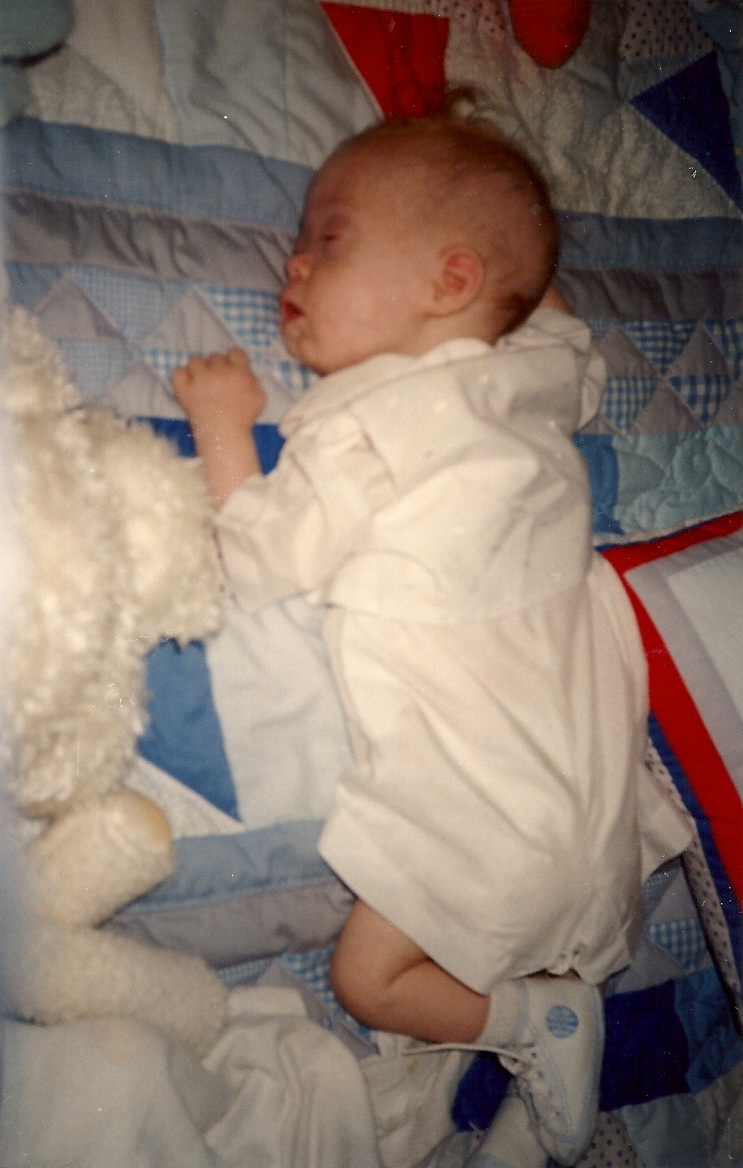
Baby Nick sleeps contently after his christening.  See how baggy his white jumper looks with his low muscle tone………

scan0001

Our trip to Holland, while unexpected was filled with joy and sprinkled with sorrow.  There were twinges of jealousy on occasion wishing my child could do the normal things that most children naturally did. But what was much more devastating was the second diagnosis of autism.  The trip to Holland took a bad turn to what resembled Siberia. This change in flight plans changed the game entirely.  For me, this is when sorrow took over.  This new world felt isolated.  My son didn’t fit in with the Down syndrome support group anymore.  The autism groups all seem to have children who were higher functioning both academically and stronger verbal skills.  I felt lost and found myself pulling inward.

Eventually, I plucked myself up, got out of the funk and sought support.  Little Friends Center for Autism helped me educate myself and offered trainings to help my son navigate his world better.  The National Association for Down Syndrome (NADS) offered a retreat for families with a dual diagnosis.  This is where we found parents who “got it.”  We all shared similar stories.  Some which we dared not to tell anyone else before as it would be too shocking.  We laughed and cried as we commiserated.  We found a new home.

Right now the days are filled with more joy than sorrow.  But like all of us there are times where I feel overwhelmed and sad.  I try to remember what saved me. Stay plugged in and ask for help. Always keep the faith that there will be better days ahead.  That’s what is in my noggin this week.

~Teresa

This smile brings me great joy…….. 🙂

060406_19341


Posted in Autism, Down syndrome, Education and Special Needs

Blog #46~A Day in the Life of Nick

Blog #46~A Day in the Life of Nick

This morning I am prepping for Nick’s IEP meeting to be held at 11:51 a.m.  I review all of the progress reports that I requested ahead of time. It is essential to get those reports early so you know what is going on.  Plus it saves time during the meeting.  I have more tips in Blog #24~Top Ten Things I have Learned While Navigating Nick through School, (located in the October archives). I want to give you a glimpse into the day in the life of Nick’s world at school.  What does someone like Nick who has Down syndrome and autism (lacking reading and writing skills) work on in school?

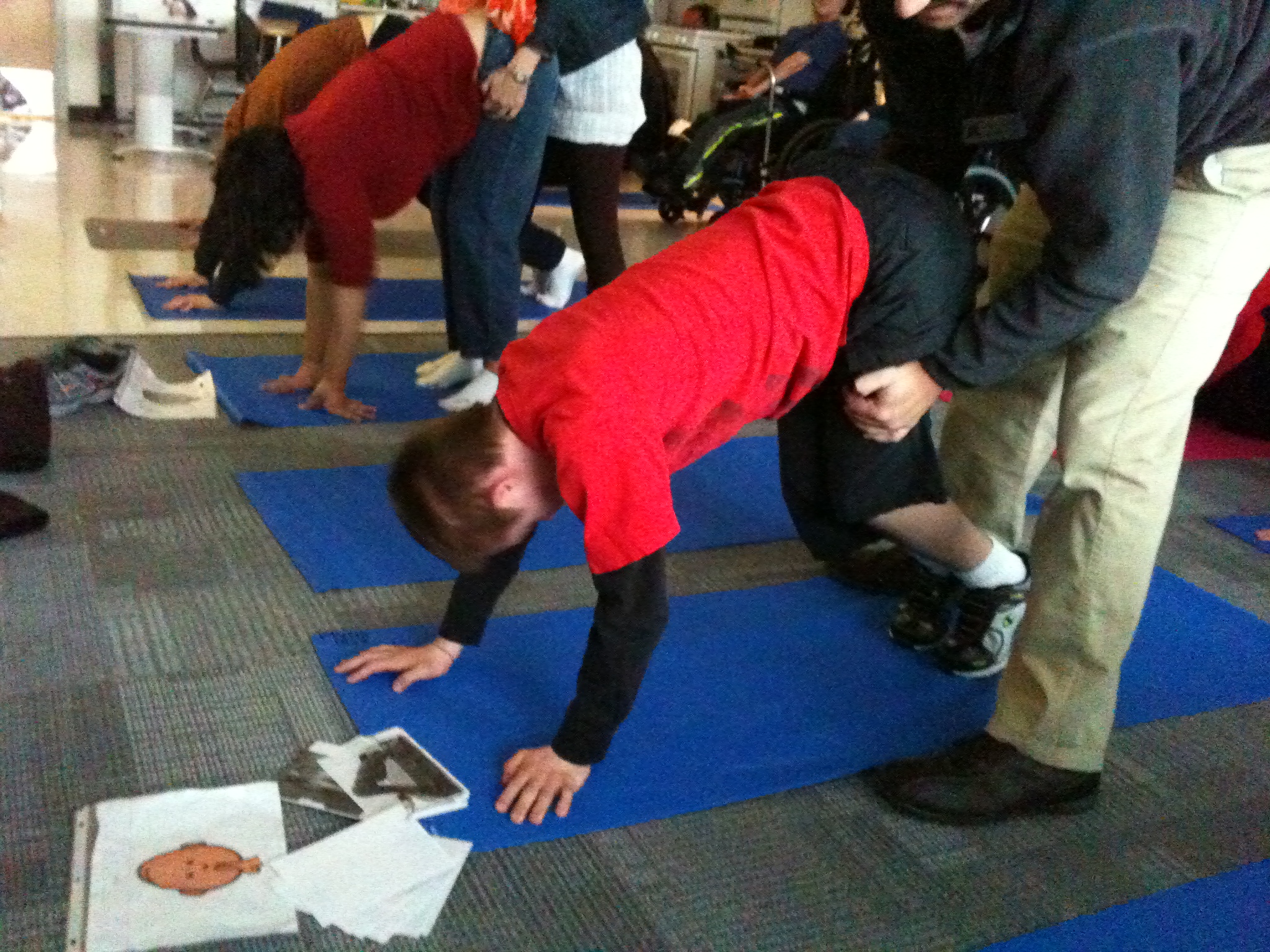
His day starts early, the skies are still dark when the bus rolls up at 6:30 a.m.  Most mornings Nick is dragging but when I mention it’s a community day he tends to perk up a little quicker.  The first two periods of Nick’s day are called “Life Skills.”  The class looks at the calendar, works on dates, upcoming events and the weather.  Nick enjoys telling others about the weather and is consistent in picking out the correct icon and working the weather page on his iPod Touch Chat program. After calendar, the students practice yoga.  They are following the “Get Ready to Learn Yoga Program.”

nick_yoga2

This is followed up with reading skills working on IEP goals of community safety words and pictures, computer programs and group news sharing session of current events.  On Thursdays there is a cooking unit.  Nick loves it and has tried several new foods this year including chili mac, waffles, pancakes, chocolate chip cookies and spaghetti tacos.  Now I am hungry! 🙂

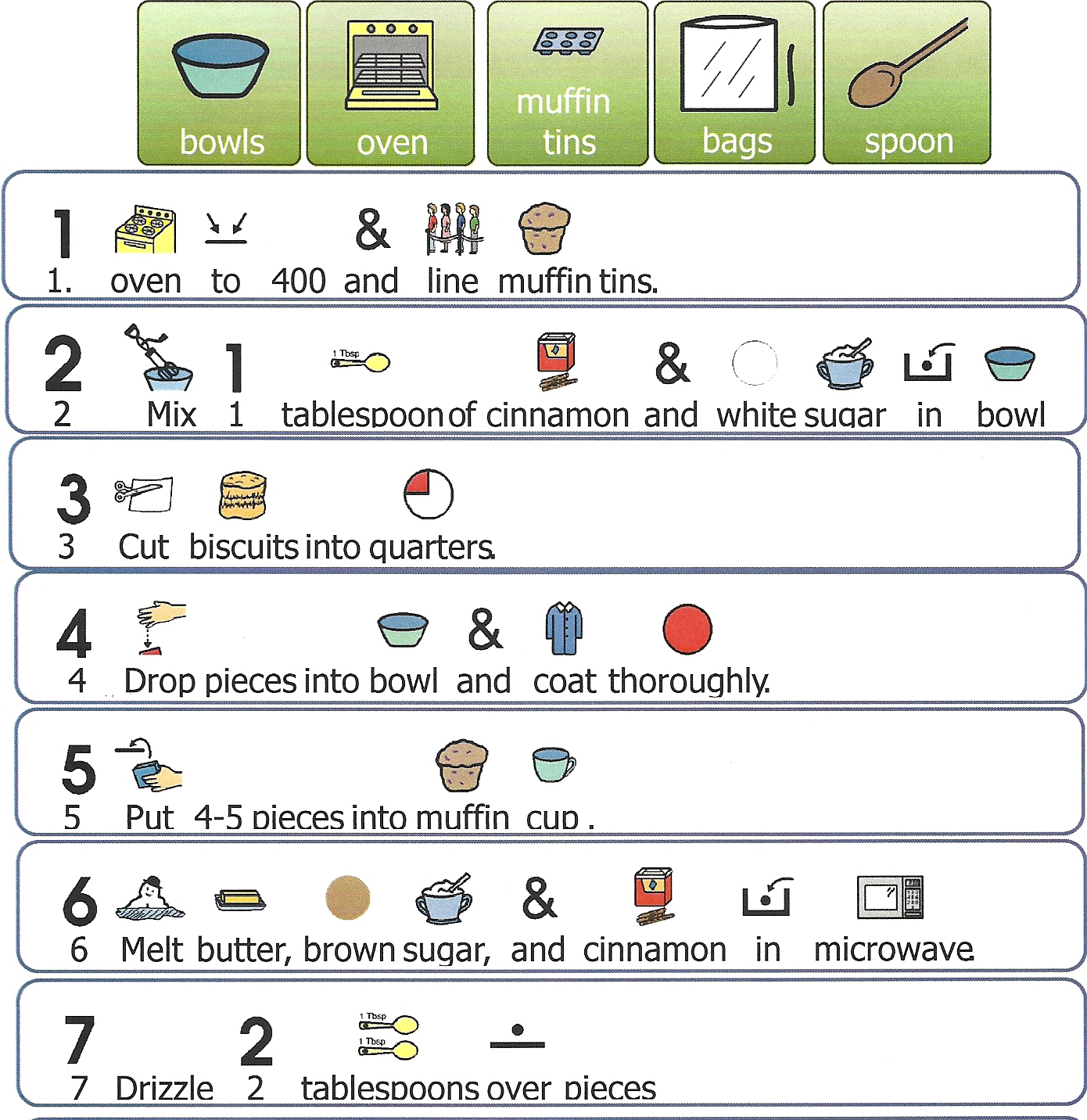
Here’s an example of a recipe they use at school for monkey bread…….

scan0002

Third period is called “Home Maintenance.” During this time Nick prepares a simple snack.  He makes a choice using either his picture icons or iPod Touch Chat.  He likes Cheezits, pretzels, popcorn, salami and cheese. Here he is able to practice fine motor skills like cutting and opening packages with the occupational therapist.  He also works on hygiene skills, (brushing teeth, putting on deodorant and body spray, etc…).  For practical information and visual supports about hygiene and dressing be sure to read  Blog #22~Grooming 101 (located in the September archives).

Nick takes adapted physical education in fourth period.  Units include soccer, swimming, basketball, volleyball, badminton, kickball, adventure education and walking.  He really enjoys the interaction with peer buddies in class.  Period five is lunch time. 🙂

APE swimming 006 (4)

In the afternoon for periods six through eight, Nick has “Vocational and Community” skill building. Nick is working at job training sites three days a week.   These include Tabor Hills (retirement home) and Re-Store (Habitat for Humanity) where is responsible for vacuuming.

Nick vacumming_Tabor Hills (3)

His third job is at Adopt (animal shelter) where he removes leaflets from stacks of newspapers for cages.  On the other days he has school jobs which include shredding, work bins, rental laundry.  Wednesdays I have no problem getting Nick out of bed. It’s community day. 🙂 He enjoys it and is so happy being out and about.  The activities include dining out both at fast food and sit down restaurants, mall walking and shopping at Wal-Mart for groceries to use in the cooking unit.  Here he works on his goal to pay with a debit card.

Nick trying on sunglasses at the store…… He’s looking pretty fly!

018 (2)

He can manage a grocery cart (with reminders to not purposefully run into items or people)

Ramming speed ahead! You should see Nick barreling through Costco 🙂

grocery cart

That is the day in the life of Nick in high school.  His days are filled and structured during the week from 6:30 a.m. until 2:30 p.m. He loves going to school and enjoys the staff (and giving them a run for their money.) That’s what is in my noggin this week.

~Teresa

Posted in Augmentative and Alternative Communication (AAC), Speech and Occupational Therapy

Blog #45~Can We Talk?


Blog#45~Can We Talk?

How does someone like Nick who has Down syndrome and autism communicate his needs and wants?  Let me start at the beginning.  When Nick was in the infant program he was taught sign language.  He would sign “more, all done, yes, no and other basic words.”  Using sign language gave him a voice when the low tone of having Down syndrome slowed up his speech.

When he was around 4 years old I began to snap photographs and put them on one of those blue school pocket charts.  These pictures included things he enjoyed like juice, Goldfish, Thomas the Train and Barney videos. These worked great and he understood all of them.

In first grade I requested an assessment to see if he would do better with an augmentative and alternative communication device. According to  About.com, Augmentative communication is an alternative way to help students and adults with language disorders use expressive language or receptive language. Augmentative communication can be accomplished through assistive technology devices such as computers or hand held devices. Low technology such as picture communication systems can also be used as augmentative communication.

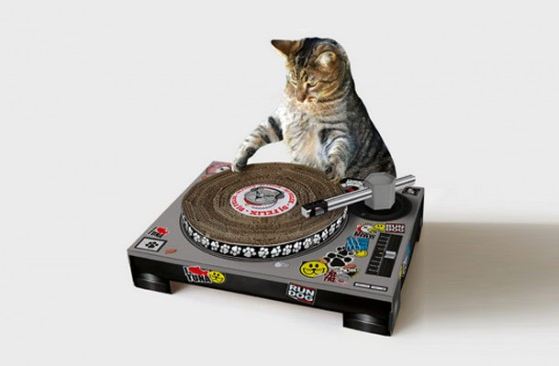
The evaluator came out to the home to try some of the voice output devices with Nick.  He just stimmed on the devices,  hitting the buttons rapid fire like a DJ scratching a rap record.

Cat-DJ-Scratch-Set-1

The evaluator concluded that it would serve Nick better to use a low tech picture system to help him communicate.  She gave me a handful of laminated pictures (goldfish, chicken tenders, pasta, milk, juice and Coke.) They were like rare, gold coins that I treasured. (There was nothing like Google Images back when he was 6 years old.) You either had to snap photographs, cut out pictures out of magazines or beg for icons from the speech therapist. Note that around this time, Nick was also diagnosed with Verbal Apraxia of Speech which further complicated his ablility to articulate.  For years, Nick used pictures and sign language to communicate his needs.

Since Nick can’t read or write and his verbal skills are limited, he needs support.  What we learned is that someone like Nick who has autism tends to see things clearly with pictures.  If he can see it, he can understand it.  In fifth grade the school team was trained on how to use the PECS (Picture Exchange Communication System). There is a precise protocol to the system.  Once the protocol was followed, Nick made great strides in using the pictures to communicate wants and needs. He finally had a voice! 🙂

The cost of buying the software used by most schools is steep as well.  A Mayer-Johnson Boardmaker program can be $400-$800 dollars!  However, if you are a parent you can purchase these programs for 1/2 price. 🙂  Also if your CD gets damaged (aka, Nick dropping it from the second floor) they will replace it for no charge.  Check with your support teacher, as they should have access to this software and will make any laminated icons you might need for home use.  In addition, check with your local library and agencies like Easter Seals to see if they have it available to check out.

Most of the time Nick puts the pictures and icons on a velcro strip and hands it to the caregiver.  However sometimes he gets a little more creative. 🙂

“Hey Mom,  I’ve laid out my plan for what I want to do now”……..

photo (116)

Poor Kitty, nap interrupted………..

photo (117)

The next re-evaluation came in middle school.  The team decided to try Nick on a voice output device.  He was given a set amount time to just play and stim on it.  But then, he began to understand that the device was to be used to communicate.  There are all sizes and the cost for these can be thousands of dollars. Nick’s was around $8,000 dollars.  The Dynavox V was the Cadillac of AAC (Augmentative and Alternative Communication)  devices that would grow with Nick. This was provided by the school district. We found out later that the Dynavox V had major drawback.  It was that it was heavy and bulky.

Dynavox V or as we named it “The Brick”……

photo (115)

After a few years with the Dynavox,  We looked into other devices that would be more portable and less obtrusive. We ditched the “Brick” and moved to an iPod touch loaded with a program called Touch Chat.  Another popular program is called Proloquo2Go.  I like Touch Chat because you can upload your own pictures as well as using theirs. Both programs are excellent. The iPod is protected and enhanced with sound using a case with speakers- (iMainGo Speaker case.)

imaingo case

In essence, it is an electronic version of his PECS communication book.  He still needs a lot of practice using it properly without stimming on it.  The jury is still out on whether this will take over as his primary means to communicate.

Touch chat screen….

touch chat pic

Finding the means to help Nick’s communicate continues to be a work in progress. If he is on the phone with you he might say hi and your name if he recognizes your voice.  But mostly he will smile and wave.

photo (118)

He continues to use some verbal speech,  sign language, Pecs picture book and the iPod Touch Chat.  It’s like walking down the stairs.  Sometimes you need to hold onto the handrail and sometimes you don’t.   All of these communication methods are his handrail that support and facilitate his speech.

I have learned that there is no perfect way to help with speech.  All of these serve him and have their drawbacks.  It’s always good to have the backup PECS book in case the batteries die or the device goes for an unexpected dip in the pool. I hope this gives you some insight into the evolution of Nick’s way of talking through the years.  That’s what is in my noggin this week.

~Teresa 🙂

Posted in Education and Special Needs

Blog #43~Taking the Next Step after High School

Blog #42~ Taking the Next Step after High School

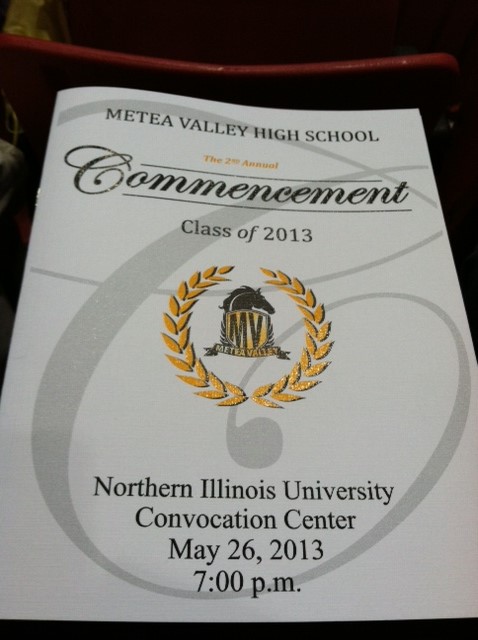
In a few months, Nick will be walking across the stage to accept his high school diploma.  We are not doing the typical things you do for the senior year.  No need to reserve the tux or limo for prom.  It’s not in the cards to visit any college campuses.  And ten bucks says that the hat and tassel are going Frisbee air born as he crosses the stage at the NIU Convocation Center.  Question is….. What does someone who has Down syndrome and autism resulting in severe cognitive and speech delays plan to do after high school?

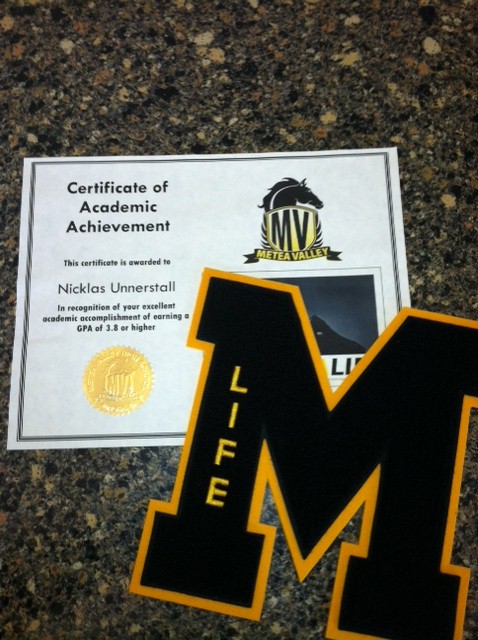
Actually, since Nick has not met the academic requirements needed for a diploma, he will receive a “certificate of completion” upon graduation.  He did letter in high school and a look at that GPA.🙂

photo (117)

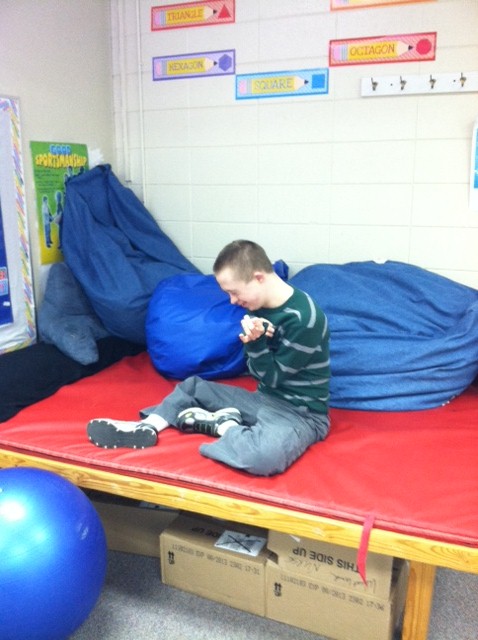
Once the “certificate of completion” is put on the shelf, we move into the next phase for Nick.  The program is affiliated with the school district and called STEPS (Supported Training Experiences Post-Secondary).  Under the *IDEA law, a student with special needs may continue with high school or enter a transition program up until they turn 22 years old.  The decision for placement is based on the child’s individual needs.  Students with developmental delays may benefit more by having extra time to work on vocational, social/leisure, self-help skills along with their educational training.  Many students who are higher functioning academically may be able to take college courses and have paid jobs.  Last week we had the opportunity to visit the campus and get a closer look at the STEPS program.  Al attended the first session.  I followed up with Nick since we had to do a team tag with him and went to the second session geared for graduating seniors.  While we waited for the second meeting, Nick and I took a tour of the building. By the way, all but one fire alarm is not covered but I bet it will be soon.🙂  He loved the campus, especially the sensory room.

photo (116)

So here’s what I learned about the next phase for Nick.  The STEPS program is designed to build a bridge between school life and adult life.  The focus is to identify what services are needed and what linkages need to be made to help your child be successful in adult life.  The questions not to ponder are as follows:

1. What does Nick need to connect to the next level of adult life? 

2. When finished with public school, what type of work will Nick be involved in (paid job, volunteer work?) 

3. Will Nick participate in a vocational and/or life skills day training program or enroll in a degree-seeking program?  

4. Upon completion of public school what arrangements need to be made for independent living (community activities, living arrangements, sports and recreation, transportation, healthcare, financial support, emotional support)?  How do we plan to access them? What supports are needed?  

So the task at hand is to figure out what Nick is good at and also what he likes to do.  From there we work with the team to build a program with this in mind.  The three main areas are educational and vocational training along with building his independent living skills.  Each classroom has a function in the building.  There is a kitchen to work on cooking skills.  One classroom is built around vocational skills (with can crushers, shredders, work bins, and the campus micro-enterprise that includes making note cards and beaded jewelry.) A current STEPS student has her own business making beaded jewelry.  Check it out at http://www.specialsparkle.com!  Another room is for fitness and recreation filled with music, a Wii gaming system and comfy couches.  There is also a sensory room along with a few others that are used for academics and working on self-help skills (like time management, money handling, riding public transportation, etc…) Again, the program is centered on the individual their goals and getting them to that place by the exit date which is the day before their 22nd birthday.  I should add here that some students exit earlier if they reach a place where they are working independently at a paid job.

So Nick will have new jobs next fall and opportunities to do community service along with social functions (clubs, dances, bowling, etc…) It looks much like what he is already doing in high school but more laid back (no school bells, the students manage their own schedules.)  Looks like I will need to get an app for that.

photo (2)

I felt better after seeing the campus and visiting with the staff.  Amazing how the anxiety level goes down when you can actually get a visual of what lies ahead.  Now all I need to do is answer all those questions above, yikes!  Maybe I’ll go make a cup of tea and mull over it. I’ve got a few weeks until Nick’s IEP meeting. 🙂

photo (115)

That’s what is in my noggin this week, stay tuned maybe I’ll have some answers by mid-March!

~Teresa

*From Wikipedia: The Individuals with Disabilities Education Act (IDEA) is a United States federal law that governs how states and public agencies provide early intervention, special education, and related services to children with disabilities. It addresses the educational needs of children with disabilities from birth to age 18 or 21[1][2] in cases that involve 14 specified categories of disability.  In defining the purpose of special education, IDEA 2004 clarifies Congress’ intended outcome for each child with a disability: students must be provided a Free Appropriate Public Education (FAPE) that prepares them for further education, employment and independent living.[3]

Under IDEA 2004:

  • Special education and related services should be designed to meet the unique learning needs of eligible children with disabilities, preschool through age 21.
  • Students with disabilities should be prepared for further education, employment, and  independent living.
Posted in Fun Side of Nick

Blog #42~Love, Nick Style

Blog #42~ Love, Nick Style

Last week over Valentine’s Day I got to thinking about the ways in which Nick shows love, affection and compassion.  How can a person having both Down syndrome and autism do so without being able to use many words?  I threw the question out there to those who are closest to him.  I found some interesting responses along with a few similar, underlying themes about love, Nick style.

love america style

What a great show bordering on naughty for the 1970’s.  Anybody remember it? It was must see TV! 🙂

What is love?  According to Wikipedia, Love is an emotion of a strong affection and personal attachment.[1] Love is also said to be a virtue representing all of human kindness, compassion, and affection —”the unselfish loyal and benevolent concern for the good of another”.[2] Love may describe compassionate and affectionate actions towards other humans, one’s self or animals.[3]

The famous balcony scene from Romeo and Juliet. 1884 painting by Frank Bernard Dicksee. Courtesy of Wikipedia.….

RomeoandJuliet pic

As Nick’s mom, I feel his love freely with the kisses he gives me.  They are cute little pecks on my cheek or sometimes on my shoulder.  He gives those to his Dad and brother and even the cat sometimes. I see it in his eyes that gleam when he is happy.  I sense it when he offers up his neck for me to blow him some raspberries.  I know it when I come home from a long evening out and the icon strip has my picture on it. I see this time again with the picture icons.  He will hand me one with his Dad, grandparents, aunts, uncles, brother, teachers and former respite workers like Jess and Mr. T.  I know he misses them and wants to see them.  The day after my father passed away, he handed me the picture of my Dad on a gloomy, snowy morning in October.  I held it and gave him a hug.  As I looked out the window fighting back tears the sun’s rays began to peek out behind the clouds.

sun rays

Al’s parents noticed this too.  Here is what Jim and Theresa U. had to say about how Nick shows love. One thing comes to mind that, I think, is pretty specific.  I think when he puts his “icon” on your shoulder or lap, or wherever, it shows that he has trust that you will listen to his request for whatever the icon shows.  I also think that the fact he even picks us out in a crowd indicates that he likes us and knows that we like him too and are willing to honor his request.  It is a way of getting our attention and showing affection. I think “high-fives” and hugs are a definite sign of affection.  Also, he loves to be “kissed” on the side of his neck, too!  It’s really not a kiss that he wants but he does come to you for some affection…..in his own way.”

Nick with Gma Theresa…..

008

Nick’s teacher, Daina Hunt had some interesting insights from the school setting…

“I think Nick has many ways in which he shows his feelings of love, affection, and compassion.  Physically, he does a great job by sharing elbows, rubbing noses, high fives, etc. I think that Nick is very affectionate with adults with whom he has built strong relationships. I also feel like Nick’s sense of humor is something that he shares with those he is close to.   

I’ve also seen Nick have a “crush” on another student this year.  He often picks her when he has to take turns and often watches to see what is going on with her when we are in the classroom.  When she becomes upset, Nick will quickly look to her and raise his voice in protest too.  Now, I understand that Nick is not a fan of noise made by others, but his reaction to this student is unique.   

I’ve seen Nick’s compassion extend even farther to others.  He is good at mimicking others emotions, and pointing out emotions (think about the sad egg t-shirt). He also has a genuine side of compassion.  I have had staff tell me that Nick has cried after watching others cry. 

From my own personal experience, I can say nothing is better than when Nick asks for a raspberry, nose, or elbow.  The raspberries and noses may not be totally age appropriate, but it rocks to know he cares enough to share one with me.” 🙂 

The infamous “egg shirt”…….poor egg is so sad… 😦
photo (115)

Yes, Nick does like to bond with those he loves by offering his neck up to get some raspberries.  Aunt Ali had this to say, “We know how Nick and I bond with our hellos full of raspberries!!!  He enjoys receiving as many as I can give!  His tender hand touch is always there to say “hi” when we are together and hanging out.”   My friend KB agrees,I just wanted to lip blow in his neck.  It makes me laugh as much as he laughs. He loves that kind of affectionate connection! I can say his love is also expressed when saw Sadie or the cats.. Even when you brought him to Petsmart adoption center!”

His aide and respite worker Lara have a special bond,Nick will sometimes lay his head on my shoulder and then look up at me with a smile and a twinkle in his eyes.” 

Sometimes it’s a touch on the cheek like with Grandma Babs, or rubbing elbows or noses.  My brother and his daughter Courtney think the *Eskimo kisses are awesome!

 Nick with his cousin Courtney…….A new take on kissing cousins 🙂
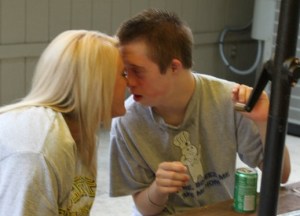
photo (116)

Here with his Dad as he says, “nose!”

photo (115)

My sister, Aunt Laura has a unique bond that neither time or distance separates.  “Nick gives me special things like the “eyes” or Nick might decide that he wants to touch my nose or he will touch elbows with me then if he is in a really loving mood he will give me a very special belly flash.”

Oh yes, the belly flashes.  I don’t even know how that started but it did years ago when he was around 3 or 4 years old. There are only a select few that are in what we called “The Belly Flash Club.”  My friend Sally is an elite member and recalls it as a sure sign of approval and affection.  While cute then, we eventually had to try and wean him off that practice so he wouldn’t come off as a pervert.   Well, that was until recently. Here is what Brian his speech therapist had to say, I’m not sure if you were going to include in your blog Nick’s affinity for flashing his abs as a show of affection. Of course I don’t belong to this exclusive club, but the only two female grad students he has ever worked with are!” 

Let me add that these two grad students are young and very attractive. 🙂

So, that is love, Nick style.  Hope you enjoyed the unique perspectives.  For more about Nick and his special relationships check out Blog #6~ The Nick Connection which is located in the May archives.  That’s what is in my noggin this week.  Until next Monday, peace, love and belly flashes!

~Teresa

*Eskimo Kiss- According to Wikipedia…..

“In modern Western culture, an eskimo kiss is the act of pressing the tip of one’s nose against another’s. It is loosely based on a traditional Inuit greeting called a kunik.[1]

A kunik is a form of expressing affection, usually between family members and loved ones, that involves pressing the nose and upper lip against the skin (commonly the cheeks or forehead) and breathing in, causing the loved one’s skin or hair to be suctioned against the nose and upper lip.[2] A common misconception is that the practice arose so that Inuit could kiss without their mouths freezing together. In fact, it is a non-erotic form of greeting that serves as an intimate way of greeting one another for people who, when they meet, often have little except their nose and eyes exposed.”