Posted in Augmentative and Alternative Communication (AAC), Autism, Down syndrome, Dual Diagnosis Down syndrome and autism

Blog #113~Ready, SETT, Go!

Blog #113~Ready, SETT, Go!

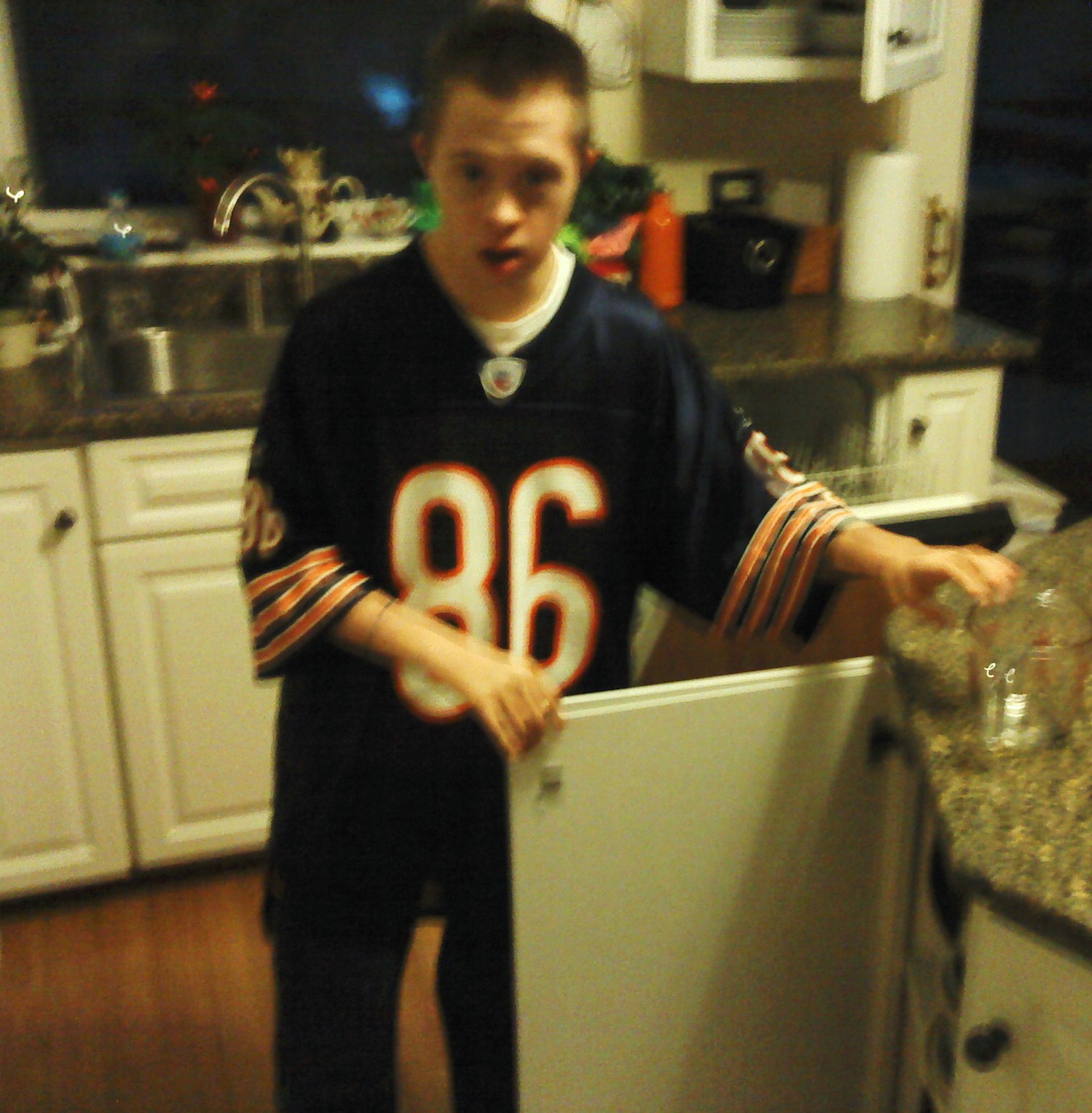
Recently, we did a SETT meeting at Nick’s school to re-evaluate the device he uses to communicate with. This is called an Augmentative and Alternative Communication device (AAC). Nick is 21 years old and has Down syndrome and autism.

Nick with his private speech therapist…..

Brian and Nick

SETT is an acronym for Student, Environment, Task and Tools. The team gathers to ask key questions and get information that will help to pinpoint what technologies would best suit the student. Here are the areas the team looks at in a SETT meeting:

STUDENT

*What are the student’s current abilities?

*What are the student’s special needs?

*What are the functional areas of concern?

*What are the other students doing that this student needs to be able to do?

*What does the student need to be able to do that is difficult or impossible to accomplish independently at this time?

ENVIRONMENTS

*What activities take place in the environment?

*Where will the student participate—classroom, home, community, therapy?

*What is the physical arrangement?

*What activities do other students do that this student cannot currently participate in?

*What assistive technology does the student have access to or currently use?

TASKS

*What specific tasks occur in the environment?

*What activities are the student expected to do?

*What does success look like?

TOOLS

*Are the tools being considered on a continuum from no/low to high-tech?

*Are the tools student centered and task oriented and reflect the student’s current needs?

*Are tools being considered because of their features that are needed rather than brand names?

*What is the cognitive load required by the student to use the tool?

*What are the training requirements for the student, family and staff?

Ready set go

The SETT meeting allows for team members to provide their unique perspectives of Nick.  The members included:

*Support teacher/Case Manager

*Speech and Occupational therapists

*Teaching assistant

*Parent

*Private speech therapist

*School District AT Specialist/Facilitator

The brainstorming session is recorded on butcher paper. At the end of the meeting each team member puts a star on the three most important aspects of the communication device for Nick:

IMG_4318

The AT Specialist gathers up all the butcher paper and compiles the notes to share with the team. These notes enable the AT Specialist to hone in on what devices and speech programs would best suit Nick’s needs. The SETT meeting catches all the ideas of the team and guides them to make informed decisions regarding technologies for the student. Next week, I will share the compiled notes so you get a sense of Nick’s learning style, what motivates and what works best for him. That’s what is in my noggin this week. 🙂

~Teresa

Posted in Autism, Down syndrome, Dual Diagnosis Down syndrome and autism

Blog #74~ Teaching to 21

Blog #73~ Teaching to 21
Last week, I was a guest lecturer at Northern Illinois University. The graduate level class topic was “Functional Communication and Social Skills” as it relates to autism. I presented a parent’s perspective.

NIU logo

One of the greatest gifts we can give our kids is teaching personal independence. It’s never too early to start working on these skills. One concept brought to my attention by Nick’s support teacher from elementary school is called, “Teaching to 21.” What skills will an individual with special needs require to lead a successful life after school is finished? Here is a list of skills that should be addressed both in school and at home for students with special needs:

 Assessment of Functional Living Skills (AFLS)

Source: http://autismbeacon.com/topics/article/functional_skills_for_people_on_the_autism_spectrum

“Functional skills” are those skills that if learners cannot do for themselves, someone will have to do for them. Functional skills are immediately useful and important. They increase self-help and independence and are present in every setting and throughout every stage of life:

Basic skills:
Self-management
Basic Communication
Dressing
Toileting
Grooming
Bathing
Health, safety, first aid
Night time routines

Home Skills Module:
Meals at home
Dishes
Clothing
Laundry
Housekeeping
Chores
Household mechanics
Leisure
Kitchen
Cooking

Community Participation:
Basic mobility
Community knowledge
Shopping
Meals in public
Money handling
Phone
Time
Social awareness
Manners

School Skills:
School waiting and transitions
Classroom routines
Meals at school
Classroom people, places and objects
Classroom mechanics
Outside school
Functional academics
Classroom leisure and independence

The IEP team should address these skills in goal planning and daily schedules of the student. In addition, supports should be put in place that will assist the student in reaching these goals. Here are some of the supports that Nick has used in school. Since Nick has a dual diagnosis of Down syndrome and autism, these tangible provisions give him clarity and focus in doing his tasks.

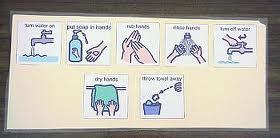
*Visual supports such as task strips, social stories, picture schedules and video modeling:
task strip
*First-then visual or app to remind student what they are working for:
first then

first then app
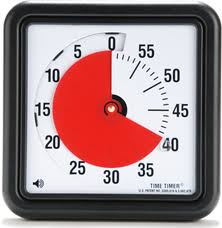
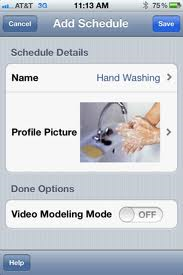
*Timed Timer clock or app and Picture Scheduler app:

timed timer

picture schedule app
*Physical prompting-teacher may do hand over hand to teach a school and fade back to just pointing to direct student.

*Guiding student with visual cues (putting stickers on washcloths to teach folding sequence, sprinkle hole punch paper dots on floor to teach vacuuming, using counting templates, etc…)

Nick packaging door knobs_Habitat_4 (2)

For students with autism, if they can see it…. they can understand it. In Blog #5~Ready, Set, Action (located in April 2012 Archives) I wrote about how successful video modeling was in teaching Nick skills around the house. He responds to and is motivated by seeing the footage in a video format. It also landed him a community job at a local elder residence care facility.

Nick hard at work 🙂
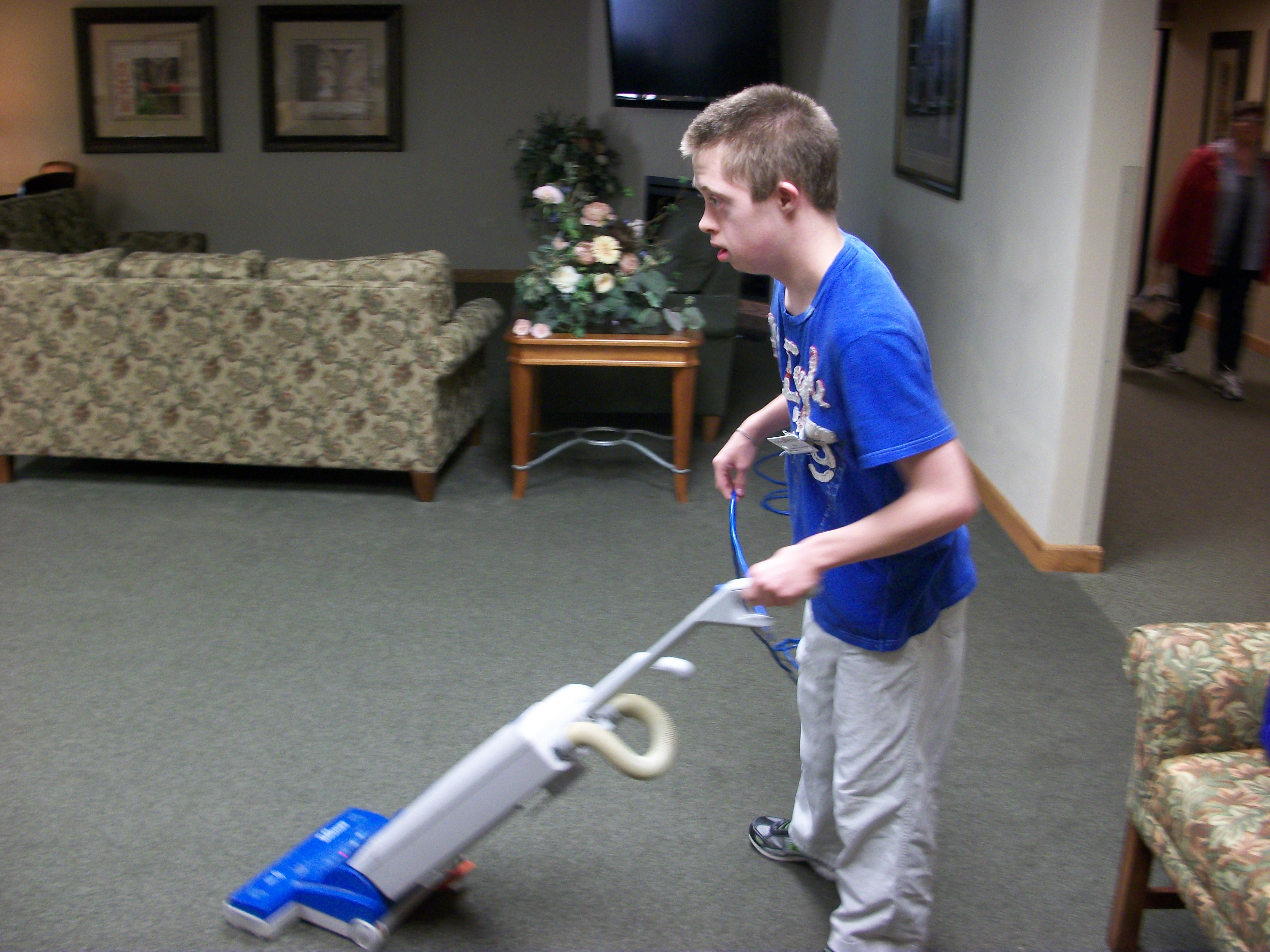
Nick vacumming_Tabor Hills (3).

Nick takes great pride in his jobs both in the community, school and at home. We continue to work on the skills needed for him to be as independent in all areas of his life so he is ready to manage things when he is finished with school. It’s all about starting early and teaching to 21! That’s what is in my noggin this week. 🙂

~Teresa

Follow Nick on Social Media:

Facebook and Pinterest @Down Syndrome With A Slice Of Autism

Instagram @nickdsautism

Twitter @tjunnerstall

Posted in Autism, Autism Safety and Wandering, Dual Diagnosis Down syndrome and autism

Blog #60~Wandering and Autism: 7 Prevention Strategies

Blog #60~ Wandering and Autism: 7 Prevention Strategies
Wandering and autism

HEADLINES…… 

“Car hits, kills 11-year-old autistic boy on the Katy Freeway” 

“Body found in pond is missing autistic child” 

“Autistic boy found dead, face down in a lake”

A lost child is a parent’s worst nightmare. Sadly, the headlines above are just a sample of instances involving wandering/elopement and autism all over the country.

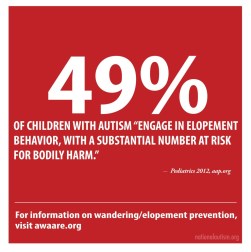
Much like the wandering behaviors in seniors with dementia or Alzheimer’s, children and adults with an Autism Spectrum Disorder (ASD) are prone to wandering away from a safe environment.  A study done by The Interactive Autism Network through the Kennedy Krieger Institute found this: “49% of children with autism attempt to elope from a safe environment, a rate nearly four times higher than their unaffected siblings. Two in three parents of elopers reported their missing children had a “close call” with a traffic injury. Thirty-two percent of parents reported a “close call” with a possible drowning.”

I understand this fear all too well.  There have been a several occasions where Nick has wandered, taken off at the pool and bolted down the street.  Nick is 19 years old and has a dual diagnosis of Down syndrome and autism (DS-ASD).  He has deficits in the areas of language and cognitive function which limits his understanding of safety.  He has no concept of danger.

One day when Nick 11 years old he was on the swing set in the backyard.  His Dad stepped inside to grab a baseball hat for a second.  Something made me stop and put down the garden shovel next to the flat of flowers. I walked around to the backyard.   He was gone.

Al came out the patio door.  I shouted to him, “Did Nick go inside?”

“No, I just came in for a second to grab a baseball hat.”

I felt a hot wave run through my body as I climbed up the burm, the slow crested hill that separated the backyard from the busy street.

downsized_0511010726 (2)

Al had recently ruptured his Achilles tendon and was wearing a therapy boot.  He hobbled up slowly behind me.  There was nothing but a stream of fast-moving cars pacing the road behind our house.

 I called out to his older brother, “Hank, go to the front and check with the neighbors and see if anyone saw him okay. Do it now!”

My neighbor came over, “I saw him a few minutes ago.  He got off the swing and started chasing a bunny.”  He pointed his finger left, “He ran that way.”

In the Midwest, the yards blend from one to the next in a seamless row like football fields connected one after the other. I squinted hoping to see some movement.  There was nothing,  just eerie silence. I took off running.  A dozen houses down, nothing.  Over ten minutes had passed since he had gone missing. I was in panic mode, my body was shaking and legs began to fatigue.  I kept sprinting but there were only five houses left before the subdivision entrance.   Suddenly, I saw a small figure running. “Nick stop now!”

He just kept going.  My strides turned into leaps.  I caught up with him 2 houses before he reached the subdivision entrance.  He looked at me as if nothing was wrong.  We walked in silence back home.  I gripped his hand tightly and counted how many houses he had run passed.  Final count=20 houses!

It makes me sick to my stomach recalling that horrible day. We have since put some things in place as a precaution to keep Nick safe. What can families do to insure the safety of their child?  In my research, I found an excellent website called AWAARE which stands for Autism Wandering Awareness Alerts Response Educationwww.awaare.org.  This site has a comprehensive list of tips, materials and tools.

7 TIPS FOR WANDERING AND AUTISM RISK MANAGEMENT:

1. Secure your home

Install secure door locks, home security systems, install inexpensive battery operated alarms on door and window to alert when opened. Place hook and eye locks on all doors above your childs reach.  Fence in the yard and put visuals like stop signs to doors.

Here is what we have on our doors…….
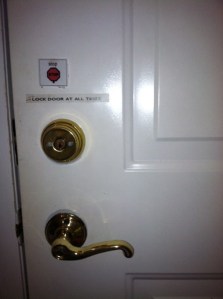
photo (115)

2. Get an ID Bracelet

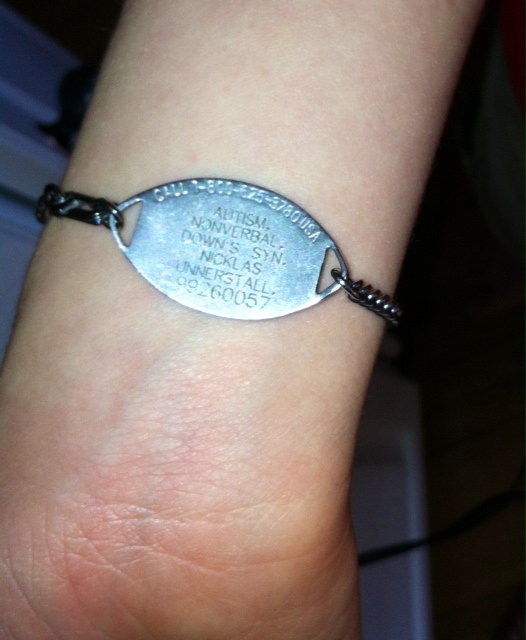
Medic Alert, www.medicalert.org  is what Nick wears and it stays on him firm.
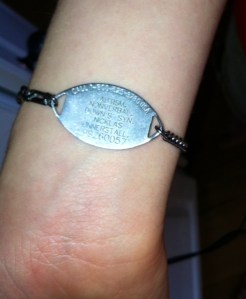
photo (116)

Another popular bracelet is called Project Lifesaver, www.projectlifesaver.org.

3. Consider a mobile tracking device

Project Lifesaver (https://projectlifesaver.org), Angel Sense https://www.angelsense.com) and LoJack SafetyNet (www.safetynetbylojack.com) services have wrist and ankle tracking devices.  There are many other mobile GPS tracking systems you can purchase at Best Buy and other big box stores along with phone apps as well.  See the resource page on the AWAARE website above for more information.

4. Teach your child to swim

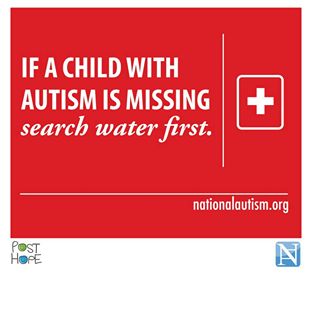
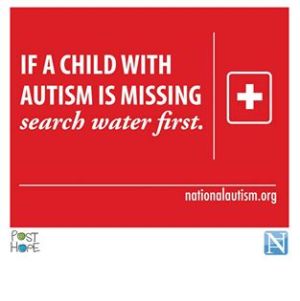
A large percentage of the headlines for wandering and autism end tragically because of drowning deaths.  Children are often drawn to water.  Check your local YMCA or special recreation association for swim lessons.
autism missing pic

5. Alert your neighbors

Make a simple handout with your name, address, phone number, information about your child (autism, non-verbal etc….) and include a photograph of your child.   Ask them to call you immediately if they see your child outside of your home.

6. Alert First Responders

Provide the local police and fire stations with key information before an incident occurs. Ask your local police department if they have a data base and registration program for individuals with special needs. See the AWAARE website given above for printable handouts.  There is also a free Big Red Safety Toolkit with free downloads on wandering and prevention.

7. Work with an ABA Therapist on a Behavior Plan

A BCBA certified behavior therapist can help with understanding the child’s goal and triggers that cause them to wander. The child may be trying to get to something they prefer, or avoid something they don’t want to do. When you can determine the function of this behavior, you can put supports and strategies in place to decrease wandering or bolting. If the behavior is occuring in school, address this with the IEP team and put measures in place to insure safety for your child.

Nick still requires 24/7 supervision and the house is sealed up like Fort Knox.  As a family we have to make sure there is always a designated watchman.  After doing this research on autism and wandering, I understand the necessity to be proactive and more responsible. Next stop: Make a call into the local police and fire stations to see what they have in place for wandering and persons with autism and other special needs in our community.   Discussion of this topic needs to continue.  I will be researching more tracking and monitoring devices.  Look for this on Part Two of  Autism and Wandering within the next two weeks.

That’s what is in my noggin this week!

~Teresa 🙂

Follow Nick:

Facebook and Pinterest @Down Syndrome With A Slice Of Autism

Instagram #nickdsautism

Twitter @tjunnerstall

Posted in Autism, Behavior/ ABA, Down syndrome, Dual Diagnosis Down syndrome and autism, Feeding, Personal Hygiene, Toileting, Speech and Occupational Therapy

Blog #18~ A Cut Above The Rest

Blog #18~ A Cut Above The Rest

Haircuts are no fun with Nick, period.

I can still remember the first time they started to bother him.  It was right before we moved to California in 1998.  He was around four years old. I took him in on a Sunday morning hoping the churchgoers would be worshipping and the salon would be empty.  We walked in and there was only one lady who sat relaxed in her chair and getting a perm.  I sat him on my lap and as soon as the scissors came out, he began squirming and yelling.  Next thing you know he set off the car remote I had put in my pocket.  I couldn’t get out of the salon quick enough. I slapped a twenty down on the counter and got the hell out of there.  That was one of the last professional haircuts he ever got.

Nick’s first haircut in 1996, this one went well……

Nick the early years. His hair was so soft and silky…..

It got to the point where we decided to get some clippers and just give him a home haircut.  Nick’s new look became the buzz cut.

The older he got, the stronger Nick became. Nick has Down syndrome and autism.  His behaviors became more challenging as he got older. He started putting up a big fight.  In fact, if you ever wondered why his tooth is chipped it was from him flailing his body and hitting his face on the floor during a haircut.  Al and I began to dread them as much as Nick did.  Bribes, oh I mean rewards such as a Sprite and a shower didn’t seem to help either.  He began to pitch even bigger fits and we had no choice but to pin him down.  The worst haircut was sitting on the floor of the bathroom with my legs around him and my arms holding his in a basket hold. We were covered with sweat and his fallen hair felt like needles jabbing at our skin. Nick flailed and then peed all over the floor.  We sat there in a puddle of warm urine and fallen hair sticking to us.  Worst yet, we were only half done.  Picture this,  a buzz cut front in the front and mullet in the back.

As I mentioned earlier the bigger the fight, the more traumatized he became (and the longer it took him to de-escalate).  We would finish these sessions and he would be shaking, red-faced with tears streaming down his cheeks.  It broke my heart. 😦

As Nick got into his teen years, I worried that we were going to have to go to extreme measures.  Then, there was another area of hair removal to be addressed. He was starting to grow facial hair, nooooooooooo!

Now it was already impossible to give him haircuts and clipping his toenails was no walk in the park either.  It’s much easier after being in the hot tub or a long shower so that the nails are a little bit supple.  How could we possibly get a razor to his face.  Luckily I had a good team of teachers and aides in high school who offered both visual supports and tips to tackle this next hurdle.

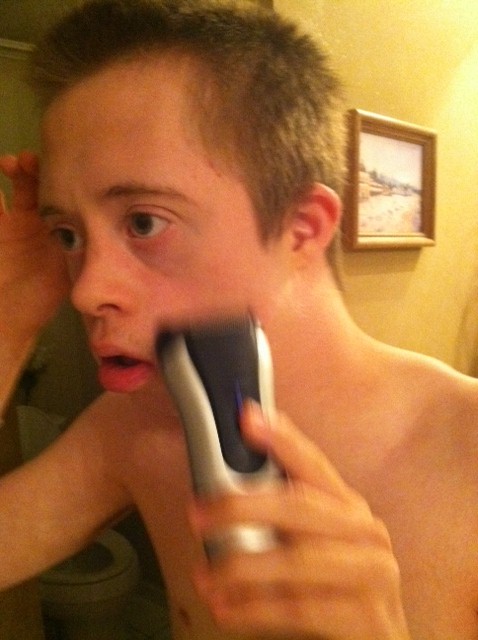
I have to give a lot of credit to Rob Trefil, Nick’s aide in high school.  He was able to get Nick to tolerate an electric razor and actually get in there at his chin and mustache area.  We found the roller top razor worked much better than the rotary one.  Introduce shaving a little bit at a time.  Then, increase the time with each session and lots of praise.  Having a male to model this helps a lot.

Mr. T rocks…..

Big guy shaving……

Last weekend, we geared up for another haircut session.  I was worried because we had waited too long and his mop was out of control.  It was going to be like cutting the lawn two weeks too late.

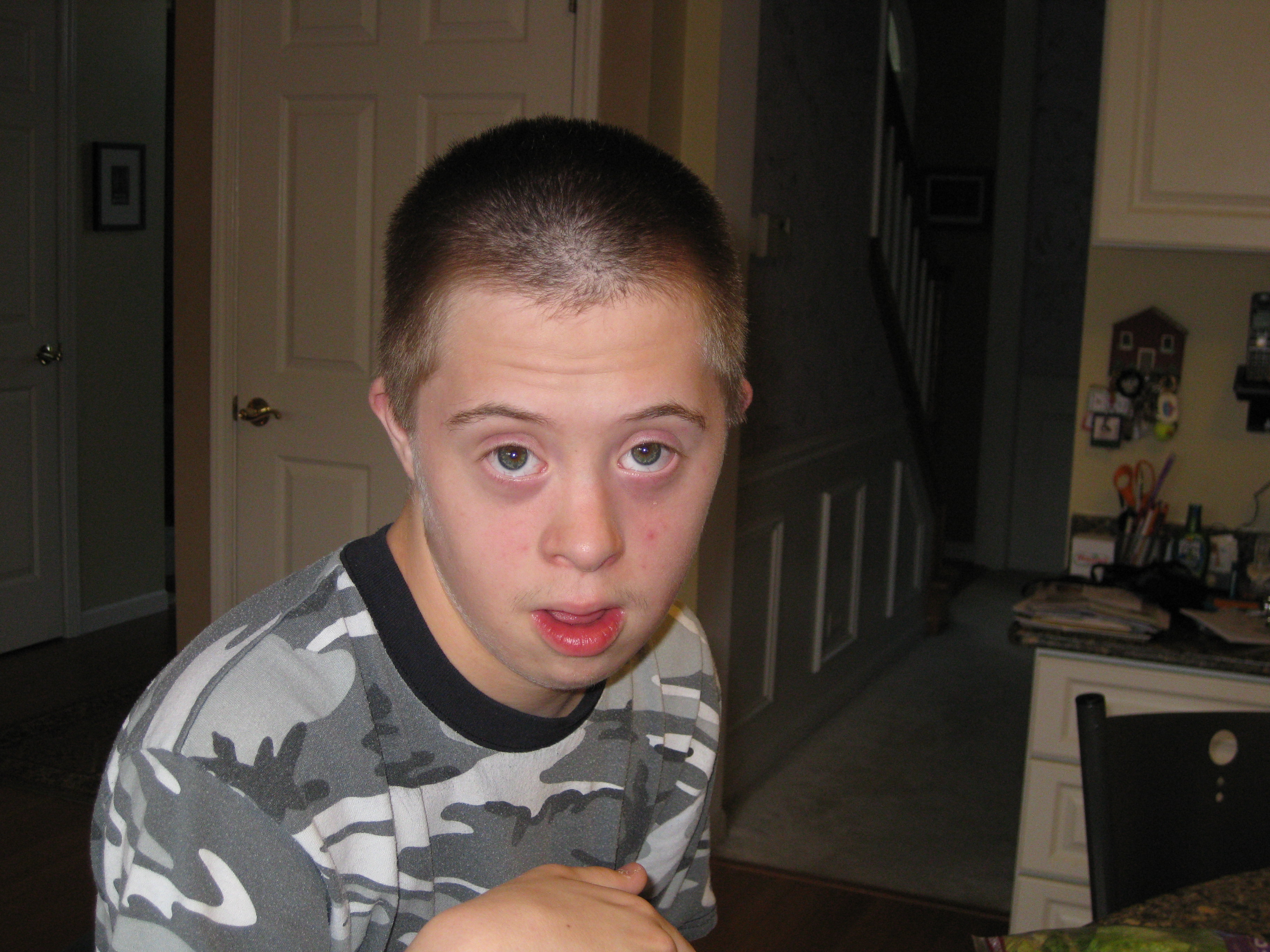
Pre-haircut Nick, it’s a bit scrappy? 

To my surprise, Nick did outstanding.  In fact, it was the easiest haircut we had ever given him. He didn’t cry or get too upset at all. Hallelujah 🙂

Post haircut Nick….. *A cut above the rest!

I think a couple of things have happened to tone down the level of anxiety and how he tolerates haircuts.  Puberty has passed along with the severe aggressive meltdowns.  I see a maturity about Nick now that he is a young adult.  As parents, we have learned more about behavior management, and use visuals to guide him through the process.  We also figured out that it’s easier to cut his hair first thing in the morning before being bombarded with sensory overload.  Finally, investing in a good pair of clippers makes the cuts go smoother. Nick even helps some with it.  I am so glad the days of holding him down in a basket hold and shearing him are gone.  That is what’s in my noggin, until next Monday may every day be a good hair day!

~Teresa 🙂

*A cut above the rest…. It is originated from the saying “you and I are cut from the same cloth” (being the fabric of life) and that the cloth, from which you were cut… was or superior quality.


Posted in Autism, Down syndrome, Dual Diagnosis Down syndrome and autism, Education and Special Needs, Tech Stuff/Apps and Video Based Instruction

Blog #5 Ready, Set, Action!

“Wash… wash…wash,” I hesitated going into the other room in fear of what Nick might be doing.  Would it be my fitness shoes in the sink under the faucets running full blast yet again?  To my surprise, I went into the laundry room to witness him taking the dirty clothes off floor and one by one plunking them into the washing machine and with each one saying the word wash!  It hasn’t just been the laundry either. For the past year, he has step up in other household chores.  Trying to get his brother, Hank to unload the dishwasher was like trying to pull teeth.  But Nick completely enjoys his role that he took over since his brother left for college last fall.  Everything has its place and his careful eye has taken note over the years.  He proudly puts every cup, plate, pot and pan along with the stemware carefully in the cupboards.

A few months ago I packed away the last of the Christmas ornaments and decorations and pulled out the vacuum to clean up all of the needles that had fallen on the carpet. I plugged the cord in and turned around to see Nick with his hand on the handle.  He was ready to take it on!  Much to my surprise, he not only navigated it but held the cord appropriately off to the side and did a nice job running the vacuum across the carpet.  I knew he was doing this for his school job at the elder care home but had no idea how well he was performing.

I have to give all of the credit to the staff at his high school.  Mrs. W brought in Northern Illinois University (NIU) to do a study that was done on six of her students last year.  The abstract was about maintaining vocational skills of individuals with autism and developmental disabilities through video modeling.  Research has shown that using video modeling helps to promote independent work-related behaviors and decrease the reliance on staff.  Video based supports often result in fostering independence and generalization of job related skills.  This means there is less reliance on job coaches and co-workers all for which are critical for sustaining competitive employment.  It is like a script in that breaks down the tasks that need to be performed.  These short videos are narrated in the background with short verbal prompts.  Nick watched them every day for two weeks and then each time before he was to perform a particular task. In the case of the NIU study the videos were for loading the dishwasher and washing machine.  What I noticed immediately is that Nick enjoyed watching them over and over again.  They are much more effective than any task strip that he has always used in the past. Here is an example of a task strip:

For me the proof is in the pudding*.  I noticed a significant increase in Nick initiative and accuracy in helping out around the house.  The videos did in fact increase his generalization to doing other chores besides these two.

While the jobs are pretty basic for most people, for Nick they mark a milestone.  His goals are no longer academic in nature for the most part they are all functional.  Functional goals are non-academic and generally understood to refer to skills used in the context of routine activities and daily living. Anything he can do independently gives him not only a better chance at getting a job upon graduation but also a placement into a group home someday.   Right now, he also has many other jobs at school including shredding, washing windows, loading the dishwasher, recycling and washing clothes for the PE department.  This week we have his annual IEP meeting to discuss his progress and goals for his senior year of high school.  As I look back it is amazing to see the progress he has made given his disabilities.  At this rate, I am going to be able to give him the reigns around the house while I sit back on the couch, prop my feet up and eat bon bons!  That is what’s in my noggin this week.

*Origin of Proof is in the Pudding

Proof in this case means “ultimate test.” To “prove” used to mean to test, a meaning which survives in a limited number of usages. This is one: it literally means you can show me a wonderful recipe, and tell me about your fine ingredients, but ultimately, the test is in the thing itself, the actual results.